I remember that

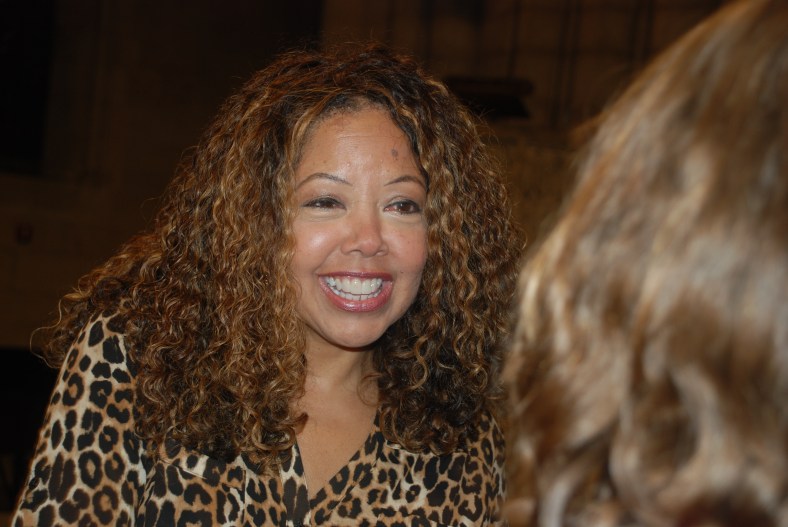
lucy-mcbathLucy McBath finds joy in her calling to make her son’s death have meaning. But the scars of her sorrow still show every time she speaks. 


News headlines flash at you and disappear, like an oncoming driver flicking his bright lights. Then sometime later the story beneath that headline is resurrected. You meet someone who brings it back to life and you think, “I remember that.”

Only now, it’s real because you’re talking to the person involved. It’s not ink on a page. It’s a voice in the ear, a person in your eye.

I met Lucy McBath in New York City this week. She’s the mother of Jordan Davis, the young man who pulled into a gas station Nov. 23, 2012 in Jacksonville, FL playing his music too loud for the pleasure of Michael Dunn.

Dunn asked/told Davis and his companions to turn down the volume. Davis, as a 17-year-old kid would do, got his back up and they had words. Dunn got a gun from his car and shot it 10 times into Davis’ car, striking him three times and killing him.

Davis was black. Dunn is white. But they both bleed red. The difference is that Dunn’s blood is still in his body in prison somewhere. Davis’ was spilled out onto the parking lot and his car seat.

It’s dangerous to be black in America.

Of course, I’ve just returned from the conference God and Guns 2016 at Riverside Church in New York City. So my nerves are raw. I’ve been illumined to the underlying causes of much of the gun violence in this country. (I’ll soon post stories at BaptistNews.com. There I covered them straight. Here I’m talking more from the heart.)

In New York I met Lucy McBath, Jordan’s mother. As soon as she started telling her story, I thought, “I remember that.”

But now, instead of a flashing headline, her story is meat and bone. She has dedicated her life to ending gun violence in America so that Jordan’s life and death will not have been in vain.

Addressing conference participants, McBath said change will not come if we wait for someone else or some other time. She quoted President Obama, who said, “We are the ones that we’ve been waiting for.”

McBath is the Faith and Community outreach leader for Everytown for Gun Safety, a fairly new organization with chapters in all 50 states that sprung up after the Sandy Hook shootings in Newtown. Their goal is “common sense reforms to reduce gun violence.”

“Ninety-one people each day will continue to die if people of faith are not engaged in saving lives,” McBath said. “It must be our task to usher in a nationwide moral movement against gun violence.”

She reeled off the statistics that any advocate will have at the tip of her tongue:

An American is 25 times more likely than in any other developed country to die by gun violence:

52 percent of women killed by guns are killed by their intimate partner or family member;

Easy access to firearms plays a major role in childhood death;

More than 21,000 people each year kill themselves with a gun;

The presence of a gun in the house greatly increases the chance that a domestic argument or a period of depression will turn lethal.

“After Jordan died I questioned the absence of the faith community,” said McBath, a devout Christian. “Their silence troubled my spirit. Where were the pastors, the ministers, the reverends and priests abiding by the Word of God to challenge the ethical and moral violation of the sixth commandment, ‘Thou shalt not murder?’”

McBath is dedicating her life to reducing gun violence so other boys like her son, and the sons of Sandra Rougier and Natasha Christopher and the students of Newtown teacher Mary Ann Jacob who all testified at the conference can live in a time and place without fear of being gunned down in the street.

I remember that.

Can a consultant help your stewardship efforts?

‘It was different because it was better’

It takes more than a tithing sermon from Malachi 3:10 to create an effective annual stewardship campaign in your church.

The question is, if you’re going to do more – if you’re going to approach your annual giving emphasis like a real campaign – can you do it by yourself?

Let’s assume your goal is to do more than prod your members to meet a budget. You want to teach stewardship and lead them to grow in the spiritual discipline of generosity.

That requires more than a single sermon and an all church mailing of pledge cards.

An effective effort requires a major time commitment to plan calendar, enlist volunteers, establish committees, design materials, produce mailings, conduct meetings and prepare appropriate sermons. And, the pastor and staff are expected to do all of this while keeping all their other ministry plates spinning.

Is it wise to engage the help of a professional consultant if you want your annual stewardship effort to be more than, well, more than an annual stewardship effort?

Two pastors of churches that recently conducted highly successful annual stewardship campaigns utilizing a resource development consultant confessed that they could not do it all.

Davis Chappell, pastor of the 8,000-member Brentwood United Methodist Church near Nashville, TN realized he had “so many wheels turning” in his second year at the megachurch that “I really needed someone I could count on who could help us.”

“As a pastor, you say you can do that in addition to your other duties, but you cut corners,” Chappell said. “The more you have someone who can take some of that off you the more successful you’re going to be.”

Chappell led the church’s annual giving campaign the previous year himself and saw growth. “We could do it ourselves,” he said. “But we’re stronger when we have a consultant who comes in to help.”

Bruce Cochran, pastor of 250-member First Baptist Church of Seymour, IN says the professional help they received increased their effectiveness, developed leaders, freed them for regular pastoral duties and resulted in significant financial gains to support church ministries.

Cochran said the difference in conducting their campaign internally as they have done, or in using a consultant “was polish, professionalism, efficiency and comprehensiveness.”

“It was different because it was better,” Cochran said. “It was communicated better, participation was better, and it was not just the pastor standing up and saying we should do this.”

First Baptist’s priority was to return to the place where it could again devote 20 percent of its income to missions – an historical standard the church had to back away from during the recession. Results were so positive the church is again giving to missions at that generous level.

The Brentwood church also gives missions high priority and dovetailed one of its satellite churches into its annual campaign effort with professional help.

Chappell said his church did not emphasize a financial goal or the need to fund a budget. “We pointed out that the stronger our generosity the deeper our outreach,” Chappell said.

The result was a growth in commitments of “roughly 340” new giving units and an $800,000 increase in committed gifts. “That is “really significant” for us, he said.

The satellite church, which was conducting its campaign at the same time, saw an increase of 65 percent – or $100,000 – which was “enormous.”

Chappell encourages pastors to address stewardship as a spiritual discipline. Besides, he said, “everybody’s talking about money” and the conversation is better directed from the pulpit than in the parking lot.

“The only thing worse than a church that always talks about money is one that never talks about money,” he said. “I’ve never known a person who accidently tithed. Discipleship is not an accident, it’s an intention.”

What about a capital campaign?

Although churches are more likely to go it alone in an annual stewardship event, what about a capital campaign for a big project? Such a campaign typically raises significant funds from members over a three-year period to accomplish something very significant that annual budgeting simply cannot do.

Look, no consultant brings money with him or her. All the money committed during a campaign will come from the members themselves, who catch the vision God is casting for their church. “We can do it ourselves,” members may say. “We are a generous church and hiring a consultant shows a lack of faith in our people.”

Consider a couple of responses to that.

First, wisdom and experience matters, and those who provide it come with a cost.

Second, no matter which member is assigned the task of coordinating a capital campaign, responsibility ultimately falls to the pastor. Always. Now consider all of the tasks that already consume your pastor. Do you fully appreciate the hours spent in ministry, sermon prep, administration, counseling, mentoring staff, community involvement, visitation, prayer and teaching? Do you want to add another plate to those he is spinning? Another straw to the burden?

Third, although I don’t have statistics, anecdotal evidence is rampant that a pastor spends all of his or her political chips when leading a campaign. The necessity to cajole volunteers and to hold them accountable, to plan, set up and conduct meetings, to train committees, monitor budgets and materials, combined with the ongoing additional work with architects and builders simply is overwhelming. When the campaign is done, they are burned out and used up, with no political capital remaining. Too often their last official act as pastor is to lead the building’s dedication.

Help in choosing a consultant

The idea of choosing counsel to help you teach stewardship and generosity in the context of an annual campaign is a fairly new concept. “Teaching” is an added element from most capital campaigns and choosing counsel with ministerial experience and a deep appreciation for the ministries of the Church is very helpful.

The right professional counsel will offer insight, technical assistance and production services typically too time consuming for most congregations to duplicate on their own.

Make your expectations clear. The right counsel will operate in the background and will always shine the light on staff, but his/her enthusiasm and energy will infuse your staff with hope and anticipation.

Be “up front” about your church statistics and whether or not you have any issues, or skeletons, that should be addressed upfront to increase your chances for success.

Remember, your first conversation with a prospective counsel carries no obligation for either party. Consider that a consultant is coming to you at his or her own expense, so it is incumbent upon you not to host a parade of prospective consultants just to hear what they have to say. If you connect with a consultant and decide to engage his or her services, cancel any later interviews scheduled with others.

Write a clear letter of agreement or contract that details the areas of responsibility for the consultant and the client. The letter of agreement should also detail the financial arrangements, the period of the partnership, and how it can be terminated at anytime by the client.

Chemistry is important when you make your selection. And, when you have decided, work to develop trust. When you trust, and incorporate him or her into your staff and church functions, you will increase the sense of family and everyone will operate more effectively.

Your consultant can bring a sense of urgency to your effort, gently driving actions and results.

He or she also can bring a sense of confidence to church leaders. They’ve done this before. Trust them.

Call or write me and I will be glad to help you work through any questions you have about the process, with no obligation.

Learning terror on the highways

Self-driving cars are racing into our future. They supposedly will cut fuel consumption, extend our suburbs yet decrease commute times, cut the number of cars on the road by more than half, ultimately make our roads safer and cure the heartbreak of psoriasis.

Scientists theorize that a car with a dozen or more computerized “eyes” that are constantly alert and instantly responsive will be safer than a car with a human driver with just two eyes whose response times vary because of distractions like sleep deprivation, cell phones, music, mirror checking and messy sandwiches.

In the meantime, we humans are going to have to continue to navigate our crowded, crumbling roads and teach our offspring to drive safely upon them as well. It’s an important, and potentially terrifying lesson.

In fact, I remember just how terrifying it can be.

The 1979 movie “Alien” was the most terrifying cinema I’ve ever watched. I was sure the monster was in the cat and I urged Sigourney Weaver to leave it behind as she abandoned her space ship, but she went back for it!

I didn’t know until the final credits rolled that the movie was over. I relaxed for the first time in two hours and my stomach was sore three days from the tension.

But I didn’t know terror.

I’ve been trapped in a July hailstorm above timberline on Pikes Peak with the trail disappearing beneath ice and darkness approaching. We couldn’t have survived a night on the mountain me and three buddies braved the storm, climbing, exhausted, to the top.

But I didn’t know terror.

When I was sideswiped on a rain slick interstate by an 18-wheeler on a cold dark night, I still didn’t know terror.

I’ve taken the subway from New Jersey into Manhattan at midnight, heeding a native’s warning to sit as far front and as near the conductor as possible. I perched on the scarred plastic bench holding my country mice eyes unseeing, straight ahead. I pled silently for a cloak of invisibility to drape over me and to cover the neon sign I knew flashed above my head saying “Easy Mark.”

But terror remained only a textbook definition, a movie subject, an Edgar Allen Poe concoction. I only thought I knew terror, like a boy thinks he knows love.

Then, I took my 15-year-old daughter driving for the first time. And I discovered terror.

I grew up on a farm, driving tractors and trucks in the field from age 11. I learned the levers and pedals that made things go in slow-moving vehicles, in wide open spaces.

I had no idea until that first driving lesson how narrow are the roads or how close to the roads are mail boxes, or how sharp are the curves and how abruptly the pavement drops at the shoulder, or how wide are oncoming vehicles.

In the very first moments, after Erin adjusted the seat, mirrors, seatbelt, radio, sunglasses and hair, and figured out which pedal was go and which was stop, she almost took out one of those mailboxes. Fortunately, the ditch we rolled into on the other side kept the box safe.

It’s a helpless feeling, to be sitting on the rider’s side, with no brake and no steering wheel when all manner of disaster careens at you. I pushed a size 10 footprint into the floorboard when Erin didn’t seem to turn the wheel enough to accommodate the slow rolling curves. Unlike a 3-D movie simulation, these terrors really can jump off the screen like a Velociraptor to bite off your head.

I told Erin to ignore the cars on her bumper, and not to fear the ones coming toward her seeming to take up the whole road. When they get closer, you’ll see the road really is wide enough for both of us, I assured her. And the bridges only seem too narrow. And 30 miles per hour is fast enough!

You cannot imagine how dizzyingly fast 40 mph seems to a dad when his first time driver is behind the wheel.

To her credit, Erin finished the one-hour session with a new appreciation of how difficult and mind bending it is to drive well – a task that looks so easy when observing an experienced driver. She made a lot of progress and our next session was much easier. (I won’t go into the part about trying to teach her how to drive a stick shift.)

And importantly, I was reminded that the best way to overcome the terrors that lurk “out there” – under the bed, around the corner, in the operating room, on the next calendar page, when the phone rings, when your wife says “we need to talk” – is to face them. Get in the car with them and stare them in the eye while racing down the open highway.

Of course, it’s better to have a brake pedal on your side when you do.


Healing power of the right word

I suffered a pretty awful accident May 14 while following my grandson on a mountain bike down an open, sloping field on his parents’ property.

We’d been tooling around for an hour, just enjoying a simple ride on a perfect spring day. Who needs a helmet for that? Well, Grayson wore his because he told me, “Safety first.” I should have listened.

He led me to the top of the hill, launching from his uncle’s driveway down through the field. I took a moment to soak in the sight and relish the feeling. His joy was palpable.

He was out riding with his papa, atop the freedom of his wheels and the thrill of a downhill slope. Giving myself just a moment to appreciate the scene, I took off after him, cutting a new path to the left of his line.

A lip at the edge of the field dropped several feet. I intended just to ride it down, hanging on tightly to reach the broader, softer slope. I didn’t see the hole at the bottom until it was too late. In an instant of clarity my brain registered, “This is not going to be good.”

My front wheel hit the hole and the bike stopped dead. I kept flying toward the ground like a spear and landed on my head

Grayson ran back up the hill to see if I was all right. “No, Grayson, I’m not all right. Go get Nana.” I felt like someone had hit me in the head with a 2 x 4 and that I’d lost six inches of height from having my spine compressed.

Within moments Nana pulled the Subaru into the field beside me. She sent Grayson to his uncle Bubba’s house at the top of the hill for a towel to stop the bleeding and for an additional hand to get me into the car. By this time I’d surveyed my extremities, all of which functioned, so I knew long term I would be fine. But, oh, I hurt.

Later tests would reveal fractured skull, cracked vertebrae, bruised spleen, lots of abrasions and cuts that required 10 staples to close. But for now there was just lots of activity with the other grandkids and Bubba and his wife, Sonya while we debated calling an ambulance.

In the midst of that hubbub I heard the sweet voice of 7-year-old Grayson saying, “It’s my fault. I should have told Papa about that hole.” I reached for Grayson’s leg and told him never to think that. He bears no blame.

But during the next 15 hours in two emergency rooms and calls back and forth among family, I kept hearing that Grayson was feeling responsible. That is a heavy burden for a bright, sensitive seven-year-old. It saddened me that he felt that way.

I was released early the next morning and went home with a neck brace to rest and heal. Grayson’s mom and dad, who had been out of town celebrating their 12th wedding anniversary during all the excitement, brought the kids by the house to see that Papa was OK. I knew I needed to find the right words to relieve Grayson of his self-imposed burden of blame.

His face was painfully tentative when he saw my brace, staples and stitches and he was wondering how I would react now that I was upright. In an instant I smiled big, held out my arms and loudly said, “Grayson, my rescuer! You’re the one who rescued me when you went for help! Thank you, buddy.”

In that instant his face transformed from hesitant to happy, from reluctant to rejoicing, from tentative to triumphant. He went from self-blaming to knowing he contributed to my being OK after a bad spill.

Choose your words carefully. A well-chosen word has the power to heal. A quick, harsh word has the power to destroy, to tear a hole in the cloth of confidence.

I know people who still labor under the self-image an angry parent imposed upon them 50 years ago, rather than with the reality of the bright and beautiful people they are today.   Grayson is young and aggravating sometimes because he is so intelligent and curious and he insists there is nothing he cannot do.

But from this day forth, no matter how many times I huff and puff and say, “No, Grayson, you cannot use the chainsaw,” he will know that on May 14, he rescued his papa.