Going to need extra chairs

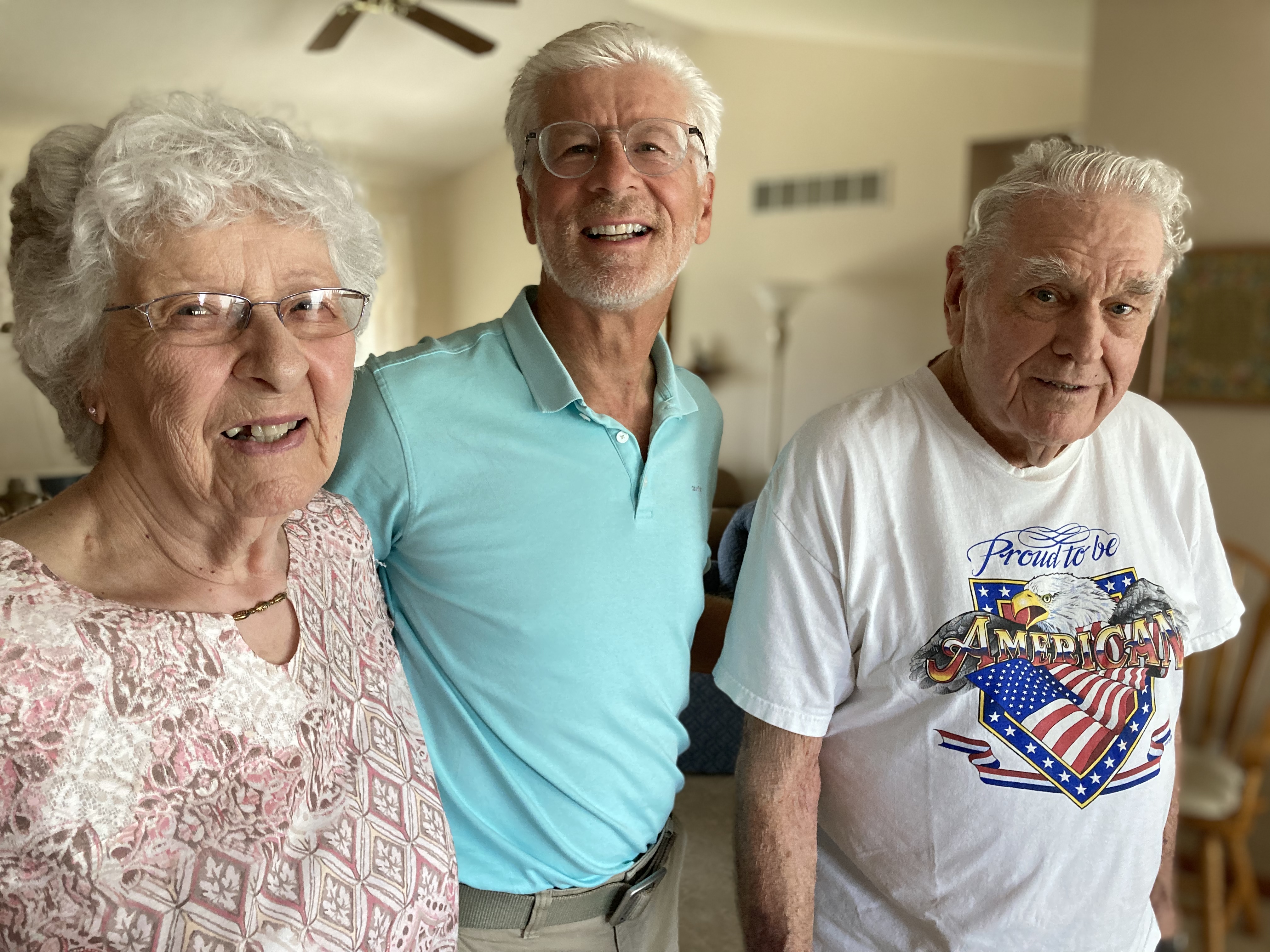
Me in the middle, with Janet and Bill in 2021.

When my grandmother died in 1979, I drove my young wife and one-month old son from our home in Nashville, TN to the funeral in Wisconsin. Grandma was young enough to have a large funeral, just 72 years old. My age.

Of course, in Rio, WI, population 788, funerals were as big a social event as Friday night football at the field in Fireman’s Park. I didn’t play football. I ran cross country instead, which I convinced myself was harder.

But I was at the football games, either running the sideline keeping stats, or in the stands playing “CHARGE” on my trombone.

After grandma’s funeral service at Redeemer Lutheran, one of six churches in town – equal to the number of bars – everyone gathered in the church basement for a lunch prepared by women of the church. Because the meal was free, and there wasn’t much else happening in town that day, the room was crowded.

My wife was most concerned with the one-month old son not accustomed to the noise and crowd and whose only real concern was keeping his tummy full and his diaper dry. So, he started fussing and wailing and that’s not the sound you want to hear piercing the din of chattery family members chowing down on store bought dinner rolls filled with a slice of ham and a slab of butter, potato salad and red Jell-O with marshmallows.

Suddenly, from across the entire fellowship hall, packed hip to hip at the folding tables, my aunt Janet yelled, “Give that boy some titty!”

Now, in another context other than a rural Wisconsin farming community, that comment might have seemed out of place, even impolite. Certainly it caused all the blood in my wife’s body to flush to her toes and then recongregate in her face, making her flush a brighter red than the Rio High School Vikings mascot. But, it also gave her the freedom to excuse herself, find a quiet Sunday School classroom, and take care of our son’s immediate need.

Aunt Janet died this week, at age 91. She was my mother’s last surviving sibling and mom preceded her in death by 29 years. They were two of eight siblings, prompting my grandpa McFarlane to say he had “Two and a half-dozen children.” When grandma McFarlane died, petty sibling grievances broke familial bonds and later on, as one sibling after another died, obituaries did not list all surviving family members, as if they never existed.

But Aunt Janet was always a friend, in part due to the loquacious character of her husband, Bill, a former police officer and much longer a seed corn salesman who knew every farmer and what they needed most. Bill preceded her in death by three years.

I confess Janet’s was the first bare breast I ever saw, as I stood wide-eyed at age five while she fed her first born son, Mark, a man who grew up to be a Presbyterian pastor, nurtured as he was on the milk of human kindness. He could preach from I Peter 2, “Like newborn babies, crave pure spiritual milk, so that by it you may grow up in your salvation.”

Janet and Bill had five children and 10 grandchildren and money never flowed like water over Niagara. Janet always put her hand to the wheel to find additional resources, driving school bus for more than two decades and making wedding cakes for lucky brides and grooms.

She looked at driving bus as ministry, taking the opportunity to offer a bright, encouraging word to children with dour faces, lifting heavy, reluctant feet up the step on the way to school.

She was certain of opinion and ready with advice.

When Janet learned my cousin Allen smoked, she asked if he would rather kiss a girl or an ashtray. Allen, sarcastically defending his nasty habit, told me he responded “Ashtray.” He’s since grown beyond that – both in girls and habit.

 Janet and Bill built a house on a hill overlooking that of her mother Eva and she was diligent in looking after her mother to the end. Eva –my grandmother on my mother’s side – expressed concern that bad weather would limit the size of her funeral. She was mentally comparing her eventual celebration to the big crowd that showed up for her husband’s sendoff. In her mind, her funeral would suffer by comparison and somehow that would reflect negatively on her life.

Though such comparison is a false equivalency, if every person whose life Janet affected positively were to attend her funeral, ushers will need to bring in extra chairs.

Two Ways To Do It

I grew up working with and for my Norwegian bachelor farmer uncle Donnie, who made a living milking 19 cows on 80 sandy acres in southern Wisconsin. As a kid I tried to impress him with my strength by carrying 40 pound buckets of milk to the cooling tank when I didn’t weigh much more than twice that. I struggled to make it look easy, but he knew it took all I had.

I get to practice what i learned while young at White Horse Farm in Pennsylvania, where my son’s family lives.

In the ‘60s corn had to be cultivated to keep the weeds down before “poison ready” genetically modified seed became the norm. So I’d sit on the tractor with Don as he drove the little plows through two rows at a time to dig out the weeds. If he hit a stone or lost concentration and the cultivator dug out some corn, I’d hop off, stick it back into the ground, and run to catch up.

Building or repairing barbed wire fence, learning how to drive tractor and truck, milk a cow and slop a pig, being rewarded with a chocolate milk and donut at the Midget Kitchen on Hwy. 16 all were part of my kinetic education – along with learning how to understand the punchline of coarse jokes.

Once I reached about age 13 my services were much in demand by local farmers who needed help detasseling corn, baling hay, picking stones or cleaning out stalls and stables. I was a tall, thin kid who was young Sheldon in the classroom and who saw Arnold Schwarzenegger in the mirror.

Our local farmers were basically one-man-and-a-son operations, and I replaced the boy who had grown and gone to the city. To make hay while the sun shined, we cut the alfalfa, let it dry for three days and hoped for no rain. Then we raked it into windrows, scooped it up and compacted it into 40-50 pound bales with a tractor pulling a baler pulling a wagon with a kid on the wagon stacking the bales.

Most generally it was me and the farmer – baling, loading, unloading onto an elevator and stacking in the barn. There were two kinds of farmers when it came to engaging my services on a hot summer day. One I’ll call Uncle Donnie’s way, on account of it’s about my Uncle Donnie. The other I could call “the efficient way,” on account of it’s the opposite of my Uncle Donnie.

When Uncle Don picked me up in the morning, we’d get to the farm and have to gas up the tractor, grease the baler and put in baling twine, hook the baler to the tractor, connect the power takeoff shaft and move the elevator into position to carry the bales up into the hay mow. It wasn’t unusual for us to have round up a wagon or two that a neighbor farmer had borrowed.

All the while I’m looking at all that hay, laying expectantly in windrows in the field, itching to get out there and get started, knowing it was going to be a long day. And it was threatening to rain.

Farmers committed to “the efficient way” and to getting all the work out of me they could, completed all the preliminaries before I got there. The baler was greased and hooked to the tractor, which was gassed and ready. The elevator was in place, all the necessary wagons were lined up, and mother had lunch in the oven.

We got twice as much done in half the time. And there are few things as satisfying as looking over a freshly harvested field, seeing it cut and clean and all the hay is in the barn before the rain comes.

That, and the fact that the more efficient farmers tended to pay $1.25 an hour, rather than $1.00.

Readiness makes the difference. Many of you work with non-profit organizations. Respect the time of your volunteers. Don’t let them show up on a work day or at a fund raising event and have to stand around and twiddle their thumbs. If they are volunteer tutors, have a student already selected and matched.

Then, let it rain.

Don’t be like my dad

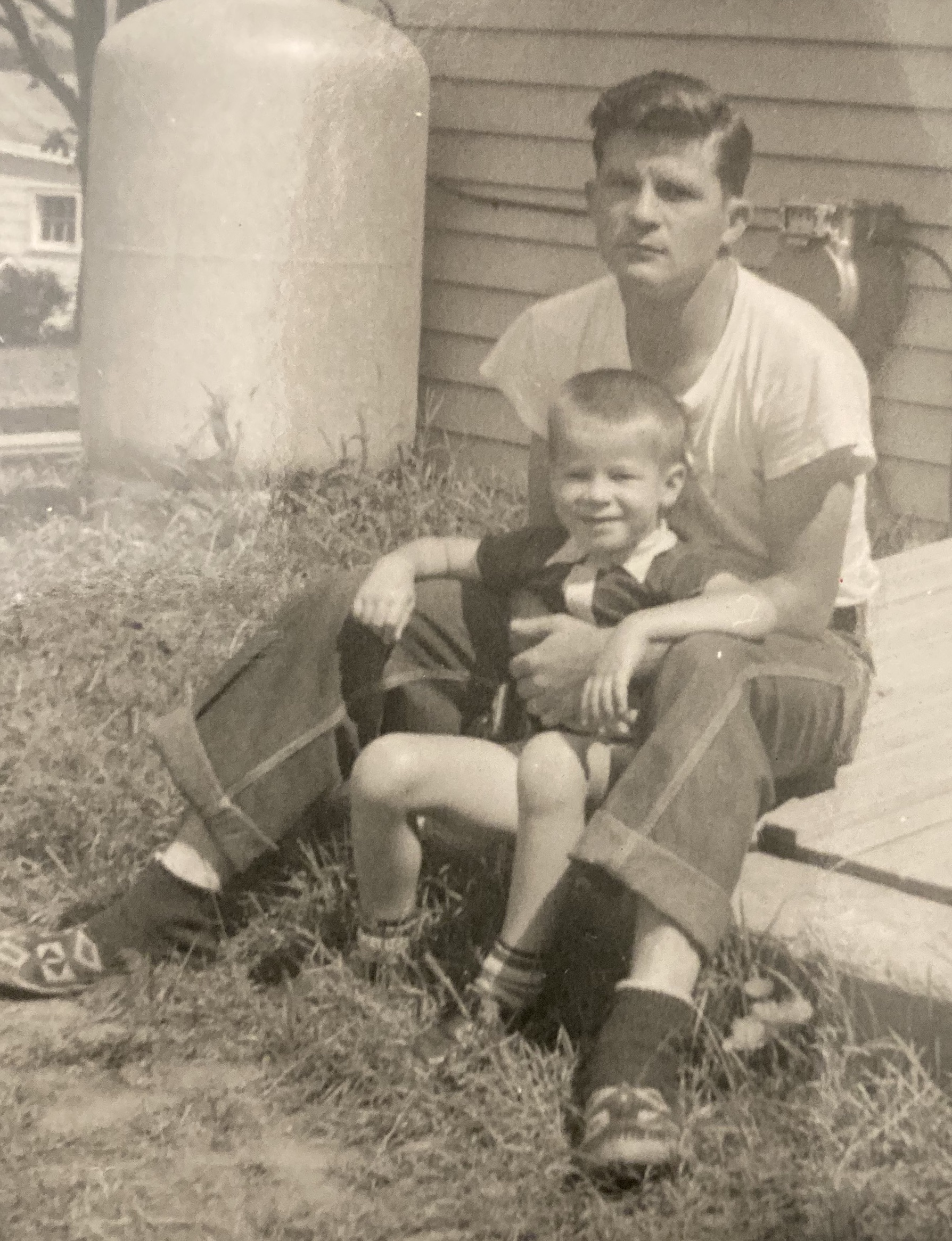
Dad and me around 1956.

Over a breakfast of toast, fruit and eggs plucked moments earlier from the coop next to the house, my wife said I’d given her too much food. She was stirring her eggs about like a kid wishing lima beans to disappear.

“Just eat what you want, dear,” I said. “Don’t be like my dad.”

My dad, Marvin. Gone now for seven years. A child of the Depression, frugal to a fault. As a young man, he worked two and three jobs to buy groceries for his wife and three children, ages four to infant, living in a 19-foot trailer. He loathed the idea of “wasting” a single morsel of food well into his prosperous 80s.

Dad cleared his plate, no matter how miserable those last forkfuls made him feel later, especially if it was a restaurant meal for which he paid. I never understood it.

“Dad,” I’d say. “Don’t let some anonymous cook in the kitchen determine how much you’re going to eat, and how you’re going to feel afterward.”

Dad and me in 2015. He died in 2017.

But the thought of sending food back to the kitchen or down the disposal was anathema to dad.

Immediately after I told Sue Ellen, “Don’t be like my dad,” regarding his relationship with food, Newton’s third law of motion kicked in and brought an “equal and opposite reaction.” I thought of so many ways I would want my wife, my children, myself and anyone else to “be just like my dad.”

Dad was devoted to his family, teaching us to work by example, never complaining about his long hours. He stretched his finances to buy “the old Peterson place on County B” with 80 acres of farmland and an acre of lawn and outbuildings. On and off he tried raising steers, pigs and chickens to supplement his income driving a fuel truck among farms in four counties.

We mowed the grass, tended the large garden, fed the animals and picked stones from the fields that the annual freeze and thaw pulled to the surface. A big bellied wood burning furnace in the basement heated the old farm house so each Fall we gathered fuel from the woods.

He loved my mother in obvious ways, not afraid to hug, kiss and be silly with her in front of his children. My most poignant memory is of dad kissing his hand and laying it against the cold glass window as the ambulance carried her body away from the house, when she succumbed to cancer. He never got over her.

Dad’s reputation as an honest man was unassailable. He gave up the gas truck to manage the local farmers’ cooperative store, while also being treasurer of the local credit union, before computers. He had an amazing mind for numbers, though he never graduated high school.

He left home at 14, riding his bike to a neighboring town to live with his teacher aunt and attend school. But the lure of earning money to drive a dump truck for the county proved more attractive than another day in the classroom.

Yet, when i showed academic promise, dad instilled in me an assumption that i would become the family’s first college graduate.

Dad held opinions about things, but he easily relinquished defense of those opinions rather than stress a relationship.

I never heard him or mom exchange a cross word.

I could go on. Every Christmas I remember how he accidentally shattered my myth holding about Santa Claus. That fall he’d given me a football, just out of the blue. Dad never played organized sports, but we tossed the ball around a time or two.

That Christmas when i opened up my gift of a basketball, he took it, rolled it about in his hands, and said, “Do you remember the football I gave you?”

I nodded of course.

“I got this basketball at the same time.”

Fantasy fractured. St. Nick deconstructed.

But from that seed of myth, cracked open with the hammer of reality, grew over decades a sapling of hope, that one day, i could be like dad.

Funerals, and other fun rituals

I attended the funeral of a friend and former colleague today. A man younger than me.

I learned of his death while driving home from a Florida vacation. I didn’t know he’d been sick, as he was a private man. As his son said in eulogy, “My dad was the most private public person in the world.”

The somber, intimate public gathering of persons who want to see and support the surviving family and who want to hear good things spoken of their deceased friend is a valuable human ritual. Loved ones recount memories and sometimes reveal things previously unknown.

Careful speakers offer subtle lines to confirm suspicions while lauding the deceased with praise most discerning supporters take with an appreciative grain of salt.

 I’m glad I attended the funeral several years ago of a former boss, who was the most difficult human I’ve ever worked with. It was healing for me to hear good things spoken of her, to hear friends recite positive qualities well disguised in our days together.

I delivered eulogies for both my parents. Some of my observations were meant specifically to comfort some quietly sobbing friend. Other words were to lighten the somber atmosphere.

My mother, who died at 64, was a very private, reserved person, not given to bawdy humor, even when the men around her were cutting up. The first night I brought my new bride to visit in the home, I found an apple on the bedside table. The next morning, I asked mom about the apple.

“That was a contraceptive,” she said. Immediately I thought of several ways that might work, none of which I voiced to mom. Instead, I asked, “Was I supposed to eat it before…or after?”

“You were supposed to eat it…instead,” she said, laughing. Those at her funeral laughed, too, at the telling.

My grandma was proud of the large attendance at grandpa’s funeral. She surmised that she didn’t loom as large in the minds of neighbors, community and family as he did, and she bemoaned that her funeral would be much smaller. “If it snows, nobody will be there,” she speculated.

If you want a large funeral, die young.

Part of my father’s lament toward the end of his 86 years was that all his friends had died. He was tired of attending funerals of his buddies, each of which left him lonelier.

I listened with great respect as the first born son of my friend delivered an insightful, humorous, sad and intimate portrait of his father. I knew this boy when he was just a kid and now he’s a man with gray hair at his temples. And I realized his relationship and age relative to his father, is the same as my oldest son to me.

And I imagined my son standing in front of my surviving friends one day. But I could not imagine what he will say.

I eulogized my father 21 years after my mother. Many of the same faces peered up at me. Many were absent, long gone to their own reward. And I realized the value of the ritual, the support those faces and kind words offered, the life they’d shared with my mother and father – experiences they recounted to fill my own my memory portfolio.

In his song “Standing Room Only,” Tim McGraw talks about this end of life ritual and encourages us to “Be somebody that’s worth rememberin’, to live a life so when we die “there’s standing room only,” at our funeral.

Since I’ll be laying down, or my ashes will already have been blown away by a strong wind, I’m not concerned about standing room. But when my children and friends go to rememberin’, I hope a smile crosses their faces.