
Going to need extra chairs

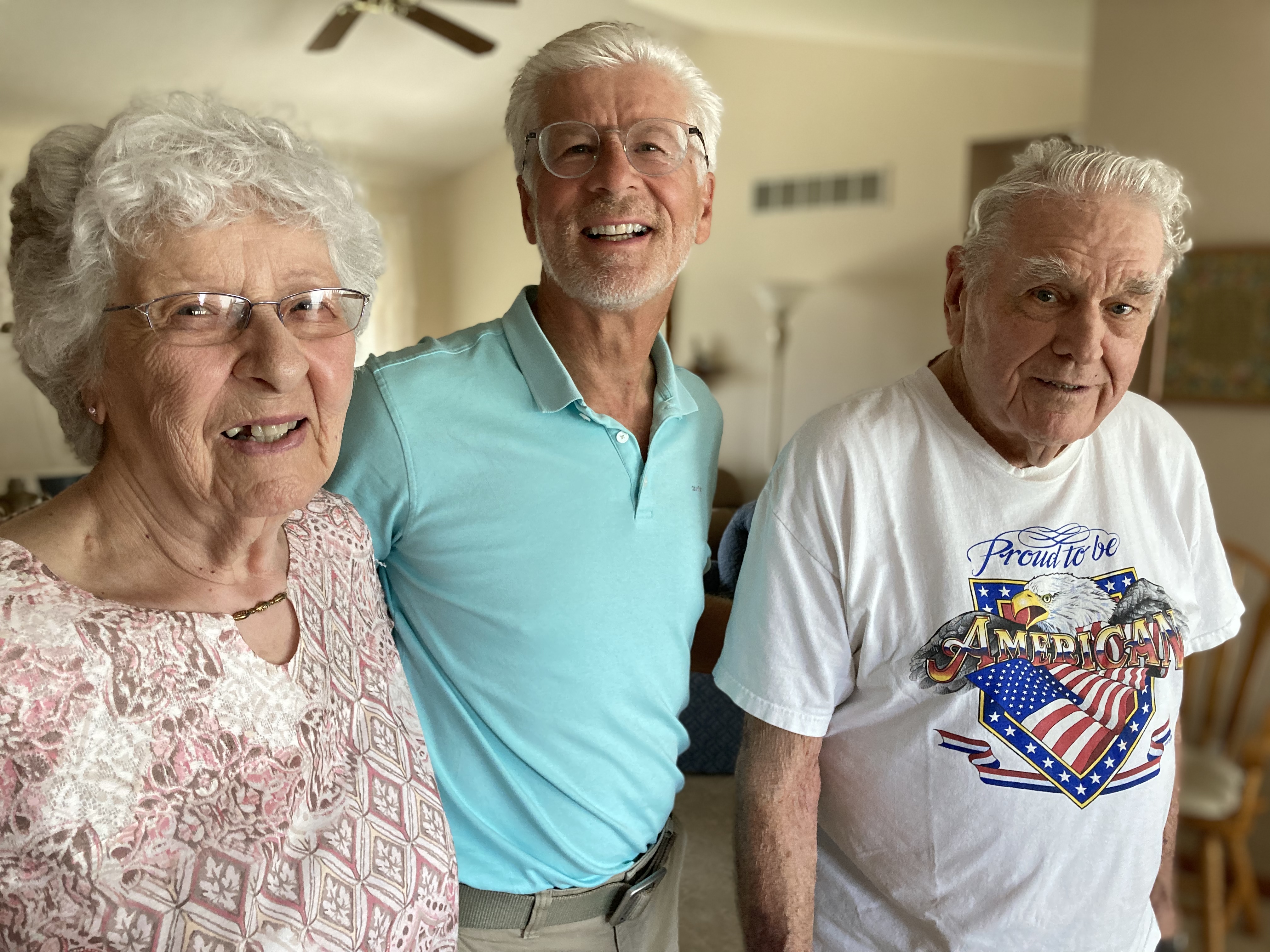
Me in the middle, with Janet and Bill in 2021.

When my grandmother died in 1979, I drove my young wife and one-month old son from our home in Nashville, TN to the funeral in Wisconsin. Grandma was young enough to have a large funeral, just 72 years old. My age.

Of course, in Rio, WI, population 788, funerals were as big a social event as Friday night football at the field in Fireman’s Park. I didn’t play football. I ran cross country instead, which I convinced myself was harder.

But I was at the football games, either running the sideline keeping stats, or in the stands playing “CHARGE” on my trombone.

After grandma’s funeral service at Redeemer Lutheran, one of six churches in town – equal to the number of bars – everyone gathered in the church basement for a lunch prepared by women of the church. Because the meal was free, and there wasn’t much else happening in town that day, the room was crowded.

My wife was most concerned with the one-month old son not accustomed to the noise and crowd and whose only real concern was keeping his tummy full and his diaper dry. So, he started fussing and wailing and that’s not the sound you want to hear piercing the din of chattery family members chowing down on store bought dinner rolls filled with a slice of ham and a slab of butter, potato salad and red Jell-O with marshmallows.

Suddenly, from across the entire fellowship hall, packed hip to hip at the folding tables, my aunt Janet yelled, “Give that boy some titty!”

Now, in another context other than a rural Wisconsin farming community, that comment might have seemed out of place, even impolite. Certainly it caused all the blood in my wife’s body to flush to her toes and then recongregate in her face, making her flush a brighter red than the Rio High School Vikings mascot. But, it also gave her the freedom to excuse herself, find a quiet Sunday School classroom, and take care of our son’s immediate need.

Aunt Janet died this week, at age 91. She was my mother’s last surviving sibling and mom preceded her in death by 29 years. They were two of eight siblings, prompting my grandpa McFarlane to say he had “Two and a half-dozen children.” When grandma McFarlane died, petty sibling grievances broke familial bonds and later on, as one sibling after another died, obituaries did not list all surviving family members, as if they never existed.

But Aunt Janet was always a friend, in part due to the loquacious character of her husband, Bill, a former police officer and much longer a seed corn salesman who knew every farmer and what they needed most. Bill preceded her in death by three years.

I confess Janet’s was the first bare breast I ever saw, as I stood wide-eyed at age five while she fed her first born son, Mark, a man who grew up to be a Presbyterian pastor, nurtured as he was on the milk of human kindness. He could preach from I Peter 2, “Like newborn babies, crave pure spiritual milk, so that by it you may grow up in your salvation.”

Janet and Bill had five children and 10 grandchildren and money never flowed like water over Niagara. Janet always put her hand to the wheel to find additional resources, driving school bus for more than two decades and making wedding cakes for lucky brides and grooms.

She looked at driving bus as ministry, taking the opportunity to offer a bright, encouraging word to children with dour faces, lifting heavy, reluctant feet up the step on the way to school.

She was certain of opinion and ready with advice.

When Janet learned my cousin Allen smoked, she asked if he would rather kiss a girl or an ashtray. Allen, sarcastically defending his nasty habit, told me he responded “Ashtray.” He’s since grown beyond that – both in girls and habit.

 Janet and Bill built a house on a hill overlooking that of her mother Eva and she was diligent in looking after her mother to the end. Eva –my grandmother on my mother’s side – expressed concern that bad weather would limit the size of her funeral. She was mentally comparing her eventual celebration to the big crowd that showed up for her husband’s sendoff. In her mind, her funeral would suffer by comparison and somehow that would reflect negatively on her life.

Though such comparison is a false equivalency, if every person whose life Janet affected positively were to attend her funeral, ushers will need to bring in extra chairs.
Carting away your history

Strangers carted away my friend’s history yesterday, piece by piece.

An auctioneer’s singsong cajoling held Dave’s life up for examination and bid. Chains, tractors, implements, house furniture, fuel tanks, rakes and hoes all appraised unemotionally for their “value” by area farmers hoping to find a deal, make a steal.

Dave’s farm, eight curvy, hilly miles from any main road, looked like a Ford dealership, as 120 trucks – at least 100 of them Ford F150s, 250s and 350s – parked nose first along the edge of the cornfield like piglets nursing. Amish neighbors in their round straw hats parked their buggies in the yard, and tied their horses to a shade tree. An early morning deluge left the grounds muddy but didn’t discourage potential buyers from picking at the accumulated instruments of Dave’s farming life.

Dave is in the second year of an ALS diagnosis and at age 72 he’d decided to sell the farm where he’d lived 46 years, raising his three children in a Trumanesque environment in rural Pennsylvania.

He is slowly losing muscle strength everywhere but in his smile.

When major items like his John Deere tractors didn’t sell for what he’d hoped, he shrugged and said, “Let’em go.” Trying to sell them on the open market later, hoping for a more equitable price, was just too much trouble to contemplate.

Dave and his dad built the house atop the hill, where his wife huddled now with a long-time neighbor to avoid seeing four decades of her life picked over, devalued and carted away. The house wasn’t quite finished in time for their first child to come home to it from the hospital. But it was finished two weeks later and she’s lived there ever since.

Dave decided to sell the house, barns and 45 acres on which he’d lived his entire adult life so that Debbie wouldn’t have to…later. Once decided, his second son, Mark, drove him through the rural neighborhood to pass out flyers announcing the sale. They left fliers with neighbors who Mark knew did not have the means as potential buyers, but he eventually realized he was driving his father around on a farewell tour.

“He just wanted to say goodbye to the neighbors he’d known for 45 years,” Mark said. When Mark realized that, he settled in and enjoyed the ritual.

The man who’d purchased the farm was present at the auction. He’d bought it for his daughter and son-in-law as a place to raise their children, in rural Pennsylvania, giving them the benefit of idyllic life in rolling hills, among Amish farmers, an area where church and school are the gravitational centers of community life.

Dave’s adult children and their spouses were present and helping. Grandchildren roamed through the barns for the last time, daringly climbing steep ladders to where hay once was stacked high, making sure that mom and dad saw their accomplishment. Dave’s sons recounted adventures with tractors, camping in the woods, trapping ground hogs and shooting that would make their survival a mystery.

This was their home being carted away on the backs of trucks and trailers. They weren’t sad – yet. The hard decision had already been made – to sell the farm and auction off the equipment. This was just the physical manifestation of their decision.

But, when the last cabinet was pushed into the back of a minivan; and the last tractor was loaded onto a flatbed; when the camper the grandkids slept in the night before rolled away behind a pickup, the somber reality settled over the property like an early morning fog settles into valleys.

I hugged each goodbye, Dave’s arms limp at his sides, and thanked them for including me in their family. Through thick and thin, good times or bad, through the struggles inevitably ahead, he’s my brother and the auction was another milestone toward “next.”

Pickleball: Funny name, great game

I was first exposed to Pickleball, four years ago when I stood in line at a local school to vote. Through windows into the gymnasium, I saw some old folks whacking a plastic ball over a net using an oversized ping pong paddle. 

I asked someone what those white-haired men and women were doing, and was told they were playing Pickleball. Odd name. Fun game.

Pickleball, which advocates claim is America’s fastest growing sport, is like a ping pong game in which you get to run on the table! Given the rate of Pickleball court construction, and tennis court conversions, they may be right. 

It’s played on a downsized tennis court, the same as that for badminton, and the ball is like your childhood whiffle ball. The paddle is hard, solid plastic, double the size of a ping pong paddle.

Last winter on vacation in Florida, my buddy and I watched Pickleballers and agreed it looked like fun, even if not quite as athletic an endeavor as we considered appropriate for us. We agreed we’d continue to play singles tennis until age 70, then doubles tennis until age 80, and then, well…Pickleball.  

In preparation for our January vacation this year, I bought a couple cans of tennis balls, packed my rackets, and threw in a Pickleball paddle in case we wanted to piddle around with that. 

My tennis rackets were never unpacked and we played Pickleball two hours a day. What a blast!

While the game is a blast, my buddy and I discovered the Pickleball community is the best part of the game. Just novices, we grabbed our paddles and were walking toward a court to figure out the game together when we saw a bunch of players already on another court. We simply asked if we could join them and they welcomed us immediately. 

If you have any eye-hand coordination and are athletic at all, particularly if you’ve played tennis, you can pick up Pickleball quickly, which is one of its attractions. And the characteristics of the game and equipment are a skills equalizer. We played with folks a decade older and 30 years younger. 

Pickleball has its own set of quirky rules and score keeping but the players patiently guided us through some initial games. I’ll not get into “the kitchen.”

In this community, bad shots are rarely criticized, or even commented upon, unless it’s, “That’s the right idea,” or “Good try,” or “Darn wind.” Good shots are complimented – by both partner and opponent – and if you manage to hit one, you’ll feel like a million bucks. 

After a rally of 10-12 quick shots, both sides appreciate the “good point” whether they won or lost it. As one player said, “No one remembers who won the last game.” Players switch partners and play another game. Suddenly you’re playing against a person you just played with, and it’s all good. 

If you’re waiting for your turn on the court, you volunteer to gather up the balls lining the fence that are out of play.  

The “poc, poc, poc” of a plastic ball caroming off a solid, composite paddle is a different sound from the “thunk” of a tennis ball off a strung racket. The Pickleball ball doesn’t bounce as much, which gives you an extra step to get to it. A windy day makes it even more interesting, as the ball is light, and it provides everyone a built-in excuse for a shot that flies awry. 

Like the promoters say, the game is fun, fast and friendly. Leagues pop up everywhere and I’ll bet you have at least one in your community. If not, just wander by the once-seldom-used tennis courts and listen for the “poc, poc, poc” of a whiffle ball. Hang on the fence looking like a hungry child and you’re almost guaranteed to be welcomed in to play

Would that all life’s interactions could be so pleasant.