Are you as good as dead?

While collecting shellfish in Australia, Eric Nerhus was bitten almost in half and swallowed by a 10-foot shark.

Swimming 25 feet below the surface, Nerhus, 41, was grabbed over his head by the shark, which took half of Nerhus’ body into his mouth. He was as good as dead.

Thinking quickly, he reached up and poked the shark’s eyes with the chisel he used to collect abalone.  The shark open its mouth and Nehus wriggled out.

Nerhus estimates he spent two minutes inside the shark’s mouth and said his chest was protected from the shark’s sharp teeth by the lead-lined vest used to weight him down as he scoured the ocean floor. He swam to the surface in a cloud of his own blood, where his son helped him into the boat and rushed him to a hospital.

The 2010 movie “127 Hours” featured the dramatic story of Aron Ralston whose arm was pinned to a rock wall by a suddenly shifting boulder while he hiked Utah’s Blue John Canyon.

No matter what he tried to dislodge his arm, he was trapped. After four days his water ran out and he drank his urine. On the sixth day, Ralston realized he was as good as dead.

Then the 27-year-old mountain climber did what he’d always known he had to do, but could not bring himself to do when he thought there was an option. Using his own body weight for leverage, he broke both the bones in his forearm. Then, with his pocketknife Ralston cut off his arm below the elbow and applied a tourniquet. He then rappelled 60 feet to the canyon floor and started walking.

He walked seven miles before encountering two tourists who called for a rescue helicopter.  

What’s the point?

Neither Eric Nerhus nor Aron Ralston are dead. At that point in their lives when there was no prospect for more life – when they were as good as dead – they found a way.

Ever thought you were “as good as dead?”  Or wished you were?

  • In the midst of company chaos, your boss approaches you with a grim face;
  • A truck in the approaching lane veers into yours;
  • You discover your father’s debilitating illness is hereditary;
  • At a conference in his office, your docor leans forward and says, “I’m sorry.”
  • Your job loss has led to anxiety, depression and a mortgage foreclosure;
  • You face an impossible financial burden to make good for a child’s accident, illness or bad mistake;
  • A dark secret you’ve carried is suddenly revealed.

Jesus’ friend Lazarus was not only as good as dead. He WAS dead. Then Jesus exercised his power of life over death and he raised Lazarus, demonstrating to us though we be as good as dead, we still possess the life option.

The same is true for a host of other biblical characters. Young David could have killed King Saul (I Sam. 24) when Saul was relieving himself in a cave and David crept in behind him and cut off a piece of his robe. Saul was as good as dead and didn’t even know it.

Joseph had a coat of many colors (Genesis 37), and was his father’s favorite, when his jealous brothers threw him into a cistern to die. He was as good as dead.  

Shadrach Meshach and Abednego were thrown into the fiery furnace; Daniel was tossed to the lions; Jonah was swallowed by the great fish; the adulterous woman dragged for stoning by an angry mob.

Why did God rescue them? Because God had a higher purpose for their lives and something in that near death experience equipped them for that purpose like nothing else could!

Your faith isn’t feeble in the face of life threatening odds. It’s most flaccid when you operate only in the realm of your own abilities, when you’re deluded enough to think you can “do it yourself.”

My favorite traditional hymn is “A Mighty Fortress is Our God.” Verse two says, “Did we in our own strength confide, our striving would be losing.”

Remember, when your dreams and promises appear to be as good as dead – yet they breathe. Aron Ralston wandered out of the dessert after cutting off his own arm. Eric Nerhus fishes again. Childless Abraham, whose body the Bible says was as good as dead, became the father of a nation.

Senior adult groups have many adorable names. One of my favorites is the ADY – Ain’t Dead Yet – Club. Circumstances may conspire to make you feel you’re as good as dead, but guess what.

You Ain’t Dead Yet.

Going to need extra chairs

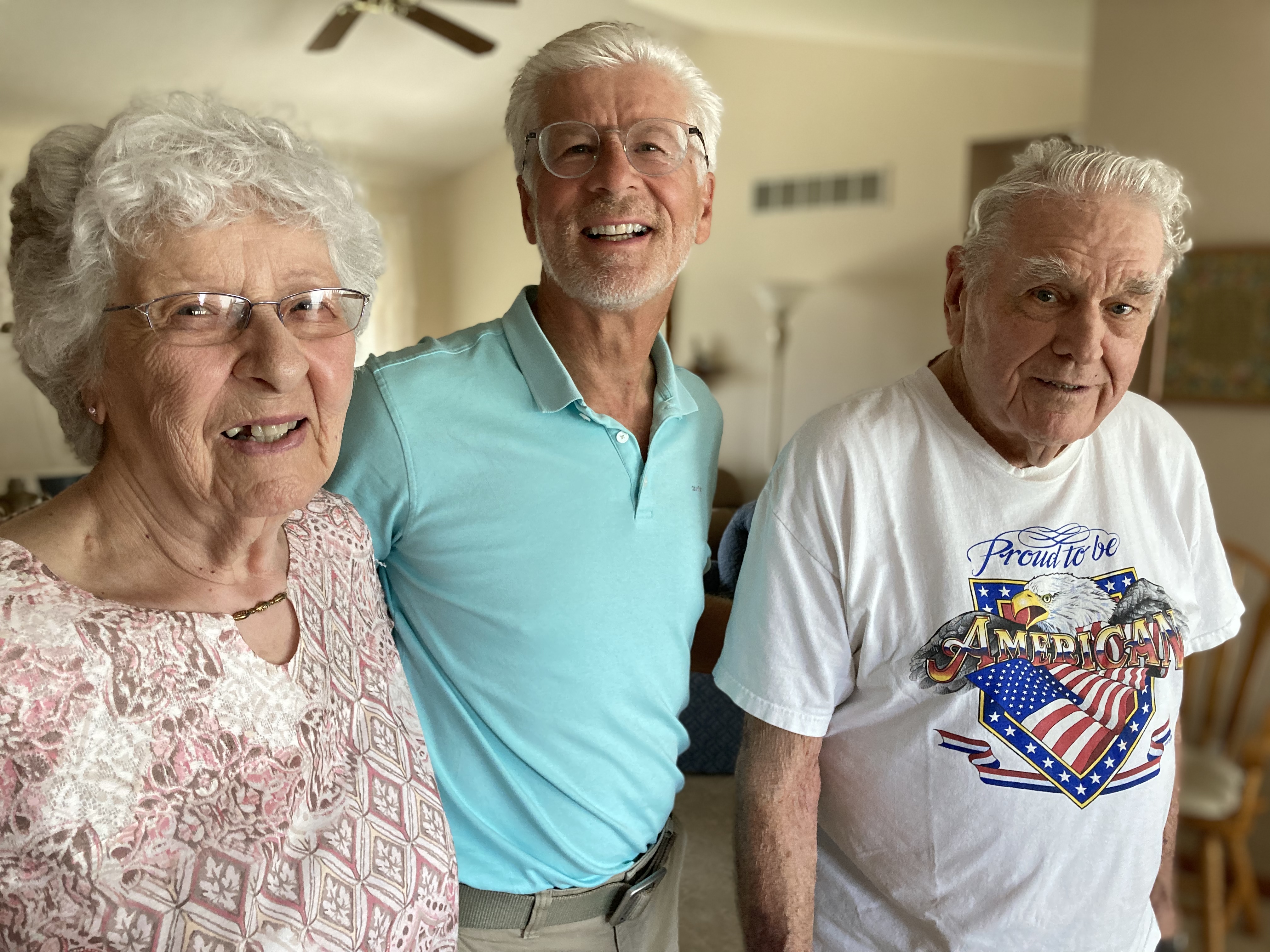
Me in the middle, with Janet and Bill in 2021.

When my grandmother died in 1979, I drove my young wife and one-month old son from our home in Nashville, TN to the funeral in Wisconsin. Grandma was young enough to have a large funeral, just 72 years old. My age.

Of course, in Rio, WI, population 788, funerals were as big a social event as Friday night football at the field in Fireman’s Park. I didn’t play football. I ran cross country instead, which I convinced myself was harder.

But I was at the football games, either running the sideline keeping stats, or in the stands playing “CHARGE” on my trombone.

After grandma’s funeral service at Redeemer Lutheran, one of six churches in town – equal to the number of bars – everyone gathered in the church basement for a lunch prepared by women of the church. Because the meal was free, and there wasn’t much else happening in town that day, the room was crowded.

My wife was most concerned with the one-month old son not accustomed to the noise and crowd and whose only real concern was keeping his tummy full and his diaper dry. So, he started fussing and wailing and that’s not the sound you want to hear piercing the din of chattery family members chowing down on store bought dinner rolls filled with a slice of ham and a slab of butter, potato salad and red Jell-O with marshmallows.

Suddenly, from across the entire fellowship hall, packed hip to hip at the folding tables, my aunt Janet yelled, “Give that boy some titty!”

Now, in another context other than a rural Wisconsin farming community, that comment might have seemed out of place, even impolite. Certainly it caused all the blood in my wife’s body to flush to her toes and then recongregate in her face, making her flush a brighter red than the Rio High School Vikings mascot. But, it also gave her the freedom to excuse herself, find a quiet Sunday School classroom, and take care of our son’s immediate need.

Aunt Janet died this week, at age 91. She was my mother’s last surviving sibling and mom preceded her in death by 29 years. They were two of eight siblings, prompting my grandpa McFarlane to say he had “Two and a half-dozen children.” When grandma McFarlane died, petty sibling grievances broke familial bonds and later on, as one sibling after another died, obituaries did not list all surviving family members, as if they never existed.

But Aunt Janet was always a friend, in part due to the loquacious character of her husband, Bill, a former police officer and much longer a seed corn salesman who knew every farmer and what they needed most. Bill preceded her in death by three years.

I confess Janet’s was the first bare breast I ever saw, as I stood wide-eyed at age five while she fed her first born son, Mark, a man who grew up to be a Presbyterian pastor, nurtured as he was on the milk of human kindness. He could preach from I Peter 2, “Like newborn babies, crave pure spiritual milk, so that by it you may grow up in your salvation.”

Janet and Bill had five children and 10 grandchildren and money never flowed like water over Niagara. Janet always put her hand to the wheel to find additional resources, driving school bus for more than two decades and making wedding cakes for lucky brides and grooms.

She looked at driving bus as ministry, taking the opportunity to offer a bright, encouraging word to children with dour faces, lifting heavy, reluctant feet up the step on the way to school.

She was certain of opinion and ready with advice.

When Janet learned my cousin Allen smoked, she asked if he would rather kiss a girl or an ashtray. Allen, sarcastically defending his nasty habit, told me he responded “Ashtray.” He’s since grown beyond that – both in girls and habit.

 Janet and Bill built a house on a hill overlooking that of her mother Eva and she was diligent in looking after her mother to the end. Eva –my grandmother on my mother’s side – expressed concern that bad weather would limit the size of her funeral. She was mentally comparing her eventual celebration to the big crowd that showed up for her husband’s sendoff. In her mind, her funeral would suffer by comparison and somehow that would reflect negatively on her life.

Though such comparison is a false equivalency, if every person whose life Janet affected positively were to attend her funeral, ushers will need to bring in extra chairs.

Funerals, and other fun rituals

I attended the funeral of a friend and former colleague today. A man younger than me.

I learned of his death while driving home from a Florida vacation. I didn’t know he’d been sick, as he was a private man. As his son said in eulogy, “My dad was the most private public person in the world.”

The somber, intimate public gathering of persons who want to see and support the surviving family and who want to hear good things spoken of their deceased friend is a valuable human ritual. Loved ones recount memories and sometimes reveal things previously unknown.

Careful speakers offer subtle lines to confirm suspicions while lauding the deceased with praise most discerning supporters take with an appreciative grain of salt.

 I’m glad I attended the funeral several years ago of a former boss, who was the most difficult human I’ve ever worked with. It was healing for me to hear good things spoken of her, to hear friends recite positive qualities well disguised in our days together.

I delivered eulogies for both my parents. Some of my observations were meant specifically to comfort some quietly sobbing friend. Other words were to lighten the somber atmosphere.

My mother, who died at 64, was a very private, reserved person, not given to bawdy humor, even when the men around her were cutting up. The first night I brought my new bride to visit in the home, I found an apple on the bedside table. The next morning, I asked mom about the apple.

“That was a contraceptive,” she said. Immediately I thought of several ways that might work, none of which I voiced to mom. Instead, I asked, “Was I supposed to eat it before…or after?”

“You were supposed to eat it…instead,” she said, laughing. Those at her funeral laughed, too, at the telling.

My grandma was proud of the large attendance at grandpa’s funeral. She surmised that she didn’t loom as large in the minds of neighbors, community and family as he did, and she bemoaned that her funeral would be much smaller. “If it snows, nobody will be there,” she speculated.

If you want a large funeral, die young.

Part of my father’s lament toward the end of his 86 years was that all his friends had died. He was tired of attending funerals of his buddies, each of which left him lonelier.

I listened with great respect as the first born son of my friend delivered an insightful, humorous, sad and intimate portrait of his father. I knew this boy when he was just a kid and now he’s a man with gray hair at his temples. And I realized his relationship and age relative to his father, is the same as my oldest son to me.

And I imagined my son standing in front of my surviving friends one day. But I could not imagine what he will say.

I eulogized my father 21 years after my mother. Many of the same faces peered up at me. Many were absent, long gone to their own reward. And I realized the value of the ritual, the support those faces and kind words offered, the life they’d shared with my mother and father – experiences they recounted to fill my own my memory portfolio.

In his song “Standing Room Only,” Tim McGraw talks about this end of life ritual and encourages us to “Be somebody that’s worth rememberin’, to live a life so when we die “there’s standing room only,” at our funeral.

Since I’ll be laying down, or my ashes will already have been blown away by a strong wind, I’m not concerned about standing room. But when my children and friends go to rememberin’, I hope a smile crosses their faces.

Beautiful killer

This morning I saw the most beautiful fox ever. Larger than typical, with bright red fur, tail long and bushy, not matted by thorns. It looked fresh from a spa: fluffed, puffed, tufted, shampooed and blow dried. Eyes intense, intelligent, confident and controlled. Lithe, nimbly athletic, light of foot like a dancer. 

And I wanted to kill it.

Coming back from her sunrise walk, my wife heard the terrorized shrieking of chickens in the open range pasture just behind the cottage where we stay on my son’s property. She stepped quickly to the pasture where she saw a fox with a chicken in its jaws. When she shouted and clapped, the fox sprinted away. The chicken didn’t.

Granddaughter helped to bury the first two victims of the carnage.

As Sue Ellen told me what happened, she asked what to do with the carcass. “Make nuggets” seemed an inappropriate suggestion. 

Before we could fully get our minds around what had just happened, we heard the terrified squawking again. I rushed to the door and this time I saw the fox…with another chicken in its mouth. I threw open the door and for an instant was shocked silent by the fox’s beauty.   

But my anger at its audacity quickly overcame my admiration and I stepped out the door and shouted. It understood my threat and I was pleased to see it run away, leaping the fence as if the rails were a padded obstacle in tumbling class.

I grabbed my shotgun and followed the fox’s trail, knowing it would never show its head to me while I stumbled and tripped through its habitat. I felt better somehow, though, knowing I was “doing” something, at least dropping some “man scent” around so the fox would know who it was messin’ with.

The second chicken was still breathing, its legs twitching, eyes registering a resigned acceptance of fate. I dispatched it, then tossed it into the garden while I went to get a shovel. 

My seven-year-old granddaughter watched wide eyed the entire proceedings, dressed in the “farmer girl” overalls we’d given her for an early Christmas present the day before. 

Uncowed, she helped me dig a hole, her sudden awareness of the life cycle presenting her a sad, but not devastating new insight. 

The life cycle as presented on a National Geographic special sees the fastest lion chasing down the slowest antelope, and it all seems natural and normal, almost pristine, except for the dust. Eating a hamburger never makes me think of the feed lot on which the donor was raised. 

Yet, somehow, because we fed and cared for these chickens, tucked them in at night and gave them special treats from our vegetable shavings, it became a personal insult. 

Yes, they’re free range and hawks circle constantly overhead. Yes, the fox has to eat and yes, the prey/predator cycle is natural. But, the fox invaded my space with impunity, looking at me as if I was an inconvenient interruption at his meal, like a waiter who informed him he had an urgent phone call and he had to leave the cordon bleu to cool.

It was a sad morning, but only a prelude. 

Worse, we came home after dark that night and I went out to check on the chickens, to make sure they had put themselves up in the coop, where safety lay behind a closed door. I looked inside and there was not a single chicken in the coop. 

With a sickening dread, I cast my light over the field and the beam fell on multiple carcasses, each with the head and neck gone. The goats huddled in their own shed, witness to the horror. I followed my flashlight beam around the pasture, accounting for all the chickens but one. 

I found her in the far corner, shaken and shivering. She didn’t protest a bit when I picked her up and put her in the coop, behind closed doors. I don’t know what killed the chickens and I don’t know how this one survived.

We named her Lucky.