
Too late to make old friends

IMG_1277

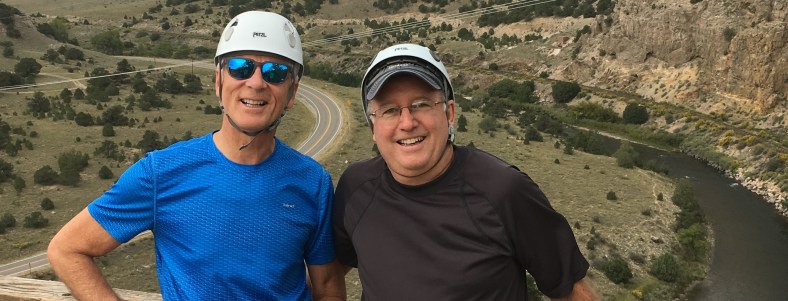
Loren, right, and me zip lining in Colorado in September.

Three of my oldest friends attended my youngest son’s wedding Nov. 4 in Nashville, Tenn.  Army buddy Steve  came from Omaha. College roomie and brother-in-law Loren came from Colorado to officiate the wedding and college friend and professional colleague David is now a North Carolina neighbor. I’ve known them since 1972, 1973 and 1974.

At the end of a long day as festivities wound down and the men hung around outside talking bold and large my oldest son noted the attendance of these three men and wondered aloud if he had a current friend who would feel close enough to him and his family to go to inconvenient lengths to attend his son’s wedding in 10 years or 20.

Bonds forged in common experience lay the groundwork for strong relationships, but they will wither without attention.

Steve and I were draftees into the Army in 1972. He had graduated from University of Iowa. I had just finished one year at Luther College. President Nixon, wisely, had eliminated the college deferment.

Steve being a bit older was great because at age 21 he could rent a car and drive us to Corpus Christi, Texas where I saw salt water for the first time. We camped on the beach and wore our Army issue boxers as swim trunks looking for all the world like gaunt porcelain survivors of shipwreck on a sunless island.

And thinking we looked like quite the macho dudes.

It was the denouement of the horrible war in Viet Nam. As draftees, Steve and I had no say in where we would be stationed after our training as medics. With other Christian friends, we debated long and hard about whether we would go to Viet Nam if so ordered. Those are conversations that tear off any veneers that keep deep friendships from forming.

Later we were in each other’s weddings, and connected when we could during his tours as a missionary. I did a story on him and Oh Be Joyful Chapel, a church he started in Crested Butte, CO. In the past decade, we rode RAGBRAI together with my son, Austin, whose wedding we were celebrating.

Loren has been my friend since Steve and I were stationed at Fort Carson, CO. We met in church and when I decided I wasn’t going to return to Luther after the army, he said, “Come to Oklahoma Baptist with me. We can room together.”

Loren instantly became a popular figure on campus, launched by expert participation in The Dating Game which was a part of freshman orientation. But in reality, his dating options were pretty limited because he had fallen for a girl back home — my future wife’s sister.

Consequently, Loren and I have been a part of the same family for four decades. But we were friends first, sharing a love for the Lord, a heart for family, appreciation for the outdoors and for relentless pursuit of laughter.

David was my hero at OBU as the all-star journalism student. We did a radio show together, and dangled our feet in the lake on a sunny spring day contemplating futures and prospects that seemed as limitless as the Oklahoma horizon.

Our career paths intersected many times in Baptist world. We both endured the machinations of denominational politicians who cloaked their motives in the Bible and we helped each other when we could. We visited in each other’s homes in various states, worked together at meetings and oversaw our kids carving pumpkins together for several years.

I was in or attended the weddings of each man, weddings that each have endured 40 years or more.

And now, here they were at my son’s wedding. And my sons not only appreciated them, but their presence gave my boys pause to consider if they have been nurturing friendships that will endure through decades.

Common experiences start friendships. Continued shared events nurture them.

Is there a buddy’s face you’d like to see; a laugh you long to hear, an experience you’d like to relive? Don’t wait for him to call.

It’s too late to make old friends.


Anger, bad conduct mimic permission giver

stick

Our president waved the permission stick over his crowds, freeing them to replicate his insults.

In the wake of angry, racist boils bursting on the face of our public persona, those charged with keeping social order urge restraint in response.

“This is not America,” they say, implying that if we will just calm down and come to our senses, we can again paint a veneer of societal peace over our burbling disruptions and return to our true national sensitive nature.

It’s hard for me to admit the ugly truth, but this IS America. We are a nation in which racial, ethnic and class tensions have bubbled beneath the surface of our society for generations – maybe since our first days when dreamers who couldn’t afford the price of passage traded several years of their lives as indentured servants in exchange for a lottery ticket on a ship to the New World.

But our diverse human hive found ways to co-exist by mutually agreeing to a set of unwritten standards of conduct. Among the many learned behaviors that govern our daily lives, we agreed that racial identity should neither hinder nor promote opportunity; that personal space should not be infringed without permission; that insults do not promote peaceful co-existence; that those who enforce the law are not above the law; that private conduct between consenting adults be kept private; that you don’t stiff the waiter.

Within these basic, mutual agreements we generally live day to day in harmony. Outbreaks against these societal mores make news precisely because they grate against the norm. Highlighting them says, in effect, “this is NOT acceptable conduct and our fragile social construct will break down if it continues.” Perpetrators of the most egregious insults are judged verboten and spend time isolated from the rest of us behind steel bars.

This “acceptable conduct” is ingrained in us through the sometimes exasperating efforts of instructive parents, teachers, bosses, friends, colleagues and strangers and instills in us subconsciously the behaviors that keep our society humming with minimal disruption.

Although basketball pro Charles Barkley declared he “is not a role model,” the conduct of high profile public figures often affirms or dissolves commitment to these behaviors.

My wife is still mad at Bill Clinton for interjecting “oral sex” into the common vernacular of our kids. On the other hand, “born again Christian” didn’t become a commonly understood term until Jimmy Carter spoke it in an interview and people scrambled to figure out what he meant.

Now the fabric seems torn. The fragile cloth of our peace frays like the edges of a flag flapping for too many miles on a car antenna.

Agitated people who for years have tamped down their personal rage in reluctant agreement to abide by social expectations suddenly feel free to vent, scream and insult and claim privilege earned by their race, age, education, position or size of their truck.

What sharp knife sliced the fabric? Apparently those who have felt left behind, even abandoned, in a world of shrinking opportunity needed only a permission giver to release their frustrations, someone to say it’s OK to act out in public the rage and prejudices they’ve kept bottled. It seems that our permission giver walked into the national consciousness with a grandiose ride down an escalator to announce his candidacy for the presidency of the United States.

As a candidate Donald Trump employed crass language to invoke brazen images of the “little guy” prevailing, riding their airboats through “the swamp” in Washington DC, shooting alligators from the gun whale. He applauded harsh treatment of protestors, mimicked disability, bragged about his peccadilloes, scape goated immigrants, denigrated leaders of the international order and encouraged caustic behavior.

He waved the permission stick over his rallies and gave the crowds freedom to act out their rage. Of course, everyone is personally responsible for his or her own conduct. But in a society where rage, fear and prejudice have been building pressure like air in a balloon, a single prick in the surface brings an explosive result.

My friend Jim was a high school principal and school superintendent for many years. He told me he would not hire our current president for any position in any school he supervised – from teacher to janitor – because most of the problems he dealt with among students and their parents had to do with breaks in the common social contract that Mr. Trump so easily disregards.

In the course of a single day a friend of mine had a friend called a “faggot,” another’s son was told to go back to “where he came from” and another friend was called a “nigger” by someone hollering out the window as he drove past his house.

Did that kind of thing happen before? Yes, but not with the freedom and frequency it’s happened since our president has cast “the other” as the source of our nation’s ills. The incidents of hate crimes, hazings, defacements and ostracizing are rampant since people feel they’ve been given permission to talk and act this way – since the president has drawn moral equivalence between Nazis and those who oppose them.

We each are responsible for our own behavior. But when someone in authority – whether a parent, teacher, school crossing guard or president – says by word and deed that it’s OK to treat “the other” with disrespect, our social fabric will quickly unravel.


Rainy walk proves journey is key

Rainy weather washed out our plans to ride bikes on the greenway. So my 7-year-old grandson Grayson and I rolled pennies, of all things.

Sue Ellen and I had months of loose coins that we’d started rolling the day before, but we weren’t going to do the pennies. We were going to just run them through the bank’s counter and pay the confiscatory fee by which they charged us to count money we were going to put into an account in their bank.

We’d sacrifice the 8-10 percentage tariff for the pennies, which weren’t worth the effort, but not for the big coins.

But, with us scrambling for entertainment on a rainy day we decided to roll pennies. Anything you can do with a little boy that gives him a sense of accomplishment is a good thing. So efficient were we, that we ran out of coin wrappers.

That necessitated a trip to the Dollar Tree a mile and a half away to get some more. I hated to drive the car that short distance, and the roads were too wet to safely ride our bikes. But the misty rainfall was not too furious to keep us from walking.

After assuring me that he could do the round trip, Grayson and I took off for an adventure, him in an old cap of mine, and a raincoat that dwarfed him.

We observed three power company trucks driving through the neighborhood as we walked, and remembered how the lights had flickered at our house, but hadn’t gone out. Odd.

We chatted as we walked, noting the quiet swimming pool on a rainy day, revisiting my recent bike wreck when he had gone for help, talked safety rules about walking on the road, teased about “chasing girls” in a few years that made him turn red.

I realized he didn’t think he’d have to wait that long. On the return trip, I made sure to inform him girls have cooties.

We talked about how a hill looks much higher and steeper from the top of a previous hill, but seems to level out as you walk it. So don’t be discouraged, keep moving forward.

He sounded the “how much further” refrain after the first mile, but by then we were in the shopping district and I could point out the traffic light we needed to reach. Alas, when we got there, the store was dark.

Employees sitting in front said they had no power and could not let us in the store. I moaned. A long walk for “nothing.”

Disappointed that we couldn’t accomplish our goal, and knowing how fragile a 7- year-old’s countenance can be, we started the long walk back home empty handed. We noticed, however, that on the other side of the street lights still blazed – including at a donut shop.

I suggested a detour and took the opportunity for more teaching about power lines, grids and transformers and how one side of the street can have electricity, while the other side remains in the dark.

I also shouldered my grandfatherly responsibility to illustrate the distinct taste advantages of an apple fritter over a chocolate covered cake donut.

Just when it looked like our adventure was a strike out, a hot and tired grandson with a chocolate smear on his face said, “We’ve got to do this again, papa.”

Grayson reminded me that time is our most precious currency and when you invest it on the journey your destination is irrelevant.


Don’t Blink

At the doctor’s office this morning I looked down to fill in the remaining blanks on the form at the receptionist’s desk. It was my first visit so, of course, they wanted to confirm my willingness to sacrifice my first born if necessary to pay their bill.

The office computer had auto-filled some of the information and I just needed to fill in the rest. Staring up at me in simple black text over the white paper form were the identifying factors that would enable them to track me down should I limp out of there with their charges unredressed.

One simple number struck and confused me: 63. I thought at first it was “Question No. 63,” but it was on the first page and the form wasn’t that long. Then I thought it might be a part of my address, or something to do with the third of June. Of course, all of that flashed through my mind in a second before I realized the number represented my calendar age – the number of years since I emerged large and in charge from my mother’s womb.

I would have shaken my head except it’s still wobbly atop my neck from my bike accident, the reason I was at the doctor’s for a follow-up.

Seeing that number reminded me of when I was being transferred from one emergency room to a more capable trauma center three weeks earlier. The medic riding in the back of the ambulance with me called ahead to the trauma center, alerting them that he was about to arrive with a “63 year-old-male, with head injuries.”

“Poor sucker,” I thought. As best I could, since I was strapped to a neck board, I craned my eyes to look round the ambulance because I thought I was the only one riding to Winston-Salem. Turns out I was alone. Then I realized he was talking about me.

Sixty-three? When did I get to be sixty-three? Except for the momentary and exceptional fact of a fractured skull and several vertebrae, I felt 40. Sixty-three was my dad. Sixty-three was grandpa when I was a kid. Sixty-three was plaid pants and knee socks in gray walking shoes, and dinner at 4:30 for the discount.

Sixty-three was not me.

During the first third of my life, I always looked younger than my actual age, and it bugged me to no end. When I was 25 I was married, living in the second house that I’d owned and a college girl came to my door to look at some furniture we were selling.

I opened the door and she said, “Is your mother home?” It took my wife three weeks to re-inflate my pride.

Twenty years later I stood at the register to order a coffee and cinnamon role at Bojangles and the server repeated into the microphone, “One senior coffee and a cinnamon role.” I tried not to cry because my associate who was with me was too busy laughing.

In twenty years I went from “Is your mother home?” to being offered a senior discount.

And now the paper says I’m 63. The mirror agrees. My body nods affirmatively. My mind shouts vehement denial. Goodness, I’m embarking on new ventures infused with still developing hopes, dreams and plans. To quote Buzz Lightyear, I’m setting sail, “to infinity, and beyond!”

I turn to my wife, a wrinkle of concern still lining her forehead as we await the doctor, and ask her to verify the identify of the patient on this form.

That’s me? Age 63? How did we get here?

Don’t blink.

Healing power of the right word

I suffered a pretty awful accident May 14 while following my grandson on a mountain bike down an open, sloping field on his parents’ property.

We’d been tooling around for an hour, just enjoying a simple ride on a perfect spring day. Who needs a helmet for that? Well, Grayson wore his because he told me, “Safety first.” I should have listened.

He led me to the top of the hill, launching from his uncle’s driveway down through the field. I took a moment to soak in the sight and relish the feeling. His joy was palpable.

He was out riding with his papa, atop the freedom of his wheels and the thrill of a downhill slope. Giving myself just a moment to appreciate the scene, I took off after him, cutting a new path to the left of his line.

A lip at the edge of the field dropped several feet. I intended just to ride it down, hanging on tightly to reach the broader, softer slope. I didn’t see the hole at the bottom until it was too late. In an instant of clarity my brain registered, “This is not going to be good.”

My front wheel hit the hole and the bike stopped dead. I kept flying toward the ground like a spear and landed on my head

Grayson ran back up the hill to see if I was all right. “No, Grayson, I’m not all right. Go get Nana.” I felt like someone had hit me in the head with a 2 x 4 and that I’d lost six inches of height from having my spine compressed.

Within moments Nana pulled the Subaru into the field beside me. She sent Grayson to his uncle Bubba’s house at the top of the hill for a towel to stop the bleeding and for an additional hand to get me into the car. By this time I’d surveyed my extremities, all of which functioned, so I knew long term I would be fine. But, oh, I hurt.

Later tests would reveal fractured skull, cracked vertebrae, bruised spleen, lots of abrasions and cuts that required 10 staples to close. But for now there was just lots of activity with the other grandkids and Bubba and his wife, Sonya while we debated calling an ambulance.

In the midst of that hubbub I heard the sweet voice of 7-year-old Grayson saying, “It’s my fault. I should have told Papa about that hole.” I reached for Grayson’s leg and told him never to think that. He bears no blame.

But during the next 15 hours in two emergency rooms and calls back and forth among family, I kept hearing that Grayson was feeling responsible. That is a heavy burden for a bright, sensitive seven-year-old. It saddened me that he felt that way.

I was released early the next morning and went home with a neck brace to rest and heal. Grayson’s mom and dad, who had been out of town celebrating their 12th wedding anniversary during all the excitement, brought the kids by the house to see that Papa was OK. I knew I needed to find the right words to relieve Grayson of his self-imposed burden of blame.

His face was painfully tentative when he saw my brace, staples and stitches and he was wondering how I would react now that I was upright. In an instant I smiled big, held out my arms and loudly said, “Grayson, my rescuer! You’re the one who rescued me when you went for help! Thank you, buddy.”

In that instant his face transformed from hesitant to happy, from reluctant to rejoicing, from tentative to triumphant. He went from self-blaming to knowing he contributed to my being OK after a bad spill.

Choose your words carefully. A well-chosen word has the power to heal. A quick, harsh word has the power to destroy, to tear a hole in the cloth of confidence.

I know people who still labor under the self-image an angry parent imposed upon them 50 years ago, rather than with the reality of the bright and beautiful people they are today.   Grayson is young and aggravating sometimes because he is so intelligent and curious and he insists there is nothing he cannot do.

But from this day forth, no matter how many times I huff and puff and say, “No, Grayson, you cannot use the chainsaw,” he will know that on May 14, he rescued his papa.

Hold the Ladder

Hold the ladder

 When I came back from a trip to Bihar, India, I thought I knew that in those dusty villages with dung-daubed mud brick walls lived the poorest people in the world.

Then I went to Haiti after the earthquake.

I was convinced then that in those barren tent cities with no apparent water source, no services and acrid smoke permeating the humid, tropical air lived the poorest people in the world.

Then I heard K Brown’s stories and saw his pictures from Ukraine.

Once more, I knew that in those frigid and muddy streets twisting without rhyme or reason between leaky shelters cobbled together with nails, wire and plastic lived the poorest people in the world.

I think I’m right this time.

After his first trip to Ukraine, Brown, a masterful video story teller, brought home haunting images of the murky, fetid streets and shacks of the Roma village in Mukacheve. Their Ukrainian neighbors consider the Roma, or gypsies, untouchable. But Brown and his team found them so winsome, transparent and hungry that he has become a regular visitor, planning and bringing medical teams and vacation Bible school workers back every year.

So often our mission trips become a four-act play of we go, we minister, we cry, we take pictures to prove we care. We leave behind everything we brought to be distributed among the people because we feel suddenly selfish having extra when they have nothing.

Dana Brown left behind more than her extra jeans. Dana, who assists her husband K on most of his documentary journeys, is the victim of a genetic defect — cardiomushextremis. Basically, she suffers from an extremely soft heart, susceptible to the emotive vibes of the poorest among us, those who feebly cling to life’s fragile fringe.

Dana finds relief for her condition only in ever higher doses of gypsy children, administered through hugs and smiles that communicate more love without words than a common language ever could.

She paints fingernails, holding each little hand in her larger hand, skin on skin, dirt on clean, hope on heart. More than polish the kids want their hands in hers and they run behind a building and scratch off the color so they can jump back in line to have Dana paint their nails — and hold their hand.

Dana encouraged an older woman waiting on the edge to join them. She at first declined but Dana’s disease is communicable and the woman softened. When Dana reached for her, the woman clutched Dana’s hand and touched it to her lips, and cried as if she’d never seen love before.

In discussing the incident K said it is not unusual for a gypsy’s only experience with touch to be harsh, from the scourge of anger or the hard discipline of a parent or spouse frustrated at the impotence imposed by poverty.

“Maybe it’s been a long time since the older woman felt the simple touch of kindness,” K says. “Maybe she has no one who snuggles up and says ‘I’m here simply because I love you.’ The tears mean something. I just wish I knew the whole story.”

K says all the noise and chaos of village life fell silent behind the tableau being painted between two strangers, with a brush of love on a canvass of common humanity. The only sound, he said, was the drop of tears into Dana’s lap.

K is inspired by the faith of gypsy Christians who see the hand of God caring for them in the worst of circumstances. A Hungarian translator keeps going back to the village “because I feel like I’m climbing a ladder to heaven every time I’m around them.”

K and Dana keep going back. They’re looking for others to help them hold the ladder.

(This story printed in the November-December 2014 issue of Herald, a publication of Baptist News Global)