Are you as good as dead?

While collecting shellfish in Australia, Eric Nerhus was bitten almost in half and swallowed by a 10-foot shark.

Swimming 25 feet below the surface, Nerhus, 41, was grabbed over his head by the shark, which took half of Nerhus’ body into his mouth. He was as good as dead.

Thinking quickly, he reached up and poked the shark’s eyes with the chisel he used to collect abalone.  The shark open its mouth and Nehus wriggled out.

Nerhus estimates he spent two minutes inside the shark’s mouth and said his chest was protected from the shark’s sharp teeth by the lead-lined vest used to weight him down as he scoured the ocean floor. He swam to the surface in a cloud of his own blood, where his son helped him into the boat and rushed him to a hospital.

The 2010 movie “127 Hours” featured the dramatic story of Aron Ralston whose arm was pinned to a rock wall by a suddenly shifting boulder while he hiked Utah’s Blue John Canyon.

No matter what he tried to dislodge his arm, he was trapped. After four days his water ran out and he drank his urine. On the sixth day, Ralston realized he was as good as dead.

Then the 27-year-old mountain climber did what he’d always known he had to do, but could not bring himself to do when he thought there was an option. Using his own body weight for leverage, he broke both the bones in his forearm. Then, with his pocketknife Ralston cut off his arm below the elbow and applied a tourniquet. He then rappelled 60 feet to the canyon floor and started walking.

He walked seven miles before encountering two tourists who called for a rescue helicopter.  

What’s the point?

Neither Eric Nerhus nor Aron Ralston are dead. At that point in their lives when there was no prospect for more life – when they were as good as dead – they found a way.

Ever thought you were “as good as dead?”  Or wished you were?

  • In the midst of company chaos, your boss approaches you with a grim face;
  • A truck in the approaching lane veers into yours;
  • You discover your father’s debilitating illness is hereditary;
  • At a conference in his office, your docor leans forward and says, “I’m sorry.”
  • Your job loss has led to anxiety, depression and a mortgage foreclosure;
  • You face an impossible financial burden to make good for a child’s accident, illness or bad mistake;
  • A dark secret you’ve carried is suddenly revealed.

Jesus’ friend Lazarus was not only as good as dead. He WAS dead. Then Jesus exercised his power of life over death and he raised Lazarus, demonstrating to us though we be as good as dead, we still possess the life option.

The same is true for a host of other biblical characters. Young David could have killed King Saul (I Sam. 24) when Saul was relieving himself in a cave and David crept in behind him and cut off a piece of his robe. Saul was as good as dead and didn’t even know it.

Joseph had a coat of many colors (Genesis 37), and was his father’s favorite, when his jealous brothers threw him into a cistern to die. He was as good as dead.  

Shadrach Meshach and Abednego were thrown into the fiery furnace; Daniel was tossed to the lions; Jonah was swallowed by the great fish; the adulterous woman dragged for stoning by an angry mob.

Why did God rescue them? Because God had a higher purpose for their lives and something in that near death experience equipped them for that purpose like nothing else could!

Your faith isn’t feeble in the face of life threatening odds. It’s most flaccid when you operate only in the realm of your own abilities, when you’re deluded enough to think you can “do it yourself.”

My favorite traditional hymn is “A Mighty Fortress is Our God.” Verse two says, “Did we in our own strength confide, our striving would be losing.”

Remember, when your dreams and promises appear to be as good as dead – yet they breathe. Aron Ralston wandered out of the dessert after cutting off his own arm. Eric Nerhus fishes again. Childless Abraham, whose body the Bible says was as good as dead, became the father of a nation.

Senior adult groups have many adorable names. One of my favorites is the ADY – Ain’t Dead Yet – Club. Circumstances may conspire to make you feel you’re as good as dead, but guess what.

You Ain’t Dead Yet.
Carting away your history

Strangers carted away my friend’s history yesterday, piece by piece.

An auctioneer’s singsong cajoling held Dave’s life up for examination and bid. Chains, tractors, implements, house furniture, fuel tanks, rakes and hoes all appraised unemotionally for their “value” by area farmers hoping to find a deal, make a steal.

Dave’s farm, eight curvy, hilly miles from any main road, looked like a Ford dealership, as 120 trucks – at least 100 of them Ford F150s, 250s and 350s – parked nose first along the edge of the cornfield like piglets nursing. Amish neighbors in their round straw hats parked their buggies in the yard, and tied their horses to a shade tree. An early morning deluge left the grounds muddy but didn’t discourage potential buyers from picking at the accumulated instruments of Dave’s farming life.

Dave is in the second year of an ALS diagnosis and at age 72 he’d decided to sell the farm where he’d lived 46 years, raising his three children in a Trumanesque environment in rural Pennsylvania.

He is slowly losing muscle strength everywhere but in his smile.

When major items like his John Deere tractors didn’t sell for what he’d hoped, he shrugged and said, “Let’em go.” Trying to sell them on the open market later, hoping for a more equitable price, was just too much trouble to contemplate.

Dave and his dad built the house atop the hill, where his wife huddled now with a long-time neighbor to avoid seeing four decades of her life picked over, devalued and carted away. The house wasn’t quite finished in time for their first child to come home to it from the hospital. But it was finished two weeks later and she’s lived there ever since.

Dave decided to sell the house, barns and 45 acres on which he’d lived his entire adult life so that Debbie wouldn’t have to…later. Once decided, his second son, Mark, drove him through the rural neighborhood to pass out flyers announcing the sale. They left fliers with neighbors who Mark knew did not have the means as potential buyers, but he eventually realized he was driving his father around on a farewell tour.

“He just wanted to say goodbye to the neighbors he’d known for 45 years,” Mark said. When Mark realized that, he settled in and enjoyed the ritual.

The man who’d purchased the farm was present at the auction. He’d bought it for his daughter and son-in-law as a place to raise their children, in rural Pennsylvania, giving them the benefit of idyllic life in rolling hills, among Amish farmers, an area where church and school are the gravitational centers of community life.

Dave’s adult children and their spouses were present and helping. Grandchildren roamed through the barns for the last time, daringly climbing steep ladders to where hay once was stacked high, making sure that mom and dad saw their accomplishment. Dave’s sons recounted adventures with tractors, camping in the woods, trapping ground hogs and shooting that would make their survival a mystery.

This was their home being carted away on the backs of trucks and trailers. They weren’t sad – yet. The hard decision had already been made – to sell the farm and auction off the equipment. This was just the physical manifestation of their decision.

But, when the last cabinet was pushed into the back of a minivan; and the last tractor was loaded onto a flatbed; when the camper the grandkids slept in the night before rolled away behind a pickup, the somber reality settled over the property like an early morning fog settles into valleys.

I hugged each goodbye, Dave’s arms limp at his sides, and thanked them for including me in their family. Through thick and thin, good times or bad, through the struggles inevitably ahead, he’s my brother and the auction was another milestone toward “next.”

Moments planted yield the fruit of memories

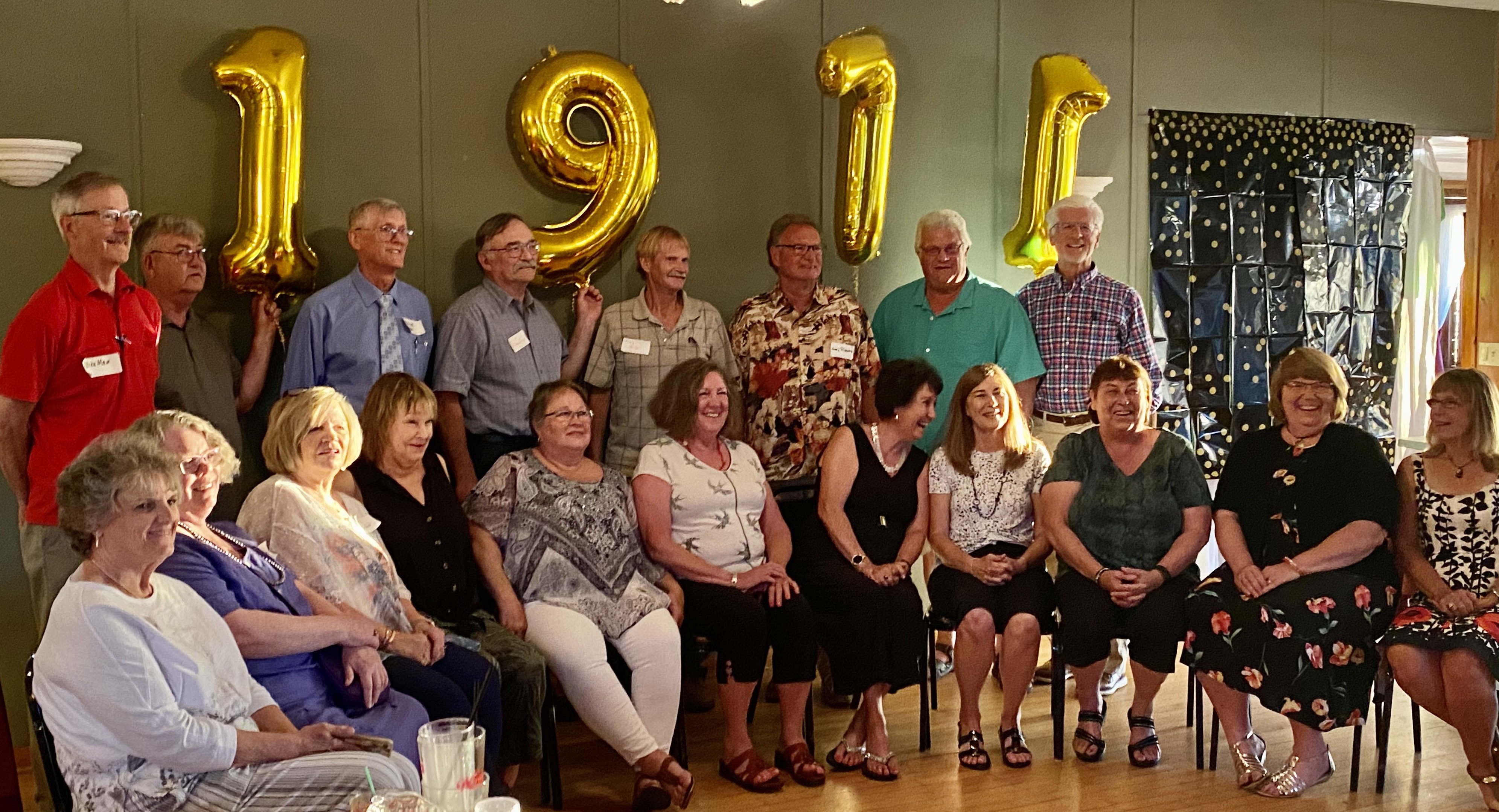
Members of the Rio, WI high school graduating class of 1971. Not a bald head among them.

Confession up front: before my 50th high school class reunion in June I looked over my year book to reacquaint myself with the names – and cherubic faces – of those from my class who might appear. 

Having delivered our graduates’ speech as valedictorian of our 53-member class five decades earlier, I was asked to “say a few words” on this very convivial night, decades past the gateway to a dream that seemed to open to us in 1971. We’re also decades past having to color our palette of life, careers, marriages, successes or failures in hues that confirmed that we’d “made it.”

So, I talked about “making it,” and memories.

Members of our class were born in 1952 or 1953. I mentioned notable characters born in those years, including Vladimir Putin, Patrick Swayze, Liam Neeson, George Strait, Floyd Mayweather, Mr. T and Roseanne Barr, Hulk Hogan, Cyndi Lauper, Pierce Brosnan and Tim Allen.

We remember these politicians and entertainers because in our minds and in our culture, they “made it.” They are rich and famous, at the top of their respective fields. Say their names and people know who you are talking about. 

“Did we make it?” I asked. “Are we making it?” 

I was pleased to hear an immediate “Darned right,” from Jerry, our star athlete who was an all-conference football player in college and who has concluded his career in insurance, primarily among farmers in two counties.

No matter what we think “making it” means, I know we all have a different perspective on that than we did 50 years ago – or even 20 years ago. Success? Riches? Fame? Security? Family? Love? Inventions? 

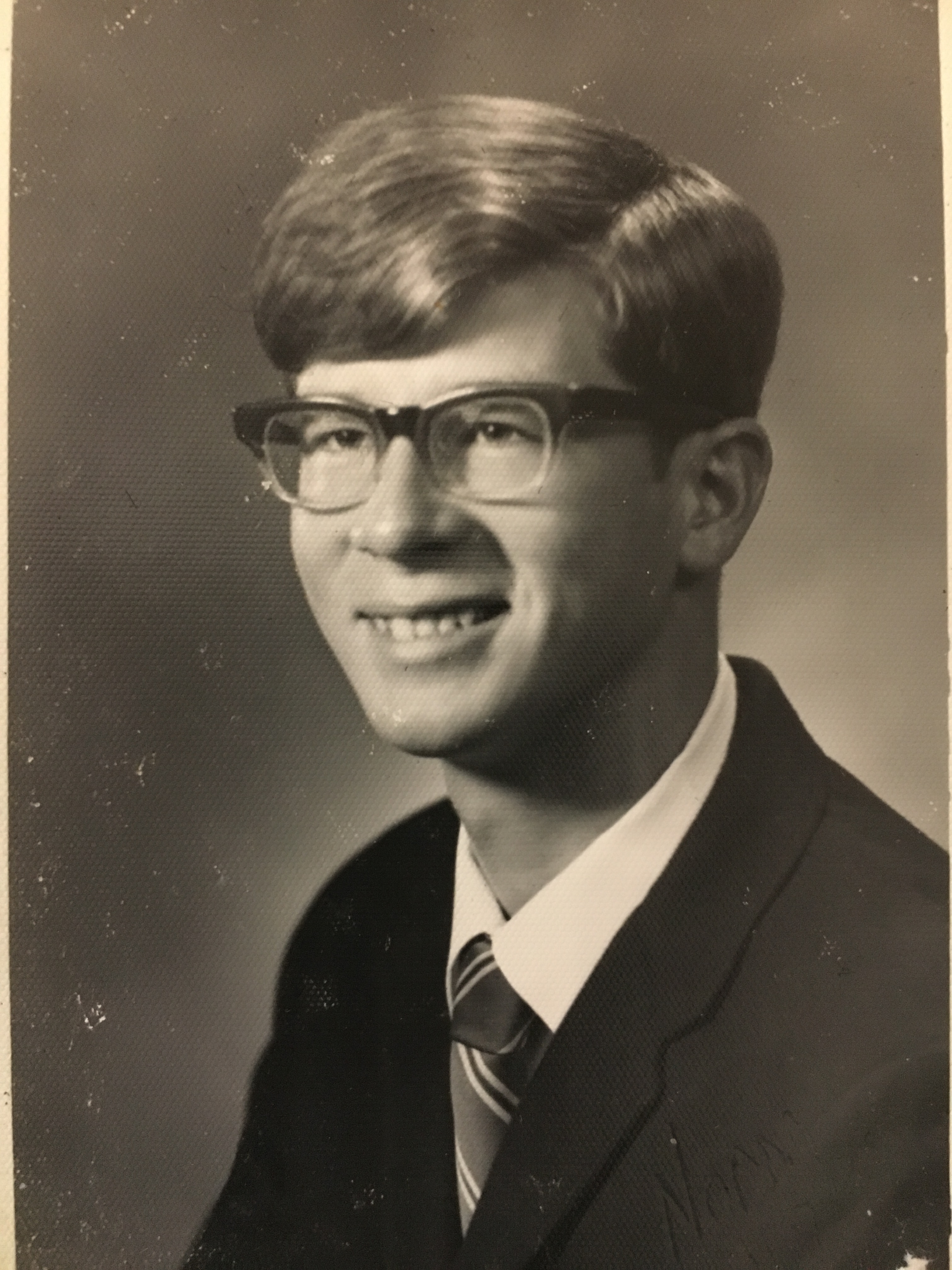
My 1971 high school graduation picture. Naive, hopeful, eager.
Fifty years of sandblasted life later, mostly in Baptist communications.

Except for seven months, I’ve never lived closer than 600 miles from either my parents or my in-laws. My quest to “make it” took me from state to state. I’ve lived twice in Texas, twice in Oklahoma, twice in Colorado, in Tennessee and now North Carolina. My daughter was six when we moved to North Carolina and North Carolina was her fourth state to live in. 

I came home annually to visit – and as long as my dad lived, Rio was always “home.” For the longest time, I thought “making it” meant anything away from Rio, population 788. My dad always told me Rio’s population stayed at 788 because any time a young woman had a baby, an older man left town. 

Looking across the room I saw vibrant senior adults, many of whom never left the area, and all of whom have “made it.” They stayed, invested themselves, coached the local teams, served on the school board, nurtured the children of other families, and offered their voices of wisdom among their peers. They’ve been important to many lives. 

Reunions are the fertile soil in which the seeds of memory planted much earlier blossom and flower. We harvested those blooms at our 50th.

We remember moments, rather than days, as philosopher Cesare Pavese said. We all have memories of high school. Some we share, others are unique because none of us lived the same life. And the best part of those remembered moments are the people we shared them with.

Writer and theologian Frederick Buechner said, “When you remember me, it means that you have carried something of who I am with you, that I have left some mark of who I am on who you are. It means that you can summon me back to your mind even though countless years and miles may stand between us. It means that if we meet again, you will know me.”

And we want to be known. And remembered. Someone has said you die twice: first, when your heart stops and you’re buried. The second time you die is the last time someone says your name… whether it’s a year, a decade, or a century.

So, I named the seven members of our class who are with us no longer. They remain alive in our memories. 

Then we had fun recalling not only the names of our teachers, but some of their idiosyncrasies: the teacher/coaches who helped athletes with grades; the biology professor we called Bernard the Monk because of his curly bowl haircut and demeanor; the English teacher who the girls always felt was peeking up their skirts.  

Gas was only 33 cents a gallon at Bleigh’s service station during high school. I’d drive across town to the Farmer’s Union Co-op if it was 32 cents there. Of course, “across town” was less than a mile, with one stop sign.

Janis Joplin was singing “Me and Bobby McGee” and “The French Connection” competed with “Fiddler on the Roof” and “Dirty Harry” for your $1.50 movie admission. 

Living in the south now, I told the class every region has its rednecks, but southerners are special. You know you’re a redneck in the south when you take your dog for a walk and you both use the same tree. Or, when grandma’s wish list includes ammo. Or when you think “The Nutcracker” is something you do off the high dive.

One anomaly I noticed was that not a single person in the room was bald. According to the U.S. National Library of Medicine, male pattern baldness at some level affects more than 50 percent of all men.  It stands to reason that someone would be bereft of hair. 

Perhaps humorist Garrison Keillor’s observation of his little hometown of Lake Wobegon – the model of which easily could be Rio, WI – is right. There, “all the women are strong, all the men are good-looking, and all the children are above average.”

For all of you who are having reunions and special functions, blessings on every classmate and friend who has “made it” this far. May you have many more years to be a positive influence in your children – who always need their parents – and their children, who more desperately need the positive influence of grandparents now than ever before. 

These are the people of our lives, thrust together by time and circumstance, calling up the memories created by moments together. I’m grateful for them. 

It’s going to be a Covid Thanksgiving

I just tucked my crying wife into bed. 

For months, we’ve been looking forward to seeing distant grandchildren and tonight we realized that Covid 19 restrictions will keep us from our visit.  They’re in a state with a sudden surge of cases – but aren’t we all.

We’ve watched the sad stories of isolated grandparents missing the hugs, kisses, smiles and simple touches of their grandchildren, and we’ve felt sorry for them. I’m a hugger and we’ve enjoyed that relationship with our local family. But now, “them are us.”

Our sadness is intensified beyond this failed visit by the stark realization we may not see the distant grands for months yet. If a negative Covid test is required for admission, and we are unwilling to take such a test simply to travel, what does that say about when we might see them? What does that reveal about fear? Or about the blanket of paranoia draped over America’s frail shoulders?

Covid-19 is not a hoax. It is real. A million cases a week in the U.S. and 1.4 million deaths worldwide attributed to Covid are evidence that some virus is circulating in the human population…after living for untold centuries in animal populations – or for months in a Wuhan lab. Who knows? But, the virus is not random. Like any bully, it picks on the weakest kids in the room. 

We may all feel weak and susceptible to the bully, but in fact, we are not equally vulnerable. Statistically, 90-plus percent of those “kids” getting bullied have health weaknesses upon which the bully feasts. They already are obese, old, frail and with poor immune systems. Covid is a Darwinian herald, an ax wielding assassin rampaging through the human population, spotting these weaknesses and swinging its deadly weapon with lethal results.

In America, we make ourselves vulnerable by not paying attention to our health. We are pale and pasty from too many sedentary hours, eating food whose ingredients we cannot pronounce, demanding our doctors prescribe antibiotics for even the smallest sniffle. Or, we insist that they diagnose the undetectable, psychosomatic disaster that we’re sure will take our life before morning – unless we get a prescription for the miracle drug we just saw on TV.

If we are vulnerable, it is in large part because we delegate responsibility for our health to “professionals” – depending more on the cauldron of chemistry to correct our ailments, than on our own diet and exercise. 

On a visit to The Sixth Floor Museum dedicated to the assassination of John F. Kennedy, I was struck with a curious itch while watching the newsreels of Kennedy’s 1963 arrival in Dallas. Something was different, a bit off. Examining the video, I finally saw it. Everyone in the video, from his security detail, to the airline personnel, to the police and virtually everyone in the crowds lining the parade route, was thin. You’d have to look hard to spot a person who looked like he was trying to smuggle a watermelon out of Winn-Dixie under his shirt.

The National Center for Health Statistics at the U.S. Center for Disease Control showed that 42.4 percent of U.S. adults were obese in 2018. Obesity is the petri dish in which countless illnesses multiply.

The constant advertising of Big Pharma for costly remedies (whose list of warnings exceeds its list of benefits) pounds into us the misplaced trust in chemistry over personal care. We’re deluded into thinking we don’t have to take care of ourselves because “there’s a pill for that.” 

Instead, doctors I follow advocate steps to promote a healthy immune system. Encourage gut health by eating whole and fermented foods. Roll in the grass, get fresh air and inhale the microbes in the atmosphere, play with your pet, or the neighbor’s. Stop sanitizing every surface  because you’re killing good microbes and creating an environment that keeps your babies from accruing immunity to simple illnesses.

A new Mayo Clinic study shows that infants who receive antibiotics before age two suffer long-term effects for anything from allergies to obesity because antibiotics kill good bacteria babies receive from their mothers in the vaginal birth process.  Yet, they are too routinely administered, like farmers administer antibiotics to chickens and beef to promote quick fattening.

We are a sick nation, which makes us more susceptible to Covid-19 than we should be. Our health care system is really a sick care system, because health is not profitable. Local hospitals are advertising “well visits” and warning us “not to neglect regular doctor’s appointments.” Our hospital systems’ financial health depends on a steady stream of people with real and imagined ailments, funded through a complicit insurance system that gets more impossibly expensive every year.

And yet, a hospital system for which I once worked, is bidding more than $5 BILLION to buy another hospital in the state. Tell me there is no money in non-profit health care. 

Covid-19 is opportunistic. A virus spread through the air, and by contact, it attacks the vulnerable. Cases of “healthy” people becoming ill from it are extremely rare. CDC data shows that Americans, regardless of age, are far more likely to die of something other than COVID-19. Even among those in the most heavily impacted age group (85 and older), only 9.4 percent of all deaths between February and September 2020 were due to COVID-19. 

A significant cadre of doctors not linked to the machinery of hospital systems, Big Pharma and insurance companies, warn that closing the country down, sentencing elderly to die alone, killing the dreams and livelihoods of hundreds of thousands of small business owning families, subjecting millions to unemployment, hunger, depression, increased suicide rates and general malaise, will have longer term negative health effects on the population than will the virus. 

I have dear friends in the high-risk category. They are basically not healthy, either from long-term illness or age or obesity or some combination of comorbidities onto which Covid-19 loves to latch. I care for them as they stay secluded in what they hope is a safe bubble. But, I miss them. 

And I miss my grandchildren. 

Didn’t you used to be somebody?

The entry alcove to our house features glass panels on either side of the solid wood door. It’s a nice touch that enables me to see who is at the door before opening it. The panels also provide a tall, narrow view to my neighborhood and at least twice a day I find myself standing by them, peering out. 

I say “find myself” because I didn’t really intend to go over there like some watcher in the woods. The world outside the glass just drew me. I watch nature’s cycles on the maple tree, from buds, to leaves, to color to bare again. 

Sometimes I see people out there: kids waiting for the school bus, adults getting into cars on their way to work, someone putting a card or letter or bill payment into the mailbox and flipping up the red arm that reminds the mailman not to pass by this box. Often there is a dog walker with a small, warm bag dangling from his hand as if he had just discovered a treasure to which only his dog could have led him.

Mustard’s mug, retired at the local diner, along with his brother Marv’s — my dad — and everyone else whose funerals meant they no longer needed the mugs.

My uncle Donnie – Mustard, to those who knew him from youth – was a Norwegian bachelor farmer right out of Garrison Keillor’s tales from Lake Wobegon. He scratched a living from the sandy loam of southern Wisconsin where he raised corn, alfalfa and oats to feed the 19 head of dairy cows whose milk fed him. 

He didn’t always trust God and nature to do their jobs after he’d worked so hard to prepare the soil for planting. He’d give God a few days to breathe life into the corn seed and then, if he saw no green shoots, he’d nervously walk down to the field, look for the little arched rows of dirt left by the planter, and scratch away the soil just to reassure himself.

Maybe the planter wasn’t working. It put the seeds directly into the ground so you didn’t really see them being distributed, unlike a grass spreader that sprays seed so you know it’s going where it needs to be. Maybe this year the seed was bad. It’s never been bad before, always come up before. But this year, maybe the seed is bad. 

And it’s been dry. Has the seed dried up before a good rain could come germinate it? Or, it’s been really wet. Maybe the seed has drowned. Donnie would scratch at the earth until he found the seed and reassure himself it had gone into the ground and was just fine. From then on, he had to trust. And God never let him down.  

When I stand at my window I feel like Uncle Donnie checking out the field, making sure everything is as it ought to be. I spotted a service man walking around the neighbor’s yard once when no one was home, and I called the neighbor at work to tell him about it. It was OK. He had an appointment and the neighbor was late. 

This morning, on my birthday, I looked out the window and wondered if I would be there to look out the same window in 20 years. If so, I’d be the age of my dad when he died. How would my life be different in 20 years? That’s not a long time. 

I’m reminded of the cartoon my wife and I, both fitness advocates, posted for years on the refrigerator. A couple, about our age, were exercise walking and one said to the other, “What do you say? Two more years and we’ll let ourselves go?”

I don’t intend to let myself go, but stuff happens. I consider myself exceptionally healthy because at age 67 I eat well, take no medicine and can still ride my bike 100 miles in a day. Then I remember I’ve had two emergency surgeries and a broken neck and cracked skull. My mom died of cancer and my dad had a heart attack and bad kidneys. 

I’m also old enough to appreciate my father’s wisdom. When he was finally retirement age I was in the thick of raising my teenage children and spare time was more rare than spare change. I told dad he must appreciate the way days surely linger for him now that he’s older, with fewer responsibilities. 

Instead, he told me, “The older I get, the faster time goes.” I didn’t believe it then. I do now. 

Someone speculated that time goes faster as we get older because each unit of time is a smaller portion of our life than it was when we were young. That last month before Christmas for a five-year-old is a huge, slow moving portion of his entire life. He’s only had 60 months. A month to wait for a 60-year-old is but a blink. He’s had 720 of them. 

I think of my older friends whose social calendar revolves around doctor visits. It’s their excuse to get out and it’s a time when someone important is looking for them, expecting them, preparing to receive them. 

And I think of my friend Cliff who had a very significant career in church ministry and administration across several states. Visiting him at age 92 in the sad, shared room of his nursing home after his wife died, he looked around at his narrow bed, the few pictures taped to his wall, the closet with just a few items hanging there, and said, “I used to be somebody.” 

We assured him his life mattered, that it had counted for good in the lives of his children and in the many he touched through his work and devotion. 

I think of that this morning, standing at my window, staring out at the corn rows of my neighborhood, and wonder if in a few years my friends and neighbors will look at this house, scratch their heads and try to remember the somebody who used to live there.

What part of our one body are refugees?

“The way we are, we are members of each other. All of us. Everything. The difference ain’t in who is a member and who is not, but in who knows it and who don’t.” – Burley Coulter in The Wild Birds, by Wendell Berry

Across the globe two waves of people ebb and flow, washing up, then back into each other like waves at the beach, roiling where the water that rushed to the sand loses momentum and falls back toward the ocean, just as the next wave pushes past it. Water lemmings rushing to their own demise. 

These are the human tides rushing to get out of somewhere, and the waves of people rushing to get into somewhere else. 

According to the UN Refugee Agency almost 70 million refugees wander the world, including 41 million displaced in their own countries,  fleeing turmoil, famine, war, drought, disease. The very uncivil war in Syria spiked a large increase since 2011. 

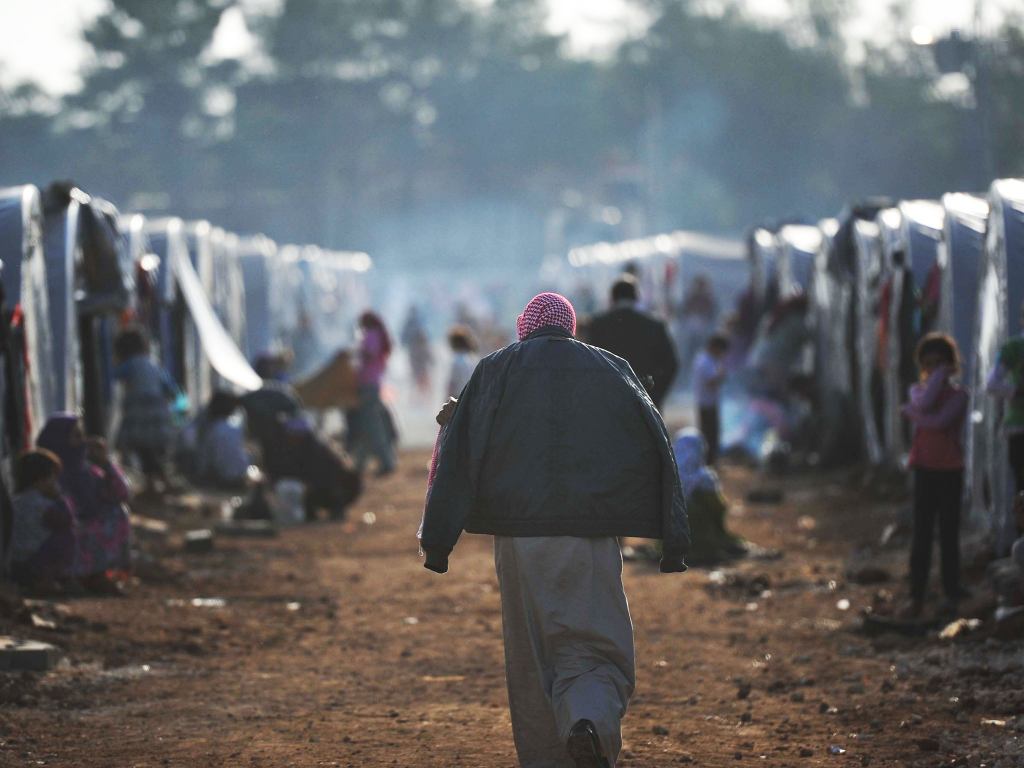
Refugees may live in squalor for years, hoping for a new home that never materializes. (Getty image)

You’ve seen the images of frightened families lugging everything they can carry, dragging their chins and bins down dusty roads in a long stream, desperate to leave behind whatever demon is tearing up their lives. Where are they going? Away. Just, away. 

They’ve cast their lot on their god and on their hopes that the milk of human kindness will somehow give them succor in whatever crowded, dirty, hungry, dangerous camp they land in next week or next month when they “arrive” at this safe haven. 

That human teat is drying up. 

Witness the wave of wanderers who washed up on the beach of the Mexico-American border and are now hunkered down waiting for a chance to present their plea for asylum to a skeleton crew of U.S. judges, operating under a “first, deny” mandate. Or the governments – and citizens – of Greece and Turkey who are saying “no more.” Stemming the easy movement of refugees from any European Union nation to another is a significant – if unspoken – element of the vote for Britain to leave the EU. 

Post-racist societies? I think not.

In October, for the first time in years, an entire month passed with no refugees officially resettled in the United States. None. The U.S. has been generous in the past with refugee resettlement, although not as generous per capita as some other nations. Under the current administration, the cap is 18,000 per year, a historic low at a time when the number of refugees is at a historic high.

This, as thousands wait for their applications to be considered. Many are huddled in squalid camps in the shadow of ports of entry, wondering where their children are, from whom they’ve been separated. Others wait in camps on the other side of the world, victims of conflicts in which we meddle – to keep the oil safe, and our access to it, secure.

Resettlement agencies, funded per capita by the number of refugees they resettle, are laying off workers and some are closing altogether. If/when our country is more open to welcoming “the tired, the poor, the huddled masses” whose industry has helped to make this country strong, resettlement agencies may not be well positioned to gear up smoothly to start again conducting their business. 

Veteran’s Day prompts such thoughts. I’m one of America’s last draftees, destined for the Army in September 1972 when my draft lottery number came up one. First. Uno. Clarity. 

America has been involved in global conflict for my entire life. Every day, if you count the unresolved status of the Koreas. “All we are saying, is give peace a chance,” we sang as students, marching Easter morning while Viet Nam still raged. 

Of the 195 countries in the world, we have troops in 177.  Some would say the presence of American troops IS giving peace a chance. Others would say the presence of our troops in other countries is the seed that grows the tree of resentment, whose fruit is conflict.

Geography is a wicked stepmother.  I’ve stood with my foot on the spot where the states of Arizona, Colorado, New Mexico and Utah meet. An inch or two either way and I’m in another state. 

A baby born on the south side of the river is Mexican; born on the north side is American. The pregnant wife of a Russian oligarch flies to Miami to have her baby and suddenly an americantsky grows up in Moscow.   

As Wendell Berry’s character Burley Coulter says, “We are members of each other,” whether we know it or not.  

Somehow the attitude that “I’ve got mine, too bad about you,” seeped into the mantra of humanity. Freedom isn’t a pie, where there is less for me if I give you a slice.

When we close our arms, our doors, our hearts the body suffers. How many of the 5,000 children in American custody – separated from their parents in a misguided and cruel effort to discourage people from South America from trying to come to the U.S. – will never be reunited with their families? Some are too young to remember their own names, to say nothing of their parents’ names, or from what town and fear they fled.

            We are members of each other. As the Bible says, we are members of the same body. (Romans 12:4-5) 

            Today, my heart part hurts. 

Lonely at the Lake

A dip in Hyco Lake saved the day.

Deep in his heart, every man longs for a battle to fight, an adventure to live and a beauty to rescue. – John Eldredge

Of all the great memories from my cross-state bike adventure with my friend Mark,  the most lasting image came from a moment off the bike. 

It was our second day, and hottest. The bank sign said 96 degrees when we rode past. It seemed we climbed all morning and early afternoon as we left the NC mountains and navigated around bodies of water, racing down to them, then slogging back up to level ground. Now, we were crossing Hyco Lake on a short, flat bridge when we looked longingly at the dark, calm water. 

“Every time we cross a lake on a hot day, I want to jump in,” Mark said. I shared the sentiment and when I saw a cabin with a “For Sale” sign on it at the far end of the bridge, I rode into the short driveway, intending to walk unnoticed to the end of its dock and jump in. But, as we rode into the cabin site, the owner came out to attend to something on his deck. 

Unthwarted, I rode up and asked if we could take a dip into the lake from his dock. Skeptical at first, he said, “Go ahead.” 

Mark, hoping tryouts are still open for Olympic underwater dancing team.

Mark stripped to his bike shorts and jumped in. I didn’t want to ride the rest of the day in wet shorts, so I got nakie and jumped. Oh my goodness. Given the day, the ride, the heat, the perfect water temp, the freedom, it was heavenly. 

After we’d gotten refreshed, we air dried a bit. I wiped myself down with my sweaty jersey, put on my dry shorts and walked back up to the cabin. Mark squished his way up to where the owner was back out on the deck. We chatted long enough to learn that he was from Massachusetts and had bought the cabin three years ago to be near his son and grandchildren, who lived about an hour from there. 

“That must have been great,” I said. “Lake house, grandkids, lots of fun.” 

“They only came twice in three years,” he said. “And my relatives from Massachusetts never came.” So, he’s selling the place and moving in with his sister back home. 

I can’t get the image out of my mind. He’s not a rich man, he said. The lake home wasn’t a vacation spot. He planted his life there so he could be near his son and grandchildren – an hour away. They came only twice in three years. 

No one visited from Massachusetts. Not once. It costs 80 bucks to get the yard mowed, and his boat looked like something you’d put your supervisor in, hoping to create a sudden job opening. He couldn’t stay. No reason to.

He was a lonely man, lonely enough to leave his grandchildren and move in with his sister back home. We thanked him, wished him well, and took off – up the hill away from the lake and on to Roxboro. 

I don’t know the family dynamics. Maybe he was hard to get along with, maybe he mistreated his son’s mother. But to uproot your life in your retirement years, move 700 miles to be close to your grandchildren, and then be ignored – that just struck me as too, too sad.

There are lots of lonely people out there. For lots of reasons. Don’t let some of them be your grandparents. And, don’t be afraid to say hello to strangers.

The wisdom of Bill

I was facing a big life decision recently so I went again to talk with my friend Bill. He’s the strong, silent type and a great listener but when he speaks, his voice always slices like a knife of insight through the goop clouding my thinking.

Bill’s place is very comfortable; shady with a great view of nature from where he rests – woodlands, pastures and now a large stand of loblolly pines that one day will be harvested. I laugh with him to think that when those trees are cut, people that have been driving by them for a generation are going to gripe and complain that the forest was cut down in pursuit of the almighty dollar.

They won’t remember the trees were planted 20 years earlier specifically as a cash crop to benefit the work of Baptist Children’s Homes of North Carolina, where Bill grew up, and lived and worked most of his career.

I can hear him chuckling and shaking his big ol’ head, rubbing the bald pate once forested with hair. The more time I’ve spent with Bill the more I realize he’s always understood people at a level much deeper than his easy-going nature typically revealed. He’s not snowed by the self-important preening of others who gathered around his table, even when it looks on the surface like he takes their words at face value.

I tell Bill how much I appreciate him, how he and his wife, Louise, took us in and showed us the ropes when I started working where he worked. I was a generation younger, in a higher “position” on the organizational chart and from another part of the country. None of that mattered, only that we respected each other, each worked hard and we all loved our children.

Bill doesn’t say much, but I know he cares. But, I digress.

I told Bill about the decision I faced. Comfort is cool; change is hard. His expression was stone cold, waiting for me to continue. The more I told him, the more I heard myself talking it through, the more it became clear which direction I should take.

I just chuckled. He’s always like that now, waiting for me to talk it through between us, without saying anything, knowing that eventually I’ll make the right decision.

With that out of the way, I tell him I know that he and Louise are enjoying their time back together again after several years apart, due to circumstances beyond their control. I catch him up on the kids, and sense his pride in them, as he’s proud of every kid who grew up at Baptist Children’s Homes, also due to circumstances beyond their control.

Bill acts as if he has all the time in the world, and I’m reluctant to leave him, but…life goes on. I thank Bill for his time and wisdom, rise to my feet, brush the fallen oak leaves from his headstone, and close the gate to God’s Acre behind me.

Thanks again, Bill. You’re always there for me.

It makes even a stoic cry

I handle bad news relatively well. My exuberance over good things isn’t excessive – unless of course, you’re talking about the winning shot hit by my child or grandchild. Those who know me might call me stoic.

But, sometimes, I find belly laugh humor in the simplest things like word play and irony. And then, out of the blue, an item will reach out from a page or conversation, or television commercial with such poignancy it strikes every raw nerve in me and makes me blubber like a baby denied its lolly. Such as, a McDonald’s commercial around Olympics time, showing a dad teaching a little girl to swim, then showing that same dad cheering on his grown daughter in the Olympic pool.

The tear trigger probably depends on an aggregation of what I’ve been doing and reading and experiencing and all the right elements coalesce to strike an emotional nerve. It happened today at lunch.

Reading in the September Reader’s Digest about teachers who changed lives, I came upon a story reprinted from 1991 about a sweet natured, but very talkative boy named Mark Eklund and his teacher who was struggling to get across a tough math concept to her junior high class. When students wouldn’t settle down, she had them write on a sheet of paper every class member’s name. Then, they were to write the nicest thing they could think of about that student – for every student – and pass the list back to her.

On Monday, she distributed their classmates’ comments to each student and heard them murmuring as they read what others said about them: “I didn’t know others liked me so much,” or “I never knew that I meant anything to anyone.”

The boy grew up, as boys do, and one day the teacher’s father said, “The Eklunds called last night.” She immediately recalled the talkative bright, polite boy and asked how he is.

“Mark was killed in Vietnam,” the father said. “The funeral is tomorrow and his parents would like it if you could attend.”

At this point, I had to pause reading because all the pain, disgust, frustration and rage I generally keep tamped down relating to America’s gross, blind, selfish, lying, cruel relationship with Vietnam burbled to the top and leaked out my eyes.

Resuming the story, teacher Helen Mrosla stood at the coffin when a pallbearer asked her if she was Mark’s math teacher. When she nodded, he said, “Mark talked about you a lot.”

After the funeral Mark’s mother pulled a piece of paper out of the wallet that was on Mark when he was killed. “I knew without looking that the papers were the ones on which I had listed all the good things each of Mark’s classmates had said about him,” Mrosla wrote.

One by one, each of Mark’s classmates from that year showed their former and favorite teacher the paper she had returned to them, folded and creased from many readings. When she finally sat down and cried, it was both in appreciation for finally knowing what that little gesture had meant to so many so long ago, and in frustration and anguish over Mark’s totally unnecessary death.

And I cried reading it, for the utterly wasted life of Mark Eklund and the other 58,208 American soldiers who died there, and the 2 million others on both sides. Youcan say these “lives”weren’t wastedbecause these men and women accomplished other things with their lives, made babies,influenced siblings and friends, bought carsto keep the wheels of American industry turning. But their lives were wasted because the war was a hopeless exercise in political overreach that never had a chance to achieve its stated purpose.

And what made my tears well up and wash down my faceand my guts clenchwasrememberingthat the politicians who prolonged the war KNEW it. They knew it for years. President Johnson couldn’t withdraw troops or he’d lose the election in 1964; Nixon sabotaged peace talks in 1968 so he could beat Hubert Humphrey.

According to a story by Bob Fitrakis in Common Dreams, Henry Kissinger, then Johnson’s adviser on Vietnam peace talks, secretly alerted Nixon’s staff that a truce was imminent.

Nixon calculated that peace in Vietnam just prior to the election would put Johnson’s VP Humphrey in the White House, instead of him. Revelations from President Nixon’s papers showed that he dispatched Anna Chennault, his liaison to the South Vietnam government, to convince the South Vietnamese to back away from the peace talks, promising a better deal when he was elected president.

Chennault was successful. South Vietnamese’s corrupt leadership backed away from the peace talks and we spent another 20,000-plus American lives and 100,000 wounded in the next five years. And in 1973, Kissinger won the Nobel Peace Prize for negotiating the same settlement he helped sabotage in 1968.

And I weep.

I weep to think of the promises, shenanigans, falsehoods and power of the military industrial complex that keeps America engaged in conflicts around the world. We are the most war mongering nation on earth. In the 243 years of our history, we’ve only been at peace for 21 years. We’ve been at war for 93 percent of our history.

It’s so common we don’t even think about it, unless you’re a parent, child or spouse of a soldier deployed.

When dealing with other nations who we perceive to be acting in a way contrary to our best interests, we rattle our sabers and say “every option is on the table,” meaning that we’re not above or beyond engaging our belts of military might to spank you into submission.

Depending on which source you quote, the U.S. spends more on its military than the next 7-12 nations combined. Yes, that includes Russia and China.

In the incredibly illuminating HBO special Chernobyl, radiation was so high that no machinery could operate to clear debris.Radiation killed operating systems within moments. So, the Russians used “bio-bots” and shovels. Yes, bio-bots – humans who were not told of the danger into which they were thrusting themselves.

Despite all the pseudo patriotic jibberish slobbering from elected officials, they see our soldiers as bio-bots. Don’t like Saddam Hussein? Make up a justification to send our bio-bots to Iraq and take him out. But don’t touch Saudi Arabia, the hot house from which 9/11 was hatched, because they buy billions of dollars in weapons.

We know that no matter when we leave Afghanistan, things will return to the tribal antagonisms and violence that have been a way of life there for centuries. The “peace” our bio-bots enforce is temporary and fragile and will never be permanent. The administration knows it but hey, there’s always another election around the corner.

We treat the sale of weapons as if they were tractors, or computers or cars. Just another manufacturing product, when in fact, weapons produced in the U.S. supply antagonists in conflicts raging around the world. Our bio-bots are being shot at by guns made in the good old U.S. of A.

“Quite frankly,” says Danny Sjursen, US Army strategist and historian, in a story in The Big Think, “Selling arms is one of the last American industries that’s left. It’s one of the last things the United States does well, that we’re still No. 1 at — No. 1 at dealing arms in the world.”

Military gets big increases in the budget while education and innovation get slashed. The biggest “welfare queens” are corporations that make billions and pay no taxes. We’re lobotomized by daily news’ fascination with sexploits, celebrity and kittens. And somehow a prominent pastor in Dallas says the president would have biblical backing to launch a nuclear war.

Dear God, on what planet am I living? Hand me a handkerchief.

Caught from behind

Basketball shot

We trailed the Fall River Pirates by 14 points with just six minutes left in the fourth quarter of a high school basketball game. Everybody beats this team, and we had too, earlier in the season.

Yet, we were getting creamed. Their fans were rocking. Ours were bewildered. My team finally put together a little rally to unveil a glimmer of hope. I was a starter, but not a star. I could shoot the ball, but as my coach told me, “You may not be tall, but you’re slow.”

The ball bounced off the opponent’s rim and I had a clear path to the rebound. I took it on the run and dribbled as hard and fast as I could the length of the floor toward our basket. Somehow a defender was there, between me and the basket. I should have slowed, faked left and gone right to the rim for a layup.

But, I didn’t dare slow down to make a move, because I was terrified of being caught from behind.

Our senior point guard could catch people from behind and knock the ball out of their hands and I always thought the guy who lost the ball must have been totally humiliated. Caught from behind. How awful. How embarrassing.

Instead, I dribbled right at the defender, and elevated to the apex of my 4-inch vertical, and shot the ball in his face. As any athlete can tell you, certain moments burn themselves into memory like a hot poker writing script on your belly, and you can recall them as if they happened after breakfast this morning.

I remember that shot because when I went up, the only thing I saw was a floating rim: no backboard, no bleachers, no lights, no ceiling, no defender. Just a big rim floating independently above me. I released the ball and fell down. I didn’t even know if I’d made the shot.

That moment returned to me last weekend during a mandatory quiet period at a four-day men’s retreat. The overall theme of the retreat – a “basic” event through Ransomed Heart ministries – was recovering a man’s masculine heart.

Speakers assumed every man carries with him at some level a wound inflicted by his father, a wound we must identify and forgive before we can be whole. After another thoughtful presentation, we were sent out to find a quiet spot at our expansive, wooded conference center to contemplate several questions relating to both our earthly and heavenly fathers, and our own willingness to grow into sons.

We were to consider the questions, “Where do you feel unfathered?” and “Where and how is your Father inviting you to become a son?”

“Since we are the sons of God, we must become the sons of God,” according to George McDonald.

I don’t know how those questions prompted the spirit of God to impress upon me the 48 year-old-memory of that rebound, race and shot moment, but the ultimate revelation for me is that I’ve lived my life afraid of being caught from behind.

It’s why I worked so hard, so long, at so many tasks, in so many places. It’s why I bit my tongue and choked down insights, information or contradictions I should have offered, rather than risking the opprobrium of my bosses, or peers.

It’s why I actually told W.C. Fields, my first and best boss in denominational life, that I was too busy to accept his invitation to ride with him in his glide plane on a beautiful spring afternoon. Dumb. One of my few regrets.

I had not learned to live into my position as a son of God, bold and free with a warrior spirit.

John Eldredge, author of Wild at Heart and the amazing Beautiful Outlaw, says a man’s greatest need is validation. I was too afraid someone was going to catch me from behind and expose me as insufficient, not enough, inadequate. If so, from where would come my validation?

Of course, the point is that all the validation a man or woman needs is to recognize we are children of God. No one can catch me from behind when the Father is reaching for my hand to pull me over the finish line.

I made that shot by the way. And we went on to win in double overtime.