The day I turned old

I turned old on August 30, 2025. I know the day. And the hour. And the moment.

No wonder the young lady stood to offer me her seat.

For much of my life, I looked younger than my age. I was a husband, father, and owned my second house before I shaved every day.

About age 26, I was in the barber chair with my hair wet and glasses off and my wife walked in, ready to take me home when I was finished, since we managed with one car. The barber noticed that she caught my eye, and asked, “Is that your mother?”

Later we listed some furniture for sale, some of our original “we-need-something-and-this-will-do-until-we-have-money,” pieces. A college girl called, said it would be perfect for her dorm, and arranged a time to come pick it up.

When I answered the door, she looked at me and asked, “Is your mother home?”

To say I was devastated is to say the Johnstown Flood was a trickle. I was floored. It took me days to get over it. Evidently, I still haven’t.

I was a college graduate, Army veteran, working a professional job with national connections and a college girl sees me in my Saturday morning T-shirt and jeans and asks if my mother is home.

I told her my mother lives in Wisconsin, 640 miles away, but if she’s here for the furniture, I can help. And then my wife picked me up off the floor.

Eventually, the sirocco winds of life aged my face, bleached my hair to arctic blonde and added enough wrinkles that I didn’t have to say, “No, really” anymore when my age came up.

My oldest son shares some of my facial features and when I’m introduced as his father, his friends invariably say, “I could’ve guessed.” I keep hoping one day someone will mistake me for his older brother.

Which brings me to the fateful day when the harsh reality of simple observation by a stranger shattered the mistaken impression that all the mirrors in my house are broken. I walk past a mirror, see the image it reflects, and I know that grizzled face can’t be me.

And yet.

In Budapest, Hungary at the beginning of a Danube River cruise taken to celebrate the 50th anniversary of marriage to a beautiful woman I had bamboozled long enough to convince her to marry me, the curtain came down on my illusion.

I stepped onto a tram car and a young woman stood to offer me her seat.

Glass shattered. Ego crumbled. Humility fallen over my shoulders like a granite yoke.

I implored the innocent to return to her seat. Over a language barrier, my pleading eyes, exasperated face and arm motions made my intention clear. “Please. No. Take your seat. ARRGGG.”

She politely declined, and I resolutely remained standing, amid the laughter of our traveling colleagues.

The insult of reality was exacerbated the next day when on a similar tram, my wife was warned that a conductor was on board and was checking tickets. In Budapest persons over age 65 ride public transportation free.  The local was kindly warning my wife that she needed a ticket.

Sue Ellen graciously informed her that she didn’t need a ticket, because she was 70. To which the kind commuter expressed astonishment, of course.

She then looked at me, seeing I was with Sue Ellen, and I swear I heard her ask, “Is that your father?”


‘/

Going to need extra chairs

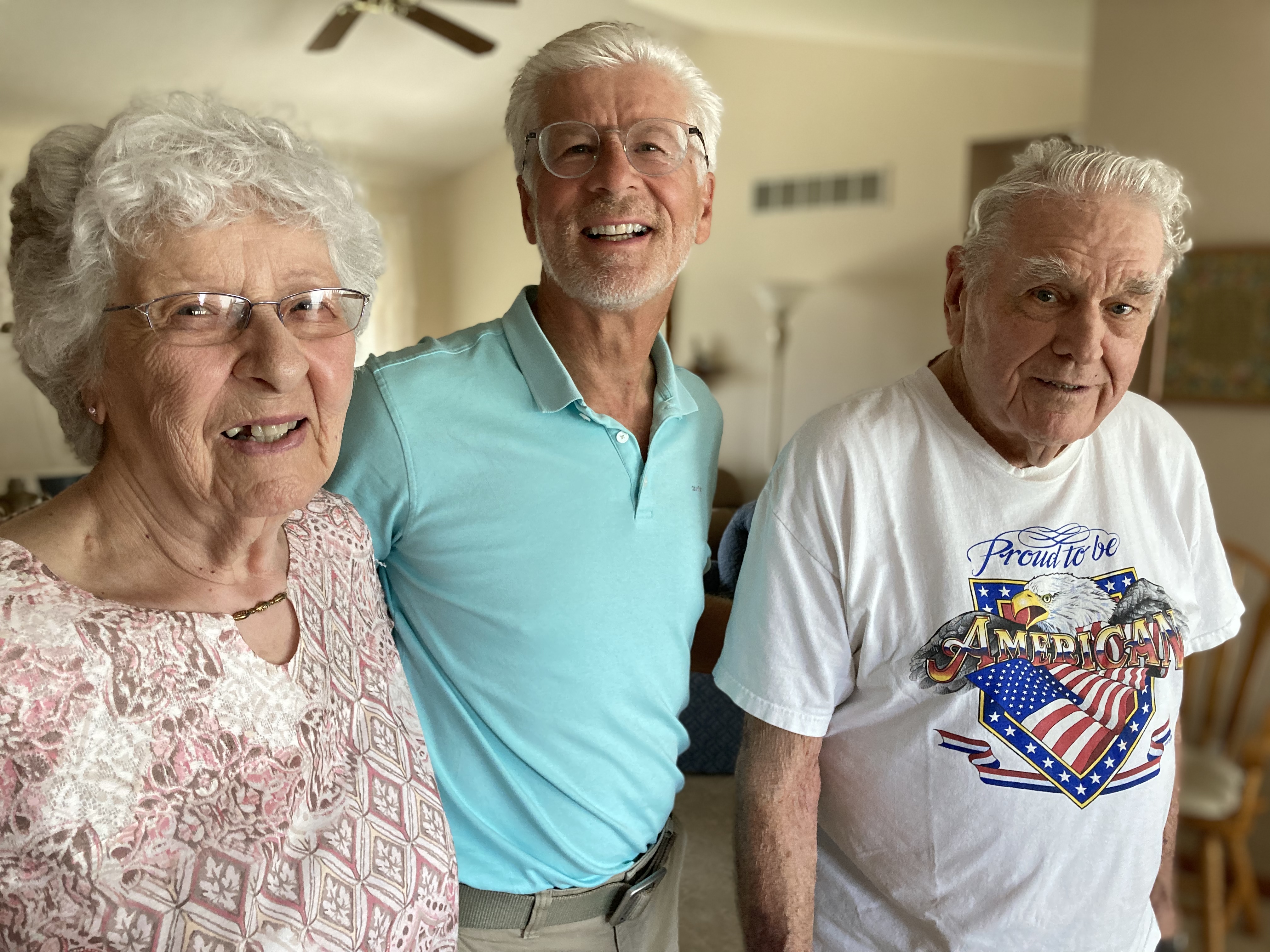
Me in the middle, with Janet and Bill in 2021.

When my grandmother died in 1979, I drove my young wife and one-month old son from our home in Nashville, TN to the funeral in Wisconsin. Grandma was young enough to have a large funeral, just 72 years old. My age.

Of course, in Rio, WI, population 788, funerals were as big a social event as Friday night football at the field in Fireman’s Park. I didn’t play football. I ran cross country instead, which I convinced myself was harder.

But I was at the football games, either running the sideline keeping stats, or in the stands playing “CHARGE” on my trombone.

After grandma’s funeral service at Redeemer Lutheran, one of six churches in town – equal to the number of bars – everyone gathered in the church basement for a lunch prepared by women of the church. Because the meal was free, and there wasn’t much else happening in town that day, the room was crowded.

My wife was most concerned with the one-month old son not accustomed to the noise and crowd and whose only real concern was keeping his tummy full and his diaper dry. So, he started fussing and wailing and that’s not the sound you want to hear piercing the din of chattery family members chowing down on store bought dinner rolls filled with a slice of ham and a slab of butter, potato salad and red Jell-O with marshmallows.

Suddenly, from across the entire fellowship hall, packed hip to hip at the folding tables, my aunt Janet yelled, “Give that boy some titty!”

Now, in another context other than a rural Wisconsin farming community, that comment might have seemed out of place, even impolite. Certainly it caused all the blood in my wife’s body to flush to her toes and then recongregate in her face, making her flush a brighter red than the Rio High School Vikings mascot. But, it also gave her the freedom to excuse herself, find a quiet Sunday School classroom, and take care of our son’s immediate need.

Aunt Janet died this week, at age 91. She was my mother’s last surviving sibling and mom preceded her in death by 29 years. They were two of eight siblings, prompting my grandpa McFarlane to say he had “Two and a half-dozen children.” When grandma McFarlane died, petty sibling grievances broke familial bonds and later on, as one sibling after another died, obituaries did not list all surviving family members, as if they never existed.

But Aunt Janet was always a friend, in part due to the loquacious character of her husband, Bill, a former police officer and much longer a seed corn salesman who knew every farmer and what they needed most. Bill preceded her in death by three years.

I confess Janet’s was the first bare breast I ever saw, as I stood wide-eyed at age five while she fed her first born son, Mark, a man who grew up to be a Presbyterian pastor, nurtured as he was on the milk of human kindness. He could preach from I Peter 2, “Like newborn babies, crave pure spiritual milk, so that by it you may grow up in your salvation.”

Janet and Bill had five children and 10 grandchildren and money never flowed like water over Niagara. Janet always put her hand to the wheel to find additional resources, driving school bus for more than two decades and making wedding cakes for lucky brides and grooms.

She looked at driving bus as ministry, taking the opportunity to offer a bright, encouraging word to children with dour faces, lifting heavy, reluctant feet up the step on the way to school.

She was certain of opinion and ready with advice.

When Janet learned my cousin Allen smoked, she asked if he would rather kiss a girl or an ashtray. Allen, sarcastically defending his nasty habit, told me he responded “Ashtray.” He’s since grown beyond that – both in girls and habit.

 Janet and Bill built a house on a hill overlooking that of her mother Eva and she was diligent in looking after her mother to the end. Eva –my grandmother on my mother’s side – expressed concern that bad weather would limit the size of her funeral. She was mentally comparing her eventual celebration to the big crowd that showed up for her husband’s sendoff. In her mind, her funeral would suffer by comparison and somehow that would reflect negatively on her life.

Though such comparison is a false equivalency, if every person whose life Janet affected positively were to attend her funeral, ushers will need to bring in extra chairs.

Carting away your history

Strangers carted away my friend’s history yesterday, piece by piece.

An auctioneer’s singsong cajoling held Dave’s life up for examination and bid. Chains, tractors, implements, house furniture, fuel tanks, rakes and hoes all appraised unemotionally for their “value” by area farmers hoping to find a deal, make a steal.

Dave’s farm, eight curvy, hilly miles from any main road, looked like a Ford dealership, as 120 trucks – at least 100 of them Ford F150s, 250s and 350s – parked nose first along the edge of the cornfield like piglets nursing. Amish neighbors in their round straw hats parked their buggies in the yard, and tied their horses to a shade tree. An early morning deluge left the grounds muddy but didn’t discourage potential buyers from picking at the accumulated instruments of Dave’s farming life.

Dave is in the second year of an ALS diagnosis and at age 72 he’d decided to sell the farm where he’d lived 46 years, raising his three children in a Trumanesque environment in rural Pennsylvania.

He is slowly losing muscle strength everywhere but in his smile.

When major items like his John Deere tractors didn’t sell for what he’d hoped, he shrugged and said, “Let’em go.” Trying to sell them on the open market later, hoping for a more equitable price, was just too much trouble to contemplate.

Dave and his dad built the house atop the hill, where his wife huddled now with a long-time neighbor to avoid seeing four decades of her life picked over, devalued and carted away. The house wasn’t quite finished in time for their first child to come home to it from the hospital. But it was finished two weeks later and she’s lived there ever since.

Dave decided to sell the house, barns and 45 acres on which he’d lived his entire adult life so that Debbie wouldn’t have to…later. Once decided, his second son, Mark, drove him through the rural neighborhood to pass out flyers announcing the sale. They left fliers with neighbors who Mark knew did not have the means as potential buyers, but he eventually realized he was driving his father around on a farewell tour.

“He just wanted to say goodbye to the neighbors he’d known for 45 years,” Mark said. When Mark realized that, he settled in and enjoyed the ritual.

The man who’d purchased the farm was present at the auction. He’d bought it for his daughter and son-in-law as a place to raise their children, in rural Pennsylvania, giving them the benefit of idyllic life in rolling hills, among Amish farmers, an area where church and school are the gravitational centers of community life.

Dave’s adult children and their spouses were present and helping. Grandchildren roamed through the barns for the last time, daringly climbing steep ladders to where hay once was stacked high, making sure that mom and dad saw their accomplishment. Dave’s sons recounted adventures with tractors, camping in the woods, trapping ground hogs and shooting that would make their survival a mystery.

This was their home being carted away on the backs of trucks and trailers. They weren’t sad – yet. The hard decision had already been made – to sell the farm and auction off the equipment. This was just the physical manifestation of their decision.

But, when the last cabinet was pushed into the back of a minivan; and the last tractor was loaded onto a flatbed; when the camper the grandkids slept in the night before rolled away behind a pickup, the somber reality settled over the property like an early morning fog settles into valleys.

I hugged each goodbye, Dave’s arms limp at his sides, and thanked them for including me in their family. Through thick and thin, good times or bad, through the struggles inevitably ahead, he’s my brother and the auction was another milestone toward “next.”

One is the loneliest number

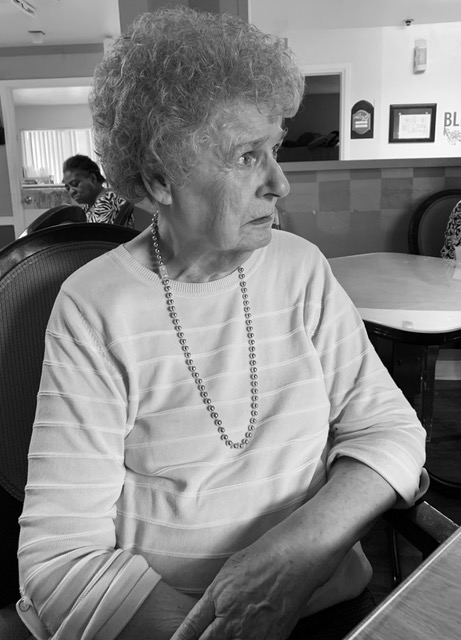
My mother-in-law, during last days in nursing care.

In August 1971 anonymous government functionaries conducted a lottery to determine the order in which 19-year-old boys would be drafted into the Army, thousands of them eventually to die in the politicians’ war in Viet Nam.

They drew my birthday first. No. 1. It was the only thing I’ve ever “won” except a case of beer at the Rio Fireman’s Picnic, and the hand of my wife. I was too young to claim the beer, and my wife was almost too young to marry.

From that day on, the musical hit “One” by Three Dog Night became the soundtrack of my life as I went off to college, hoping to get a semester in before I received my draft notice. It’s resounding assertion that “One is the loneliest number that you’ll ever do,” pounded time after time out of my reel-to-reel tape player, putting to music the angst of a life on hold.

“One is the loneliest number that you’ll ever do…

“It’s just no good anymore since you went away

“Now I spend my time just making rhymes of yesterday.”

Then the resounding, pounding refrain:

“One is the loneliest number

“One is the loneliest number

“One is the loneliest number that you’ll ever do.”

Every time that song surfaced on the radio or in sequence on my Three Dog Night album, I sank emotionally. No. 1 in the lottery. Draft certain. One is the loneliest number. The saddest experience.

Thoughts of “one” and being alone jumped at me recently while I stood in line for a table at southeastern America’s food oasis, Cracker Barrel. It hit me when the hostess asked the lady ahead of me, “How many?” and she responded, “One.” The loneliest number.

A sudden sadness for her and others being alone hit me like a gut punch through a curtain of memory.

One is the loneliest number that you’ll ever do.  And it’s a growing trend in America. We’re in an epidemic of loneliness. It’s not just aging widows and widowers. It’s younger people isolated by screens who possess no ability to communicate with real, live people.

Lacking meaningful, human to human connection can increase the risk for premature death to levels comparable to smoking 15 cigarettes a day, according to an advisory from U.S. Surgeon General Vivek Murthy.

We once called on a young man who visited our church to encourage him to become involved. He said he walks into his apartment on Friday night after work and doesn’t leave it until Monday morning. Week after week. Crawling out to visit the single adult class we led was a major effort.

The prevalence of single-person households is unprecedented historically,  rising from seven million to 38 million since 1960. 

I don’t equate “being alone” with loneliness or depression, but community involvement and social interaction is the leading indicator for health in senior adults. Of course many single adults lead vigorous, joyful, involved lives and God bless them.

It’s just that as I approach my 48th wedding anniversary I know the deep satisfaction life with a loving partner brings. I think of the shared joys, sorrows and triumphs of raising our three children, and of their loving spouses and our seven grandchildren. I would wish that common good for anyone.

Beyond that, what are the implications for a society in which so many of its members live as single, unaffiliated, isolated souls? Think – as I’m sure they are – of long term health, housing, community, end of life?

And yet, one out of four of today’s 50-year-olds will have been single their whole lives. Never married, never partnered.

Social isolation is associated with a higher risk of dementia and other serious health problems in older adults — while having positive social relationships can help people live longer, healthier lives.

In other parts of the world, nearly four in ten older adults live with extended family, an arrangement that mitigates aloneness. But older adults in the U.S. rarely live with family. 

Our culture almost demands we go it alone, that we not “need” anyone or anything. Yet that is not the preferred condition of most single adults I know.

And when the person ahead of me is asked, “How many?” her “One,” sounds like the saddest experience she’ll ever do.

“I never thought about it”

Much of the remodeling and landscape work on my son’s renovation of a 200-year-old house and barn in Pennsylvania is being done by Amish. Their work is exemplary, consistent and dependable.

Amish settled in southeastern Pennsylvania in the 1720s, leaving behind in Europe the persecution of their “strange” and separatist beliefs. Amish emphasize humility, family, community and separation from the non-Amish world, which includes a reluctance to adopt modern conveniences such as cars and electricity.

The Pennsylvania Amish community in Lancaster County is the largest in the United States, numbering about 30,000, double its size of 20 years ago. They’re distinctive for their simple dress, beards, bonnets and horse drawn buggies.

We wanted to give visiting relatives an authentic Amish experience, without being “ugly Americans” who gawk or get our legs caught in tourist traps that exploit this set apart people. So, who better to ask for advice than Aaron, a white bearded, retired farmer now working for his son’s landscaping company on our project.

To my delight, Aaron suggested simply that if we wanted to experience Amish life in Lancaster County, “Come to my farm. I’ll show you around.” We made a date two weeks hence.

I texted a couple days before the appointment and was concerned that I didn’t hear back. But on a beautiful fall afternoon we pulled into his manicured yard and Aaron and Barbie, his wife of 40 years, appeared immediately. Since they hadn’t heard from me, they wondered if we were coming.

I mentioned the text I sent earlier. Then we both laughed. Their telephone is in a building separate from the house, to be used for business purposes only, and of course, is not mobile.

We took seats in their recently constructed house, modern and perfect in every way except that there are no electrical outlets, nor lamps, nor counter appliances, nor overhead lights. Designed to let in lots of sunlight, a propane tank on wheels with a filament bulb on a tall rod provided light when darkness falls.

A propane powered refrigerator graced the kitchen. While electricity is considered a convenience too worldly, workarounds with generators for power are apparent in the barns. Rules and restrictions governing humility and simplicity vary by area bishop.

We asked Aaron why farm implements roll on bare steel wheels, with no rubber tires. He said it’s a bishop’s rule to keep people from going fast.

Daily life is guided by simplicity and a pace slow enough to appreciate the smell of freshly turned earth or cut grass or a grandson’s grasp of your leg as you walk the fields together. No doubt outsiders romanticize these things about Amish life, but the truth is starker. Anyone dependent on modern conveniences woven so completely and unconsciously into daily life that we don’t even realize our dependence, would find it very difficult to shed them in favor of a slower, harder, more deliberate life.

For that reason, Aaron said, they do not encourage people not born into the Amish community to “convert” to their faith and culture.

As a young sharecropper, my grandfather walked behind a mule pulling a plow. But when he gained access to a tractor, he embraced the innovation and convenience wholeheartedly. Amish farmers are content with their mules. Whether tractors, telephones, automobiles or microwave ovens, they recognize that innovations do not necessarily contribute to a better, fuller, deeper life.

Sitting together in a comfortable living room, a Bible and reading glasses atop a small table by their chairs, we asked this 62-year-old couple if they were granted permission to embrace any single modern convenience – the kind of utility they see every day as they live among “outsiders” – what might it be?

Silence.

After a while I suggested to Barbie that I thought she might say “electricity.” She smiled meekly and said, “I considered that.” When pressed for his answer, Aaron said, “I’ve never thought about it.”

Whoa.

Aaron farmed 50 acres with mules, raised eight children, six of whom have 33 children, raises dogs and tobacco for extra income, gave the farm to a son and now works another son’s landscaping business, is a stalwart in church and community, and he’s never thought about what mechanical, transportation, electrical, communication tool available to others he might like for himself?

All the while he lives among outsiders who think camping out overnight to be first in line for a new phone model is logical and that instant gratification is too slow. We’re bombarded by constant messages that we will be happier if we grasp, strive and reach for the next purchase, entertainment, or experience that will somehow endow us with the satisfaction Aaron has just by living a simple life in a caring community of like-minded folks.

“Content” is the only word to describe a man whose lifestyle barricades him against the onslaught of television and social media, who has never thought about embracing modern conveniences. He is content and committed to a way of life that is set apart, not conforming to the world. Romans 12:2 He evidently thinks about such things no more than a fish considers water.

Few modern Christians are consciously set apart from the world. Our most significant symbol – the cross – has been so co-opted and adulterated that it no longer retains significance as a Christian symbol.

Maybe that’s why we admire the simple, quiet, slow – contented – pace of Amish life.

Before I met Aaron, I’d never thought about it.

And the angels sang

(To read the prologue of this story, click here)

The snow outside church portended a brutal night and I watched the parking lot as much as I watched the costumed kids preparing for their role in the Christmas pageant. I expected the arrival of a new helper who was racing south from Colorado ahead of a blizzard.

She was a helper whose arrival I anticipated with mixed emotions.

I had been a volunteer at Templo Bautista in Espanola, NM for two months. Recently discharged from the Army as one of America’s last draftees, I’d gone there to exercise my faith with the goal of making a difference in an environment foreign to me, a Midwestern Scandinavian who grew up in Truman’s World.

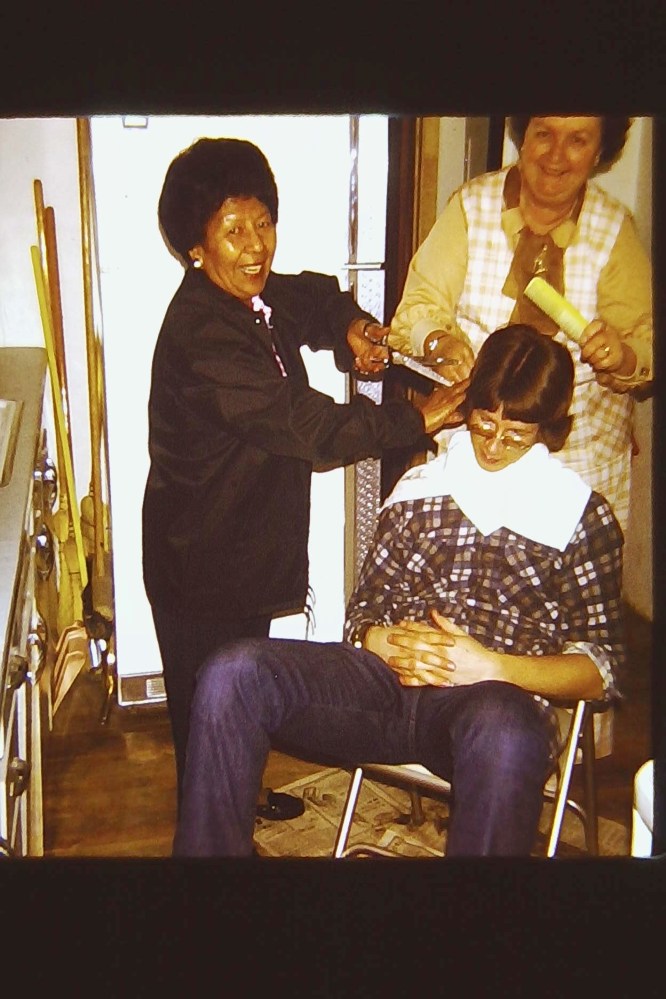
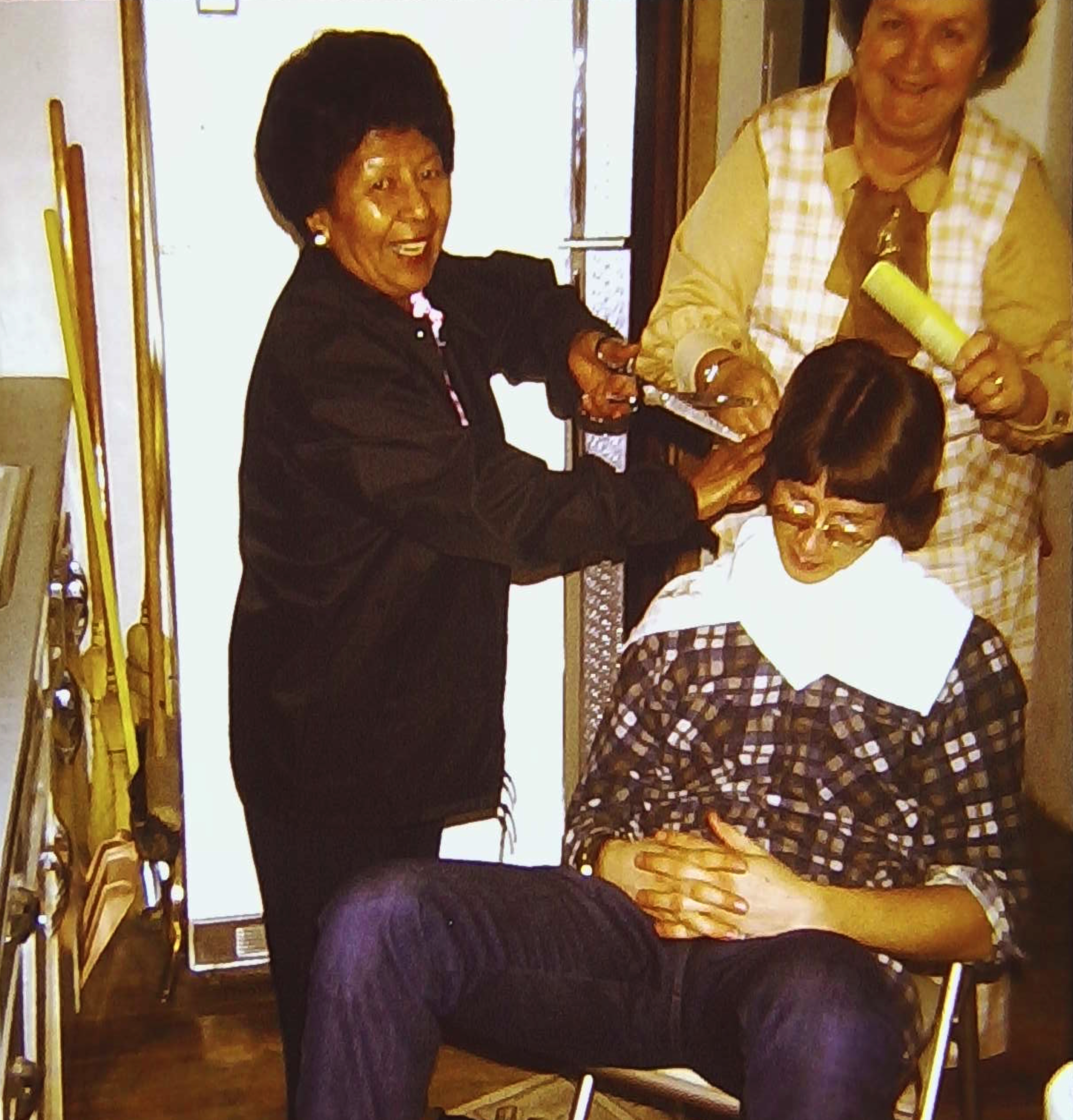
Is it any wonder I wanted no intruders? Teresita Naranjo, left, recognized as the No. 2 potter in all of New Mexico, cut my hair with Mrs. Abbott.

Mrs. John Abbott – never Ethel – carried on the work at Templo that she and her husband started decades earlier. But John had been killed in a farming accident and Mrs. Abbott told God she could only carry on as God would send help.

Enter me.

I was the first long term helper and became bus driver, Sunday School teacher, wood splitter, phone tree operator, youth director, visitation director and encourager. Life was good. Mrs. Abbott treated me like a son, fed me like a king and taught me like Socrates.

Two months later I returned to the church I attended in Colorado Springs to tell my crowd what was happening in Espanola, and to raise a few bucks to buy Christmas gifts for the kids there. In that crowd was the daughter of a man I knew well. She had just left college and was at loose ends, struggling to discern a broader, greater plan for her life.

My heartfelt appeal and enthusiasm for life at Templo Bautista struck a chord in her heart and she wanted to pray with me about the possibility of coming to help. The last thing I wanted was an intruder to dilute my lone role as Golden Child in Mrs. Abbott’s realm.

But, we prayed and this girl and I had the unmitigated gall, the brazen audacity, the cocksure brass to demand the creator of the universe provide a clearly discernible answer within seven days.

I returned to Espanola with some cash for gifts and a secret. I didn’t want my apple cart upset. I wasn’t going to stand in God’s way, but I wasn’t going to feed him an easy assist, either.

So I waited several days before telling Mrs. Abbott about Sue Ellen Carver’s interest in coming to help. I figured Mrs. Abbott would take a couple days to  pray, to cogitate and consider. By then, the seven-day deadline would be passed and I’d be home free. So, at breakfast on the sixth day, I mentioned casually that Bob Carver’s daughter, Sue Ellen, was interested in coming to Templo to help.

“Bob Carver’s daughter?” she asked. Bob had been to Templo many times on weekend work trips and was a member of a very supportive church.

And yet, who could blame me for my resistance fading?

I nodded, smug in my manipulation of the calendar. To my dismay, Mrs. Abbott reached for the phone, asked me for Sue Ellen’s number, called it and said, “Come on.”

“OK,” I thought. “It’s a couple weeks before Christmas, and she’ll have to give notice at her job and make arrangements and well, maybe I’ve got three to four weeks before the invasion.

Instead, within three days she was on the road, racing a winter storm south from Colorado to New Mexico, sliding into the median, using every ounce of knowledge her dad gave her about rocking the car to get out of a drift, crossing Raton Pass just before it was closed and arriving at Templo Bautista just as the shepherds and angels were marching through the hallway to line up for their part in announcing good news to a waiting world.

She arrived covered in frost with a smile that would melt many a heart just as the kids were shuffling down the hallway to the stage. It was a Christmas pageant scene so perfect that it would have embarrassed even Hallmark.

Over the following months, we worked daily together. Eventually, of course, I began to see Sue Ellen far less as a nuisance and far more as someone I wanted to know on a far more personal level. Sure, she was the only green-eyed blonde in Sante Fe County, but just as attractive was her indomitable, loving spirit that pitched in enthusiastically to every task and made every person who crossed her path feel like they’ve been heard, seen and loved.

Whatever it was, we left Espanola heading in different directions and had only occasional, long distance conversation until in October the following year, she came to Oklahoma Baptist University to visit her sister and we reconnected. We talked for hours – much to the dismay of her sister, who felt neglected. We talked of our own perspectives of the future, who we were and who we wanted to be, never really talking about that future together.

Yet, when I returned to my apartment after seeing her off to the airport, I knew. The next morning I called her dad and said “I want to marry your daughter.” To which he replied, “Which one?” He had four and he had no clue Sue Ellen and I had been talking.

One month later we returned to Espanola for the first time – to plan our wedding, which took place one month after that.

I’ve made a lot of decisions in my life, but none were better than that one 47 years ago.

Fateful day half-century in the making

Sept. 13.

Fifty years ago today my dad wrapped his arms around me and said out loud for the first time I can recall, “I love you.” Then I turned toward the bus idling there to take me to Milwaukee where I was inducted into the U.S. Army.

With a draft lottery number of one, received a year earlier, this day was inevitable. But it arrived under a dark cloud of dread that wouldn’t lift for months.

I never doubted my dad loved me. I never asked myself if he did. I never wondered, pondered, considered, weighed or suspected his love. He showed me in many, non-verbal ways: working hard to provide for his family, being present, shooting baskets with me, including me with tasks we could do together, assigning me responsibilities like cleaning the barn or splitting the wood for our farmhouse furnace, then bragging about me to his friends when I worked beyond his expectations.

Primarily, my assurance of dad’s love and my subconscious security in my household growing up was how he loved my mother. Our dinner time was consistently 5:30, but no one sat down until dad arrived home from his gas route. He drove a fuel truck that serviced farmers in a four-county area, but he consistently arranged his days and route to be home for dinner on time.

Then mom would meet him at the door and the kids would have to sit at the table, waiting while they hugged and kissed and got all sloppy in the doorway.

Dad never fully grasped the implications of my lottery number. It didn’t penetrate his consciousness that radio announcing my birthday as No. 1 had changed the trajectory of my life. Nor did he comprehend my heart when I petitioned for and received status as a conscientious objector, willing to serve in the military, but not willing to bear arms.

To my surprise and delight, my basic training platoon at Fort Sam Houston consisted entirely of conscientious objectors of my same persuasion. We were all to be trained as medics. Logic was, I guess, if we weren’t going to carry a gun, we should run around with a target on our backs.

Religious belief was the overwhelming rationale for conscientious objection in my platoon. And not all represented religions were Christian. Consequently, our discussions were invigorating and affirming. Our attitudes were positive and our nascent friendships sincere.

Then, we graduated from basic. And our 40 men were divided among 10 other platoons of men who had just finished basic training that included weapons, and an indoctrination of “enemies” versus the right and righteous arm of the United States.

Suddenly, barracks were bellicose. An undercurrent of distrust and tensions ran through the room where long rows of bunks ran down both sides of the room, with lockers in the middle and footlockers at the end of each bunk. You never wanted to leave either open or unlocked.

One day I hung a pair of clean underwear on the hook while I showered. When I got out, mine had been taken and replaced by someone’s dirty underwear.

Discussions were not harmonious, but usually disintegrated into offensive and defensive positions on issues, especially religious and political. The most hard core guys could not wait to get to Viet Nam and “kill some Charlie Cong.”

Such was the atmosphere that debilitated my spirit one night when I walked to the bank of phones to call my dad for a word of encouragement. I know he loved me. But he still didn’t understand.

Depressed, I was walking back to the barracks to face another miserable night when my path took me past a base chapel. It was brightly lit and happy sounds were coming from it. I walked in. Why not?

There was a youth group on the platform getting ready to perform a musical. And I found a couple of my buddies from basic training there. After the musical, the youth offered to come pick up any soldiers who wanted to attend their church on Sunday.

Pretty girls populated the platform. I eventually dated one. My buddy Steve ended up marrying her sister.

Events of that night, and that group from Baptist Temple in San Antonio, opened the portal to the rest of my life which included a career among Baptists in communications, and marrying a girl I met at a Baptist church in my next station.

Fifty years ago. Today. As I’ve said many times since, it’s not something I wanted, nor would ever want to do again. But my life was set on course by having done it once.

The Abbotts defined dedication, and I got to play

John earned the shrapnel lodged in his legs, making them ache when the weather changed, when he labored in the fields. When he remembered.

As a battlefield chaplain during World War II, John Abbot worked among wounded and dying American soldiers in Europe fighting the scourge of Nazism. His was an active faith. He believed he incarnated Jesus as he walked, crawled and bled among soldiers who needed assurance that God loved them and that their destiny was assured.

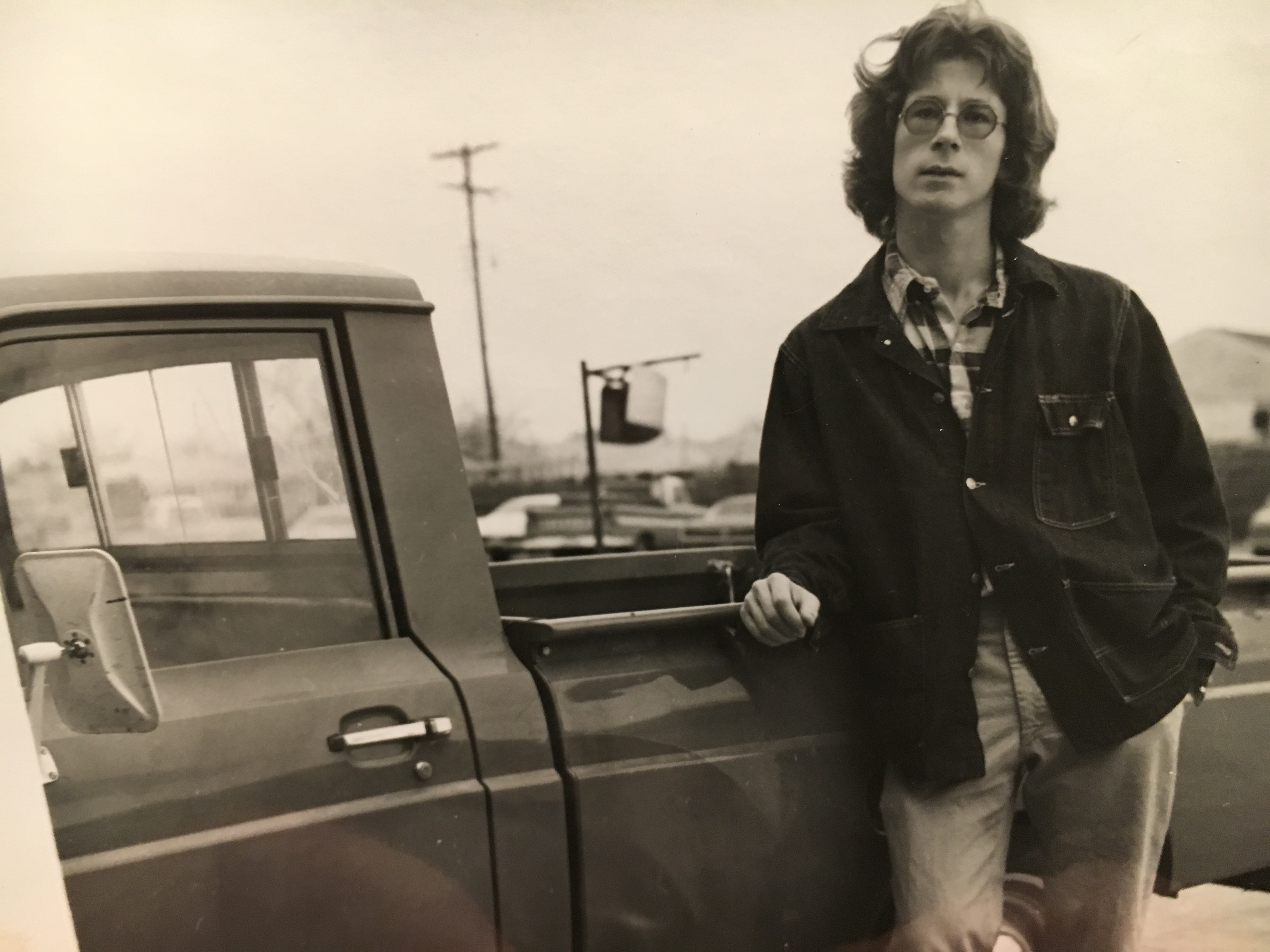
Author as jack of all trades in Espanola, after the Army, before finishing college.

When he returned from the blood-soaked fields of Europe and as America shifted gears to embrace a new, wide open world of possibility, John applied to Southern Baptists’ missionary support agency responsible for “home” missions – or missions within the continental United States. He wanted to be a missionary in his native southwest, serving people, showing them the way of Jesus and leading them to faith.

He was a committed churchman in that denomination and after his service as a chaplain in the military, he assumed that he would be approved for support so he could turn his attention to the purposes of that agency: winning people to faith in Jesus.

Instead, he was denied support because he was deemed medically unsound, due to the shrapnel in his body, lodged there in battle. Disappointed, but undaunted and illuminated by his own vision, John secured support from some Texas Baptist churches where he was known. He bought farm equipment and set up shop in a converted dance hall in Espanola, New Mexico, a small town 25 miles north of Santé Fe.

The dance hall occupied a strategic corner on the main road between Espanola and Chimayo, a tiny town that houses one of only two places on earth that claim to contain healing elements. It’s the dirt in Chimayo, and the waters in Lourdes, France, to which pilgrims crawl. Discarded crutches, canes and bandages testify to the healing properties of the dirt in the Santuario de Chimayo. People have crawled from Santé Fe to Chimayo to do penance before applying the dirt to their injury or illness.

On the north side of the windy, two-lane road between the two towns perched a wooden church, little larger than a garden shed. It was the focal point of religious Penitentes, who marched in a single line, flagellating themselves, seeking forgiveness.

In that environment, John remodeled the dance hall into a church, office, classrooms and an apartment for him and his wife, Ethel, and he utilized the equipment to open doors among the small farmers in the dusty arroyos between Espanola and Chimayo. They could not afford individually field prep and harvest equipment that would increase their yields, and they welcomed the method and message of John Abbott to work among them, to share the work and to share his faith.

With hard work, ingenuity, faith and commitment, John and Ethel started and built a church which membership was primarily Spanish, descendants of Spanish invaders of the 16th century and Native American tribes.  They called it Templo Bautista – Baptist Temple.

Then one day in one of those freak accidents that make Christians wonder if God is paying attention, a piece of equipment that John was working under fell off its jack and crushed him. I guess he was medically unsound after all.

Ethel was suddenly a widow. Much of her livelihood disappeared because she could not run the equipment. John was the pastor, breadwinner, husband, visionary, guide, energy behind the entire effort. I don’t know how old Ethel was. She always seemed old to me, but I was just 20 when I met her. I’m sure I’m older now than she was then.

She promised God she would stay at Templo, would continue the work, if God would send her help. Because of her winsome spirit and compelling stories, Ethel received a fairly regular trickle of weekend or week-long helpers to lead special events and do repair work around the ancient facility. But she needed an everyday helper.

Her prayer and mine – what to do now that I’m getting out of the Army – clanged together in God’s ear and I became that first long-term helper. I was a pale, nerdy Scandihoovian from Wisconsin, knew zero Spanish and was new in evangelical faith. I’d been drafted into the Army after one year at Luther College and now I was out and at loose ends.

I started in November 1973 as a bus driver, youth minister, preacher, log splitter, painter, floor sander, week-night Bible study leader, and encourager. We called many of our members on Sunday morning to wake them in time to catch the bus I drove.

I brought them to church, preached at them and hauled them home. All this was done with sincere, naive spirit and within a profoundly knit community. The names “Ethel” or “John Abbot” opened any door in the county quicker than an electronic key.

I realize now the way we did church was paternalistic. We expected and required too little of members. There was an easy believe-ism in which membership at Templo eased seamlessly into whatever other influences they were weighing. Part of our motivation with activities was to “keep the kids out of trouble.”

But we slogged on. I went back to my home church in Colorado Springs to tell them of the work in New Mexico, and to raise money for Christmas goody baskets for the kids. One young lady was struck by the need, by the opportunity and by my wistful pleas. A few weeks later she arrived as a second helper, in the midst of a snow storm, as the children were trekking down the hallway in their angel and wise men costumes to present the Christmas story.

Her arrival on that snowy night declared that what I’d thought to be the first chapter of this story was merely prologue.

(First chapter to come)

Re-entry after a week of RAGBRAI

It probably started when I forgot to flush. 

Then, my wife looked baffled when I drank a beer at 10 a.m. She was downright befuddled when, at 11 a.m., I ate a piece of blueberry pie, and asked at noon if she had any apple pie in the house. 

When I wanted a big, juicy, fried pork chop to eat while standing under a shade tree, she was bewildered, but she finally blew up when I went for ice cream at 1 p.m.

“You’re not on RAGBRAI anymore!” she declared. 

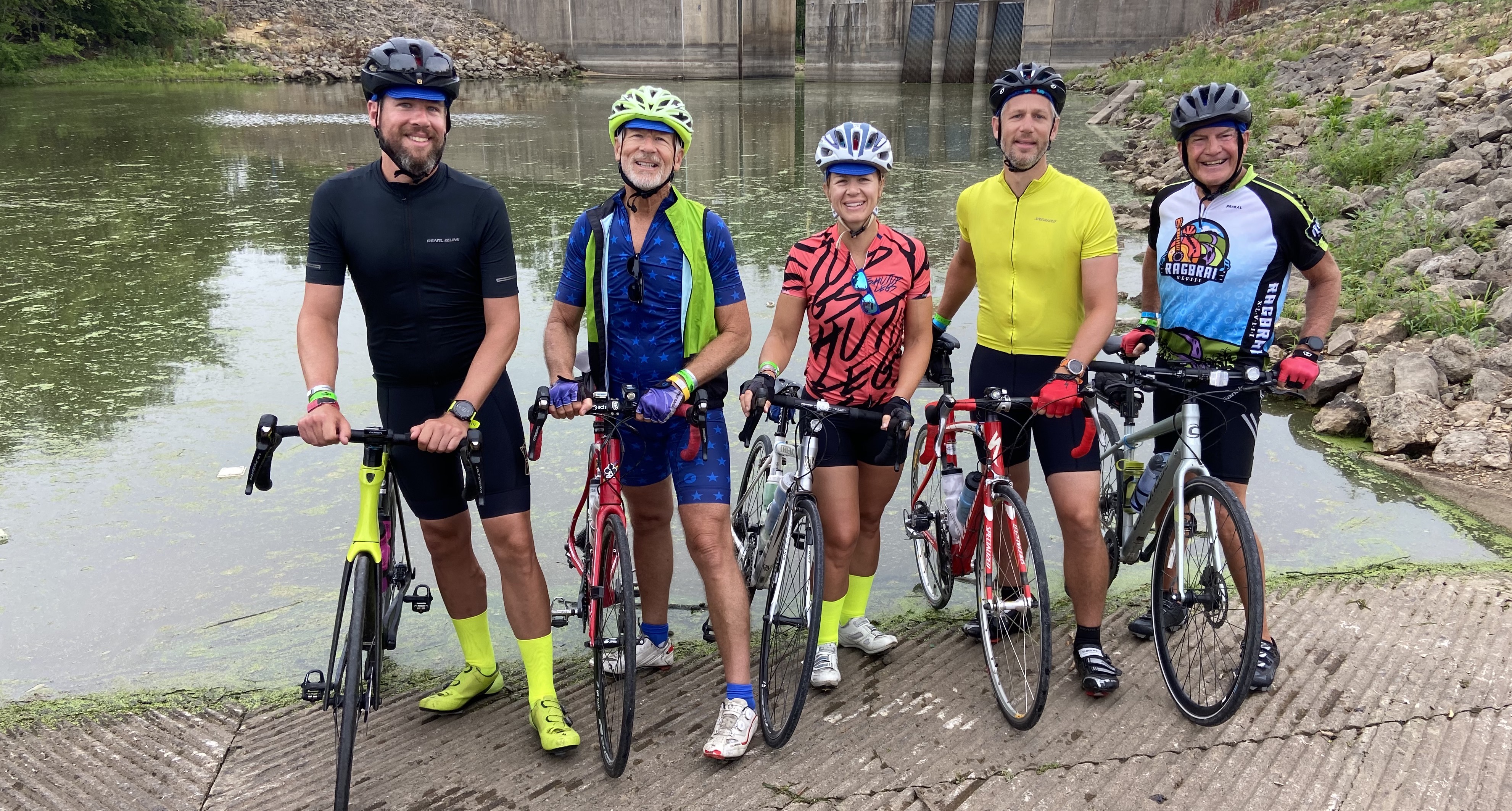
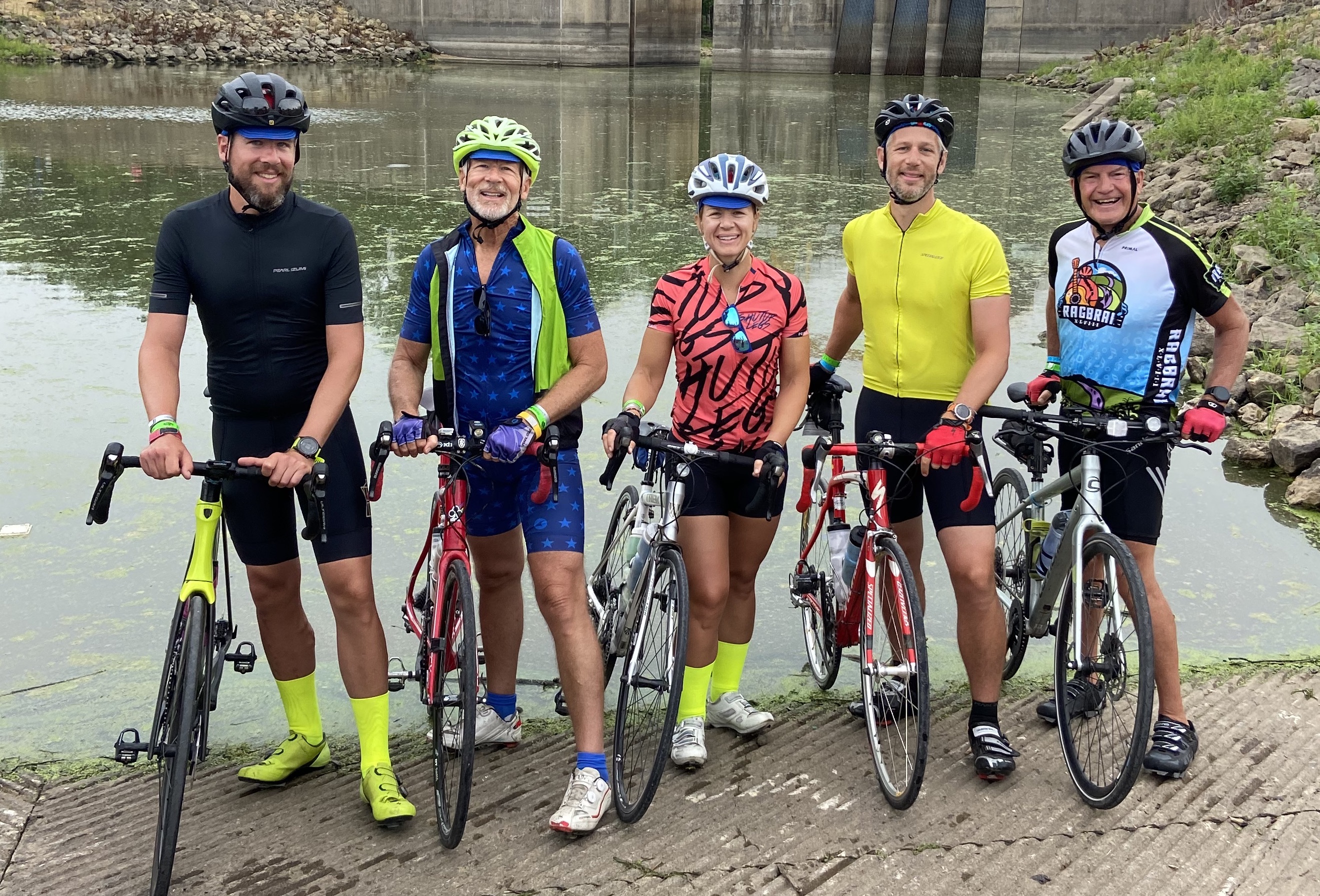
It’s true. Spending a week on my bike with my three adult children and my best buddy from the Army – and 10,000 of our closest friends – riding across Iowa in the oldest, longest and largest group ride in the world does recalibrate my sense of propriety.

Seven days of riding over 470 miles ends with a tire dip in the Mississippi River in Clinton, IA.

I mean, who flushes after using a kybo? (Kybo is the RAGBRAI term for a porta-john, coined by Australians, or, as the acronym that Boy Scouts appropriated for it, Keep Your Bowels Open)

And, a beer by 10 a.m. is appropriate because by then we’ve ridden 40-50 miles and the temperature already is 90 degrees with humidity approaching sauna level.

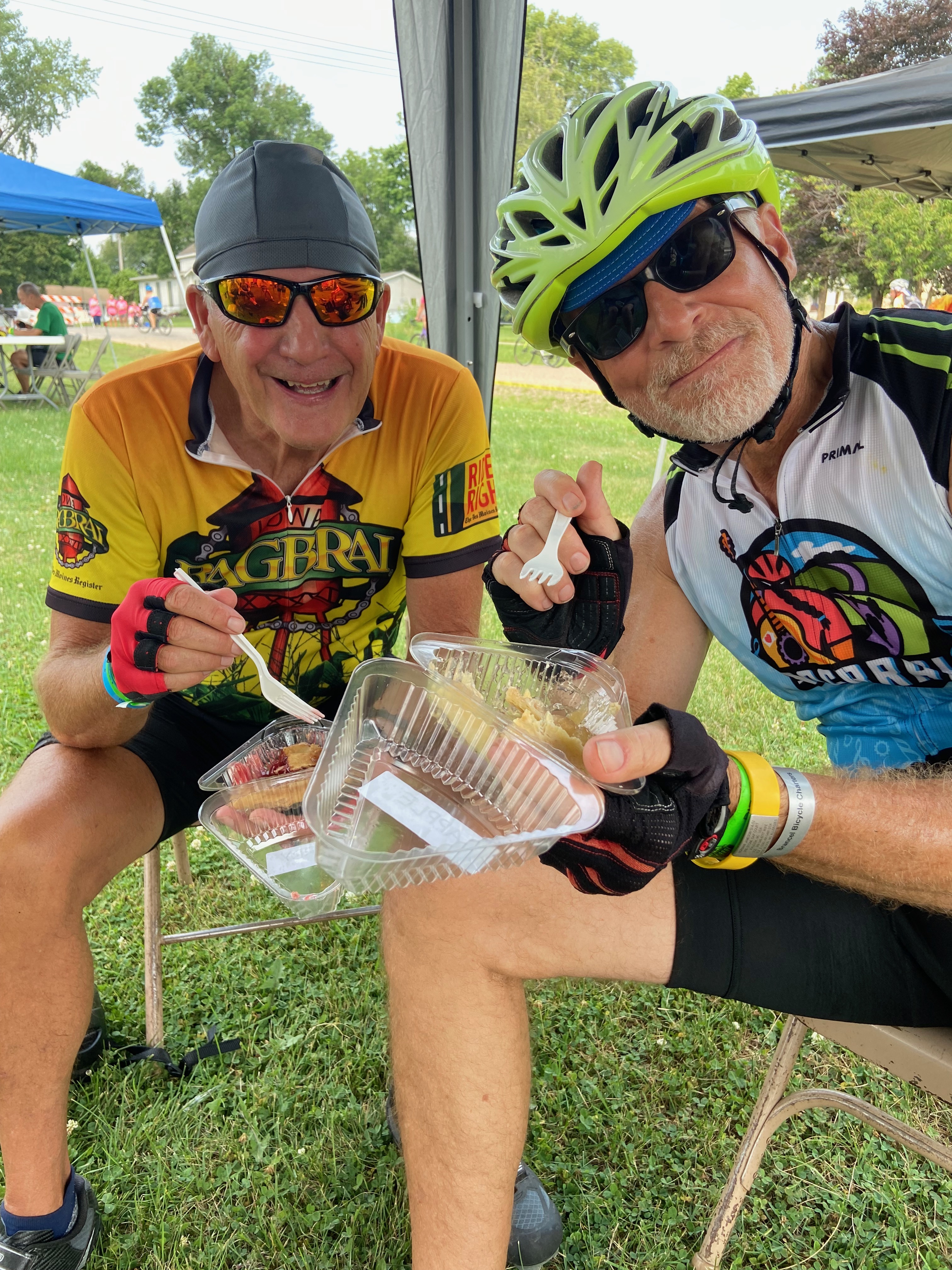
Pie? Pie makes the world go around, and provides the dietary fruit necessary to make kybo visits regular. It seems every church on the route has conscripted their resident grandmothers to make pies to raise money for roofs, mission trips or video equipment. 

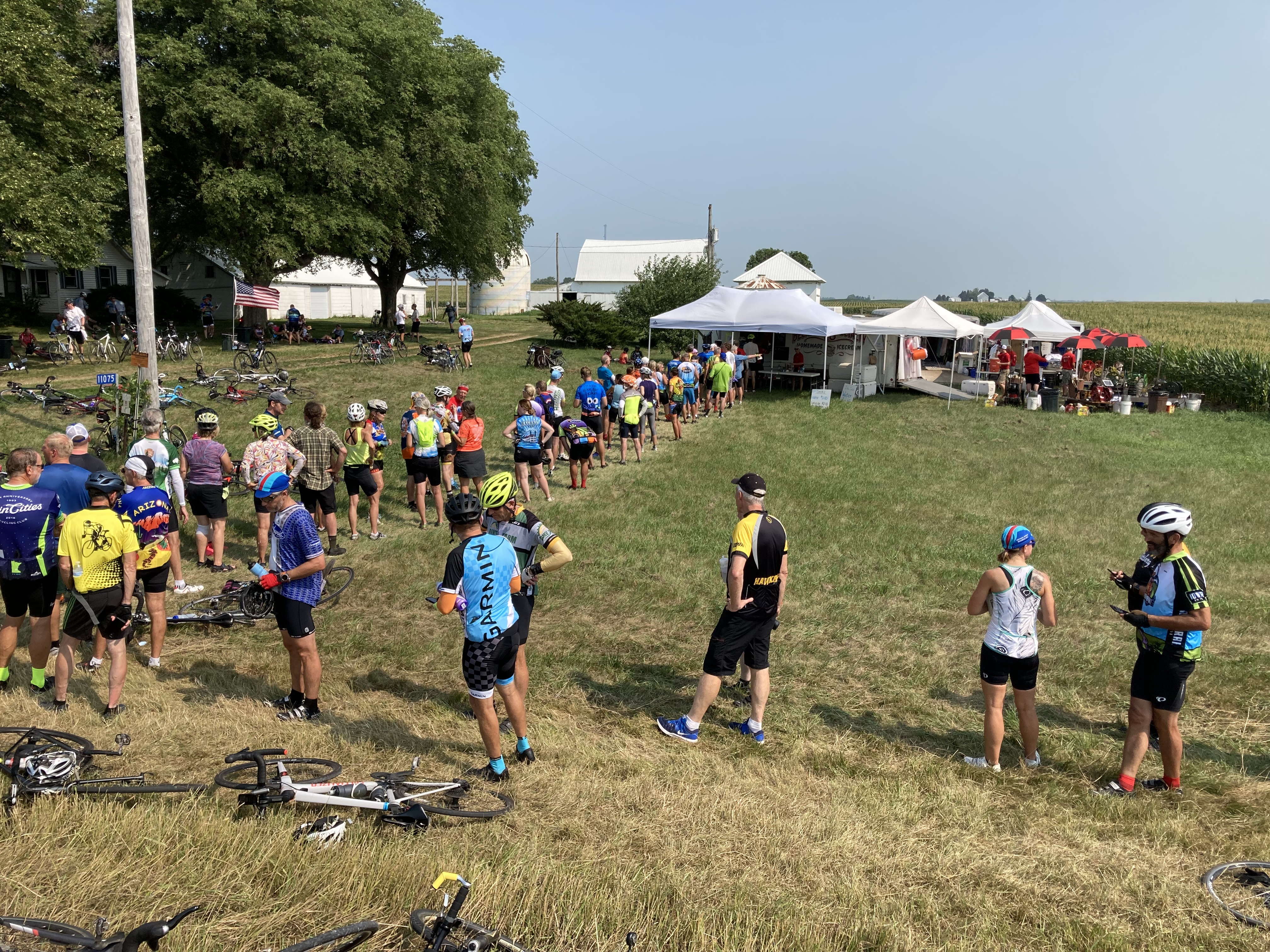
Mr. Pork Chop is one of several food vendors that position themselves each day at a distance from the start appropriate for their particular specialty. You could always find Farm Kids in time for breakfast, and Beekman’s homemade ice cream was near enough to the day’s finish to justify a satisfying stop. 

This was my fourth RAGBRAI and first since 2013. What made it special for me was riding it with my kids, who live in three different states, and my Army buddy, who lives in Nebraska. We covered nearly 500 miles in seven days, starting at the Missouri River in Le Mars on the west side, and riding a serpentine route east to Clinton, where we dipped our tires in the Mississippi River

Beekman’s Speciality ice cream was always a popular afternoon stop.

Iowa possesses its own beauty. The relentless corn fields roll endlessly to either side of us, their golden tassels wafting in the breeze like small waves in open ocean. They also provide handy a kybo experience for those who can’t make it to the next town, given the likelihood of a long waiting line. Just be sure to go at least four rows deep. 

When my daughter yelled, “Keep going, Dad,” another rider at the rest stop sprayed his mouthful of pickle juice all over the grass. Some guys need to go deeper than others. 

Each night thousands of RAGBRAI riders pitched their tents in villages with populations dwarfed by our swarm. It seems every town had railroad tracks on which ran trains whose engineers enjoyed sounding the piercing whistle way too much.  

A couple of nights featured local infantile knuckle draggers screaming past the campgrounds, blowing air horns and shouting some nonsense about what idiots we were and what nasty things we supposedly did to our mothers. But the joke was on them. The trains already made sure we weren’t sleeping, anyway.

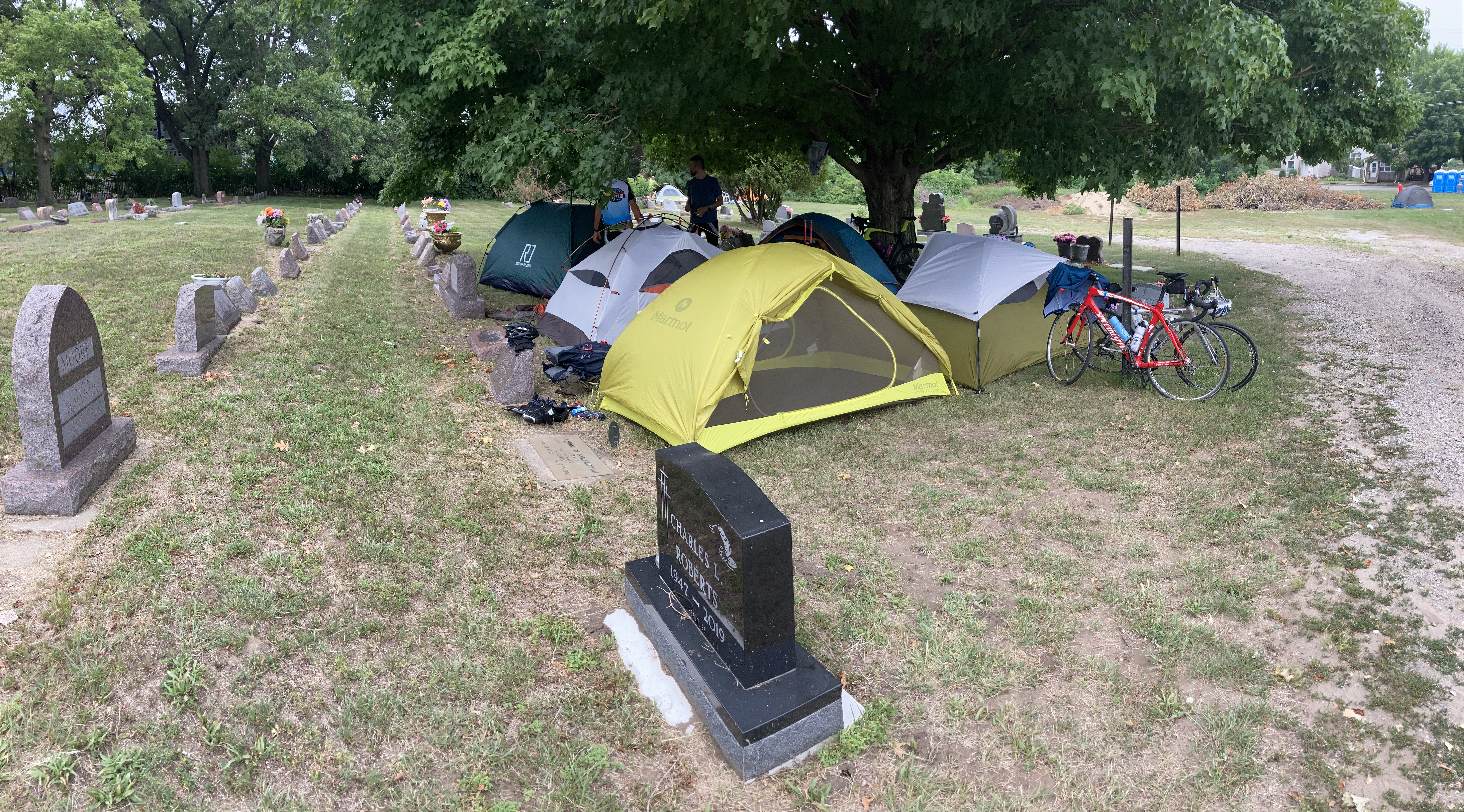
The week was exceptionally hot, in the high 90s every day until the last. One day our campsite was in an open field, just across a gravel drive from a graveyard where a big shade tree held open its arms.

Our little clan erected five tents beneath that tree, in close proximity to graves. The practical temperature in the sun was 106 degrees and it was more like 90 under the shade. We were grateful, and heard no complaints from our immediate neighbors. 

The lone shade in Waterloo turned out to be off limits.

But, someone who didn’t like us there protested to someone they deemed to have authority and that someone asked us kindly to move. We refused. When he asked if we’d prefer to get the police involved, we said, “OK.”

Slinking five minutes later into our shade, while the complainers sat in their car 10 feet away with the air conditioner running, the young policeman obviously hated to hold the conversation we forced him to have. We bantered cordially back and forth about rules, property,trespass, and lease agreements, neither of us convinced of the other’s position.

He pulled out what he thought was his ace in the hole when he asked, “How would you like it if it was YOUR mother or grandmother here and you were camping at their gravesite?”Simultaneously, all five of us said, “They would LOVE it.”

Ultimately, we decided a night in jail – even in an air-conditioned cell – wasn’t worth the hassle, so we moved our tents across the drive, 20 feet. We needed to get cool, so we decided to hitch a ride to an air-conditioned restaurant in Waterloo. After several quizzical looks by drivers who wondered how in the world we thought FIVE people could catch a ride, one lady in a big red pickup stopped. She had just come from the same cemetery where she was visiting with and praying for her recently departed husband, and she was curious about what the hundreds of people and tents were doing there.

When we said we were riding through Iowa and were staying there that night, she said, “Hallelujah, David will have some company tonight.”

It’s all about perspective, isn’t it?

As great a time as I had with my kids and buddy, riding 70 miles a day through several small towns, each of which threw us a party, the highlight came the last day as we navigated the rolling hills approaching Clinton. My team, The Jameson Jockeys, was riding close together and I punched it on a long downhill, tucking in and rolling past my oldest son.

Eastern Iowa on sixth day of riding.

He later told me he saw “an old guy” riding past him down that hill, which was his first surprise. But then he thought, “That guy has a bike like dad’s.” Then he realized, “It IS dad.” And my ride, day and week were made.

This is just the tip of what a week of RAGBRAI is like, not to mention the miles and smiles, temporary friends and cornfields that never end, the heavy heat and rough streets. There is no way to explain it, even to a long-suffering spouse who is doing her best to help me through re-entry into normal life. 

But, she did put her foot down when I programmed the white noise sound track in our bedroom to be a train whistle. 

Moments planted yield the fruit of memories

Members of the Rio, WI high school graduating class of 1971. Not a bald head among them.

Confession up front: before my 50th high school class reunion in June I looked over my year book to reacquaint myself with the names – and cherubic faces – of those from my class who might appear. 

Having delivered our graduates’ speech as valedictorian of our 53-member class five decades earlier, I was asked to “say a few words” on this very convivial night, decades past the gateway to a dream that seemed to open to us in 1971. We’re also decades past having to color our palette of life, careers, marriages, successes or failures in hues that confirmed that we’d “made it.”

So, I talked about “making it,” and memories.

Members of our class were born in 1952 or 1953. I mentioned notable characters born in those years, including Vladimir Putin, Patrick Swayze, Liam Neeson, George Strait, Floyd Mayweather, Mr. T and Roseanne Barr, Hulk Hogan, Cyndi Lauper, Pierce Brosnan and Tim Allen.

We remember these politicians and entertainers because in our minds and in our culture, they “made it.” They are rich and famous, at the top of their respective fields. Say their names and people know who you are talking about. 

“Did we make it?” I asked. “Are we making it?” 

I was pleased to hear an immediate “Darned right,” from Jerry, our star athlete who was an all-conference football player in college and who has concluded his career in insurance, primarily among farmers in two counties.

No matter what we think “making it” means, I know we all have a different perspective on that than we did 50 years ago – or even 20 years ago. Success? Riches? Fame? Security? Family? Love? Inventions? 

My 1971 high school graduation picture. Naive, hopeful, eager.
Fifty years of sandblasted life later, mostly in Baptist communications.

Except for seven months, I’ve never lived closer than 600 miles from either my parents or my in-laws. My quest to “make it” took me from state to state. I’ve lived twice in Texas, twice in Oklahoma, twice in Colorado, in Tennessee and now North Carolina. My daughter was six when we moved to North Carolina and North Carolina was her fourth state to live in. 

I came home annually to visit – and as long as my dad lived, Rio was always “home.” For the longest time, I thought “making it” meant anything away from Rio, population 788. My dad always told me Rio’s population stayed at 788 because any time a young woman had a baby, an older man left town. 

Looking across the room I saw vibrant senior adults, many of whom never left the area, and all of whom have “made it.” They stayed, invested themselves, coached the local teams, served on the school board, nurtured the children of other families, and offered their voices of wisdom among their peers. They’ve been important to many lives. 

Reunions are the fertile soil in which the seeds of memory planted much earlier blossom and flower. We harvested those blooms at our 50th.

We remember moments, rather than days, as philosopher Cesare Pavese said. We all have memories of high school. Some we share, others are unique because none of us lived the same life. And the best part of those remembered moments are the people we shared them with.

Writer and theologian Frederick Buechner said, “When you remember me, it means that you have carried something of who I am with you, that I have left some mark of who I am on who you are. It means that you can summon me back to your mind even though countless years and miles may stand between us. It means that if we meet again, you will know me.”

And we want to be known. And remembered. Someone has said you die twice: first, when your heart stops and you’re buried. The second time you die is the last time someone says your name… whether it’s a year, a decade, or a century.

So, I named the seven members of our class who are with us no longer. They remain alive in our memories. 

Then we had fun recalling not only the names of our teachers, but some of their idiosyncrasies: the teacher/coaches who helped athletes with grades; the biology professor we called Bernard the Monk because of his curly bowl haircut and demeanor; the English teacher who the girls always felt was peeking up their skirts.  

Gas was only 33 cents a gallon at Bleigh’s service station during high school. I’d drive across town to the Farmer’s Union Co-op if it was 32 cents there. Of course, “across town” was less than a mile, with one stop sign.

Janis Joplin was singing “Me and Bobby McGee” and “The French Connection” competed with “Fiddler on the Roof” and “Dirty Harry” for your $1.50 movie admission. 

Living in the south now, I told the class every region has its rednecks, but southerners are special. You know you’re a redneck in the south when you take your dog for a walk and you both use the same tree. Or, when grandma’s wish list includes ammo. Or when you think “The Nutcracker” is something you do off the high dive.

One anomaly I noticed was that not a single person in the room was bald. According to the U.S. National Library of Medicine, male pattern baldness at some level affects more than 50 percent of all men.  It stands to reason that someone would be bereft of hair. 

Perhaps humorist Garrison Keillor’s observation of his little hometown of Lake Wobegon – the model of which easily could be Rio, WI – is right. There, “all the women are strong, all the men are good-looking, and all the children are above average.”

For all of you who are having reunions and special functions, blessings on every classmate and friend who has “made it” this far. May you have many more years to be a positive influence in your children – who always need their parents – and their children, who more desperately need the positive influence of grandparents now than ever before. 

These are the people of our lives, thrust together by time and circumstance, calling up the memories created by moments together. I’m grateful for them.