Yes, the train stops there

Early in my journalism career I spent two weeks in New York City, first at a conference, then working with Religion News Service as free help while staff there oriented me to religion news writing beyond my Baptist perspective.

After the first week, I thought, “This is great. I love New York. It’s never dark, never quiet and never stops.” By the end of the second week, I was silently screaming, “Get me out of here. It’s never dark, never quiet and never stops!”

But it was a broadening experience for a small town guy in his mid-twenties, trying to navigate concrete canyons instead of cornfields. During the first week my group attended a live performance of Shakespeare in the Park. A sudden rainstorm cut the performance short, so during the second week, when I was on my own, I went back to Central Park to pick up the play to the end.

My biggest fear as a New York novice was getting onto the wrong train and ending up in a part of the city where I didn’t belong and not knowing how to get back to where I did belong. I studied the train schedule as best I could understand it and knew that the play would end just about the time the train I needed would be leaving the nearest station.

So while the final curtain was still fluttering down, I left my seat and raced through the park, to the train station. Much to my palpable relief, the train was there, idling at the station with the doors open, and the engineer sitting by an open window, his arm resting on the sill.

To be certain I wouldn’t jump onto the train to nowhere, I ran up to him and asked, “Does this train stop on 68th Street?”

He said, “Yes it does.”

Then he shut the doors, and drove off, leaving me on the platform, instantly affirming every bad thing I’d heard about New Yorkers.

Do you think he somehow didn’t know the intent of my question? Do you think he didn’t know that I did, in fact, want to go to 68th Street and wasn’t just inquiring about the train’s route?

I still can’t comprehend the engineer’s actions, but they gave me a great story to share that night when the slow movers from Central Park congregated on the platform, waiting for the next train.

There was no reason for me to get incensed. I was simply dumbfounded. I couldn’t chase the train and clamber onto the back car. I couldn’t shout or curse or wave my arms in anger and effect any change. I’d simply wait for the next train.

I’m continually amazed at the level of anger in everyday life in our society. The smallest things set someone off and lead to fisticuffs or worse – a simple urge to merge into traffic by an accomplished high school girl prompts the man in the truck next to her to shoot her dead.

Road rage? Give the car some space people. What does it cost you? Relax.

Cycling with my group two years ago we met a woman on a horse. She was riding in the ditch to our left, coming toward us. When we met her, the horse reared up. I admired her control of the animal.

Twenty minutes later a car roared up behind us. The driver pulled sharply in front of our group and slammed onto the brakes. Two riders hit the car, then the pavement. I was in front, but avoided it.

The driver was the woman who had been on the horse and she leaped out of the car, practically foaming at the mouth with anger. She said we had intentionally spooked her horse, and then rode on, not stopping to help.

Somehow she had gotten the horse back to the barn, gotten into her car and tracked us down through several turns, while managing to maintain her white hot anger that prompted her to break the law and endanger herself, eight cyclists and whoever might have approached us on the road.

I don’t understand that level of anger. I basically don’t understand anger at all. I can be disappointed, frustrated and wish things were different. But anger is a foreign emotion.

Unresolved anger leads to ill health and to dramatic actions with horrible consequences.

Take a breath. Realize that next year at this time it won’t matter…probably in the next hour it won’t matter. Smile. Give the guy the benefit of the doubt. Assume good intentions.

Just don’t get on a train in New York City if you don’t know where it’s going.


There are no old windows in Mainz

During a special anniversary trip to Europe this spring, we visited the ancient German town of Mainz. As with all excursions from our riverboat, we connected with a local guide glad to share his encyclopedic knowledge.

As he led us to the Mainz Cathedral, we entered to admire this gorgeous, active and functioning worship center on which construction started in the year 975. For those of you scoring at home that makes the cathedral 1,041 years old.

It stood during the Crusades. In fact, Holy Roman Emperor Frederick Barbarossa officially announced his support of the Third Crusade from this cathedral in 1188.

Surely the building buzzed with the excitement of Columbus’ discovery of a new world, and it was 500 years old at the Reformation started by Martin Luther.

Just saying that reminds me of how I laughed when President Reagan hosted an international economic summit in 1983 in what was continually referred to as “historic Williamsburg” Virginia. Some of the European attendees worked in office buildings older than Williamsburg.

Moments like these, embraced by walls that hold the secrets of 1,000 years, make travel an extraordinary experience.

We visited the Johannes Gutenberg Museum, honoring the Mainz native who invented moveable type, and viewed some of the most valuable and historically important books in the world.

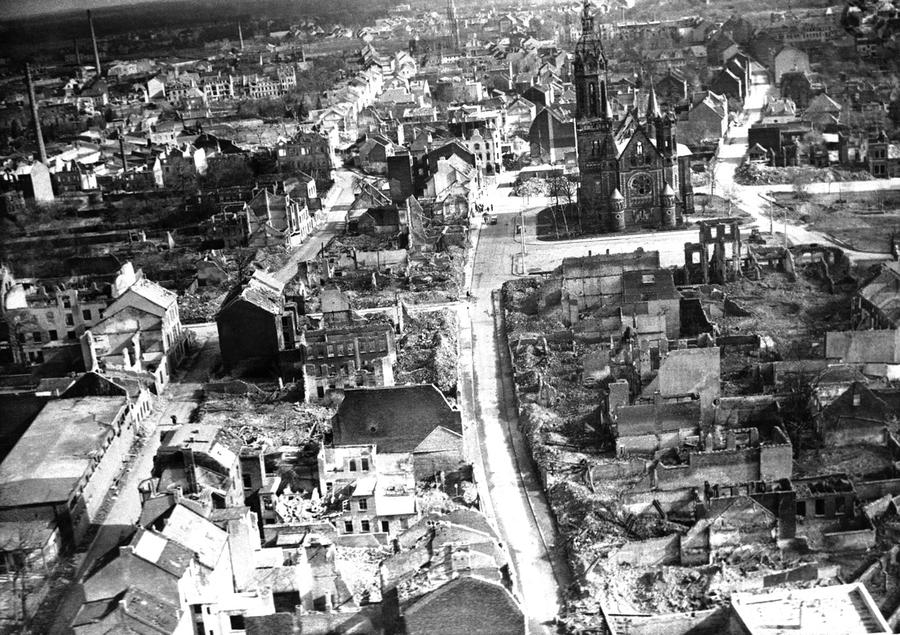
But Mainz is more than the cathedral, museums and history. During WWII it was an industrial center producing war material for Germany. Because of that, allied bombers tried to turn it to dust.

The war ended for Mainz in March 1945 when the Third US Army occupied it without a fight. Eighty percent of Mainz had been destroyed.

Consequently, as our guide said, “There are no old windows in Mainz.”

That line stuck with me ever since.

Our guides in Germany talked about the war in matter-of-fact tones. They didn’t apologize, justify or defend Germany’s aggression that plummeted the world into war. Simply, “when the war was over” the industrious residents of Mainz understood their city was blown apart. Few elements remained of its life, identify and character.

Everything fragile was gone. There are no old windows in Mainz.

They understood that rebuilding their city was a chance to start over. And starting over meant deciding what to keep, what to restore, what rubble to haul away, what remnant to patch.

They knew that the part of their history created long before there was clearly a Germany or a France was the core of their identity. It was to be the magnet for visitors – like me – to come and marvel at the majesty of the ancient. Their restoration of center city reflects Mainz as it was long before German aggression rained destruction on it.

Today Mainz is a modern economy, centered on tourism and industry once again. It thrives because people are attracted to its core.

No one wants his or her life to be blown apart. But sometimes, exterior circumstances, decisions made by others, mistakes and bad choices of your own cause everything that’s fragile in your life to shatter.

When the majority of everything you’ve known has been blown to dust, but yet you live, you rebuild. Those elements of your life that were fragile are gone, and only the core remains. Is your core strong enough to become the base upon which to rebuild?

Is there a cathedral at the center of your life that stands tall and strong in whatever chaos rains around it? Or have you spent too much time installing glass windows, and putting on display fragile things that will not stand when bombs fall?

Identify your core before the wars which will come. Strengthen it. And when the dust settles, you’ll be standing, still.

Learning terror on the highways

Self-driving cars are racing into our future. They supposedly will cut fuel consumption, extend our suburbs yet decrease commute times, cut the number of cars on the road by more than half, ultimately make our roads safer and cure the heartbreak of psoriasis.

Scientists theorize that a car with a dozen or more computerized “eyes” that are constantly alert and instantly responsive will be safer than a car with a human driver with just two eyes whose response times vary because of distractions like sleep deprivation, cell phones, music, mirror checking and messy sandwiches.

In the meantime, we humans are going to have to continue to navigate our crowded, crumbling roads and teach our offspring to drive safely upon them as well. It’s an important, and potentially terrifying lesson.

In fact, I remember just how terrifying it can be.

The 1979 movie “Alien” was the most terrifying cinema I’ve ever watched. I was sure the monster was in the cat and I urged Sigourney Weaver to leave it behind as she abandoned her space ship, but she went back for it!

I didn’t know until the final credits rolled that the movie was over. I relaxed for the first time in two hours and my stomach was sore three days from the tension.

But I didn’t know terror.

I’ve been trapped in a July hailstorm above timberline on Pikes Peak with the trail disappearing beneath ice and darkness approaching. We couldn’t have survived a night on the mountain me and three buddies braved the storm, climbing, exhausted, to the top.

But I didn’t know terror.

When I was sideswiped on a rain slick interstate by an 18-wheeler on a cold dark night, I still didn’t know terror.

I’ve taken the subway from New Jersey into Manhattan at midnight, heeding a native’s warning to sit as far front and as near the conductor as possible. I perched on the scarred plastic bench holding my country mice eyes unseeing, straight ahead. I pled silently for a cloak of invisibility to drape over me and to cover the neon sign I knew flashed above my head saying “Easy Mark.”

But terror remained only a textbook definition, a movie subject, an Edgar Allen Poe concoction. I only thought I knew terror, like a boy thinks he knows love.

Then, I took my 15-year-old daughter driving for the first time. And I discovered terror.

I grew up on a farm, driving tractors and trucks in the field from age 11. I learned the levers and pedals that made things go in slow-moving vehicles, in wide open spaces.

I had no idea until that first driving lesson how narrow are the roads or how close to the roads are mail boxes, or how sharp are the curves and how abruptly the pavement drops at the shoulder, or how wide are oncoming vehicles.

In the very first moments, after Erin adjusted the seat, mirrors, seatbelt, radio, sunglasses and hair, and figured out which pedal was go and which was stop, she almost took out one of those mailboxes. Fortunately, the ditch we rolled into on the other side kept the box safe.

It’s a helpless feeling, to be sitting on the rider’s side, with no brake and no steering wheel when all manner of disaster careens at you. I pushed a size 10 footprint into the floorboard when Erin didn’t seem to turn the wheel enough to accommodate the slow rolling curves. Unlike a 3-D movie simulation, these terrors really can jump off the screen like a Velociraptor to bite off your head.

I told Erin to ignore the cars on her bumper, and not to fear the ones coming toward her seeming to take up the whole road. When they get closer, you’ll see the road really is wide enough for both of us, I assured her. And the bridges only seem too narrow. And 30 miles per hour is fast enough!

You cannot imagine how dizzyingly fast 40 mph seems to a dad when his first time driver is behind the wheel.

To her credit, Erin finished the one-hour session with a new appreciation of how difficult and mind bending it is to drive well – a task that looks so easy when observing an experienced driver. She made a lot of progress and our next session was much easier. (I won’t go into the part about trying to teach her how to drive a stick shift.)

And importantly, I was reminded that the best way to overcome the terrors that lurk “out there” – under the bed, around the corner, in the operating room, on the next calendar page, when the phone rings, when your wife says “we need to talk” – is to face them. Get in the car with them and stare them in the eye while racing down the open highway.

Of course, it’s better to have a brake pedal on your side when you do.


Don’t Blink

At the doctor’s office this morning I looked down to fill in the remaining blanks on the form at the receptionist’s desk. It was my first visit so, of course, they wanted to confirm my willingness to sacrifice my first born if necessary to pay their bill.

The office computer had auto-filled some of the information and I just needed to fill in the rest. Staring up at me in simple black text over the white paper form were the identifying factors that would enable them to track me down should I limp out of there with their charges unredressed.

One simple number struck and confused me: 63. I thought at first it was “Question No. 63,” but it was on the first page and the form wasn’t that long. Then I thought it might be a part of my address, or something to do with the third of June. Of course, all of that flashed through my mind in a second before I realized the number represented my calendar age – the number of years since I emerged large and in charge from my mother’s womb.

I would have shaken my head except it’s still wobbly atop my neck from my bike accident, the reason I was at the doctor’s for a follow-up.

Seeing that number reminded me of when I was being transferred from one emergency room to a more capable trauma center three weeks earlier. The medic riding in the back of the ambulance with me called ahead to the trauma center, alerting them that he was about to arrive with a “63 year-old-male, with head injuries.”

“Poor sucker,” I thought. As best I could, since I was strapped to a neck board, I craned my eyes to look round the ambulance because I thought I was the only one riding to Winston-Salem. Turns out I was alone. Then I realized he was talking about me.

Sixty-three? When did I get to be sixty-three? Except for the momentary and exceptional fact of a fractured skull and several vertebrae, I felt 40. Sixty-three was my dad. Sixty-three was grandpa when I was a kid. Sixty-three was plaid pants and knee socks in gray walking shoes, and dinner at 4:30 for the discount.

Sixty-three was not me.

During the first third of my life, I always looked younger than my actual age, and it bugged me to no end. When I was 25 I was married, living in the second house that I’d owned and a college girl came to my door to look at some furniture we were selling.

I opened the door and she said, “Is your mother home?” It took my wife three weeks to re-inflate my pride.

Twenty years later I stood at the register to order a coffee and cinnamon role at Bojangles and the server repeated into the microphone, “One senior coffee and a cinnamon role.” I tried not to cry because my associate who was with me was too busy laughing.

In twenty years I went from “Is your mother home?” to being offered a senior discount.

And now the paper says I’m 63. The mirror agrees. My body nods affirmatively. My mind shouts vehement denial. Goodness, I’m embarking on new ventures infused with still developing hopes, dreams and plans. To quote Buzz Lightyear, I’m setting sail, “to infinity, and beyond!”

I turn to my wife, a wrinkle of concern still lining her forehead as we await the doctor, and ask her to verify the identify of the patient on this form.

That’s me? Age 63? How did we get here?

Don’t blink.

Healing power of the right word

I suffered a pretty awful accident May 14 while following my grandson on a mountain bike down an open, sloping field on his parents’ property.

We’d been tooling around for an hour, just enjoying a simple ride on a perfect spring day. Who needs a helmet for that? Well, Grayson wore his because he told me, “Safety first.” I should have listened.

He led me to the top of the hill, launching from his uncle’s driveway down through the field. I took a moment to soak in the sight and relish the feeling. His joy was palpable.

He was out riding with his papa, atop the freedom of his wheels and the thrill of a downhill slope. Giving myself just a moment to appreciate the scene, I took off after him, cutting a new path to the left of his line.

A lip at the edge of the field dropped several feet. I intended just to ride it down, hanging on tightly to reach the broader, softer slope. I didn’t see the hole at the bottom until it was too late. In an instant of clarity my brain registered, “This is not going to be good.”

My front wheel hit the hole and the bike stopped dead. I kept flying toward the ground like a spear and landed on my head

Grayson ran back up the hill to see if I was all right. “No, Grayson, I’m not all right. Go get Nana.” I felt like someone had hit me in the head with a 2 x 4 and that I’d lost six inches of height from having my spine compressed.

Within moments Nana pulled the Subaru into the field beside me. She sent Grayson to his uncle Bubba’s house at the top of the hill for a towel to stop the bleeding and for an additional hand to get me into the car. By this time I’d surveyed my extremities, all of which functioned, so I knew long term I would be fine. But, oh, I hurt.

Later tests would reveal fractured skull, cracked vertebrae, bruised spleen, lots of abrasions and cuts that required 10 staples to close. But for now there was just lots of activity with the other grandkids and Bubba and his wife, Sonya while we debated calling an ambulance.

In the midst of that hubbub I heard the sweet voice of 7-year-old Grayson saying, “It’s my fault. I should have told Papa about that hole.” I reached for Grayson’s leg and told him never to think that. He bears no blame.

But during the next 15 hours in two emergency rooms and calls back and forth among family, I kept hearing that Grayson was feeling responsible. That is a heavy burden for a bright, sensitive seven-year-old. It saddened me that he felt that way.

I was released early the next morning and went home with a neck brace to rest and heal. Grayson’s mom and dad, who had been out of town celebrating their 12th wedding anniversary during all the excitement, brought the kids by the house to see that Papa was OK. I knew I needed to find the right words to relieve Grayson of his self-imposed burden of blame.

His face was painfully tentative when he saw my brace, staples and stitches and he was wondering how I would react now that I was upright. In an instant I smiled big, held out my arms and loudly said, “Grayson, my rescuer! You’re the one who rescued me when you went for help! Thank you, buddy.”

In that instant his face transformed from hesitant to happy, from reluctant to rejoicing, from tentative to triumphant. He went from self-blaming to knowing he contributed to my being OK after a bad spill.

Choose your words carefully. A well-chosen word has the power to heal. A quick, harsh word has the power to destroy, to tear a hole in the cloth of confidence.

I know people who still labor under the self-image an angry parent imposed upon them 50 years ago, rather than with the reality of the bright and beautiful people they are today.   Grayson is young and aggravating sometimes because he is so intelligent and curious and he insists there is nothing he cannot do.

But from this day forth, no matter how many times I huff and puff and say, “No, Grayson, you cannot use the chainsaw,” he will know that on May 14, he rescued his papa.