
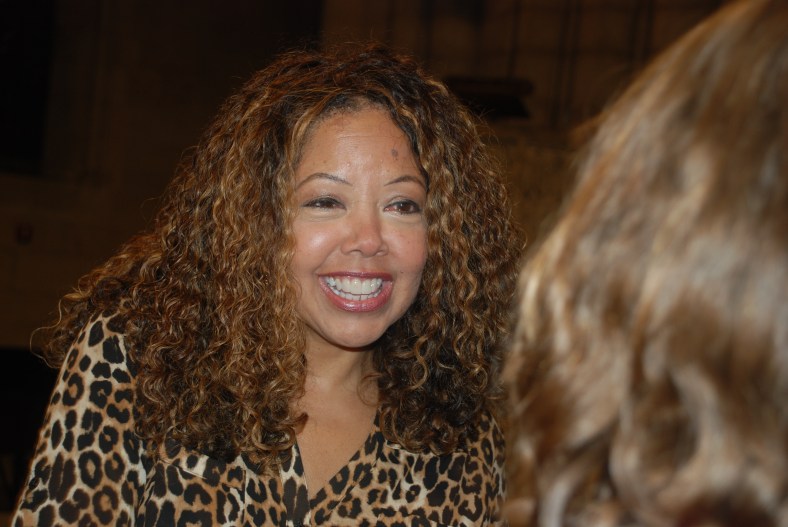
 Lucy McBath finds joy in her calling to make her son’s death have meaning. But the scars of her sorrow still show every time she speaks.
News headlines flash at you and disappear, like an oncoming driver flicking his bright lights. Then sometime later the story beneath that headline is resurrected. You meet someone who brings it back to life and you think, “I remember that.”
Only now, it’s real because you’re talking to the person involved. It’s not ink on a page. It’s a voice in the ear, a person in your eye.
I met Lucy McBath in New York City this week. She’s the mother of Jordan Davis, the young man who pulled into a gas station Nov. 23, 2012 in Jacksonville, FL playing his music too loud for the pleasure of Michael Dunn.
Dunn asked/told Davis and his companions to turn down the volume. Davis, as a 17-year-old kid would do, got his back up and they had words. Dunn got a gun from his car and shot it 10 times into Davis’ car, striking him three times and killing him.
Davis was black. Dunn is white. But they both bleed red. The difference is that Dunn’s blood is still in his body in prison somewhere. Davis’ was spilled out onto the parking lot and his car seat.
It’s dangerous to be black in America.
Of course, I’ve just returned from the conference God and Guns 2016 at Riverside Church in New York City. So my nerves are raw. I’ve been illumined to the underlying causes of much of the gun violence in this country. (I’ll soon post stories at BaptistNews.com. There I covered them straight. Here I’m talking more from the heart.)
In New York I met Lucy McBath, Jordan’s mother. As soon as she started telling her story, I thought, “I remember that.”
But now, instead of a flashing headline, her story is meat and bone. She has dedicated her life to ending gun violence in America so that Jordan’s life and death will not have been in vain.
Addressing conference participants, McBath said change will not come if we wait for someone else or some other time. She quoted President Obama, who said, “We are the ones that we’ve been waiting for.”
McBath is the Faith and Community outreach leader for Everytown for Gun Safety, a fairly new organization with chapters in all 50 states that sprung up after the Sandy Hook shootings in Newtown. Their goal is “common sense reforms to reduce gun violence.”
“Ninety-one people each day will continue to die if people of faith are not engaged in saving lives,” McBath said. “It must be our task to usher in a nationwide moral movement against gun violence.”
She reeled off the statistics that any advocate will have at the tip of her tongue:
An American is 25 times more likely than in any other developed country to die by gun violence:
52 percent of women killed by guns are killed by their intimate partner or family member;
Easy access to firearms plays a major role in childhood death;
More than 21,000 people each year kill themselves with a gun;
The presence of a gun in the house greatly increases the chance that a domestic argument or a period of depression will turn lethal.
“After Jordan died I questioned the absence of the faith community,” said McBath, a devout Christian. “Their silence troubled my spirit. Where were the pastors, the ministers, the reverends and priests abiding by the Word of God to challenge the ethical and moral violation of the sixth commandment, ‘Thou shalt not murder?’”
McBath is dedicating her life to reducing gun violence so other boys like her son, and the sons of Sandra Rougier and Natasha Christopher and the students of Newtown teacher Mary Ann Jacob who all testified at the conference can live in a time and place without fear of being gunned down in the street.
I remember that.
 wordsanddeeds.me