
Spring Cleaning Dredges Up Old Anger

My wife is in declutter mode, a seasonal psychological disorder similar to photosynthesis. Warming weather and increased hours of sunshine renew her fear that we will die inconveniently for our children, who will be forced to sort mountains of detritus left over from a full and adventurous life.

In fact, we have empty closets, a barely used attic and we decorate in what might be generously called Scandinavian Frugal. I have enough empty space in my closet to lend sanctuary to a frightened roofer fleeing the masked hoodlums of ICE.

My ankle is chaffed from the cuff and chain with which I attach myself to the bedpost for fear of being thrown out in my sleep.

Despite my Spartan home office furnishings, Sue Ellen found excess in pockets of memory-inducing memorabilia. My bookshelf was too crowded, my closet held a a photographer’s vest and an unused shelf unit.

Personally, I share the opinion of Billy Crystal, who in his memoir “Still Foolin’ ‘Em, Where I’ve Been, Where I’m Going, and Where the Hell Are My Keys?” encouraged us as we age not to throw out objects that prompt a memory. So what if that tchotchke takes up a little space? When you pick it up, hold it, rub it and lift the molecules of its texture to be raised by the gravity of your own, you remember. You go back to that day, that moment in time and you live there again.

Your body may not jump as high, recover as quickly, digest that whateveritwas with as much alacrity as it did then, but in your memory you can. And it does. And you don’t need an antacid.

And that’s why, when Sue Ellen came across a box of her own memories, and brought them to me to ruffle through and share, the voice behind my barely concealed smile said silently, “Ah, I’m right again.”

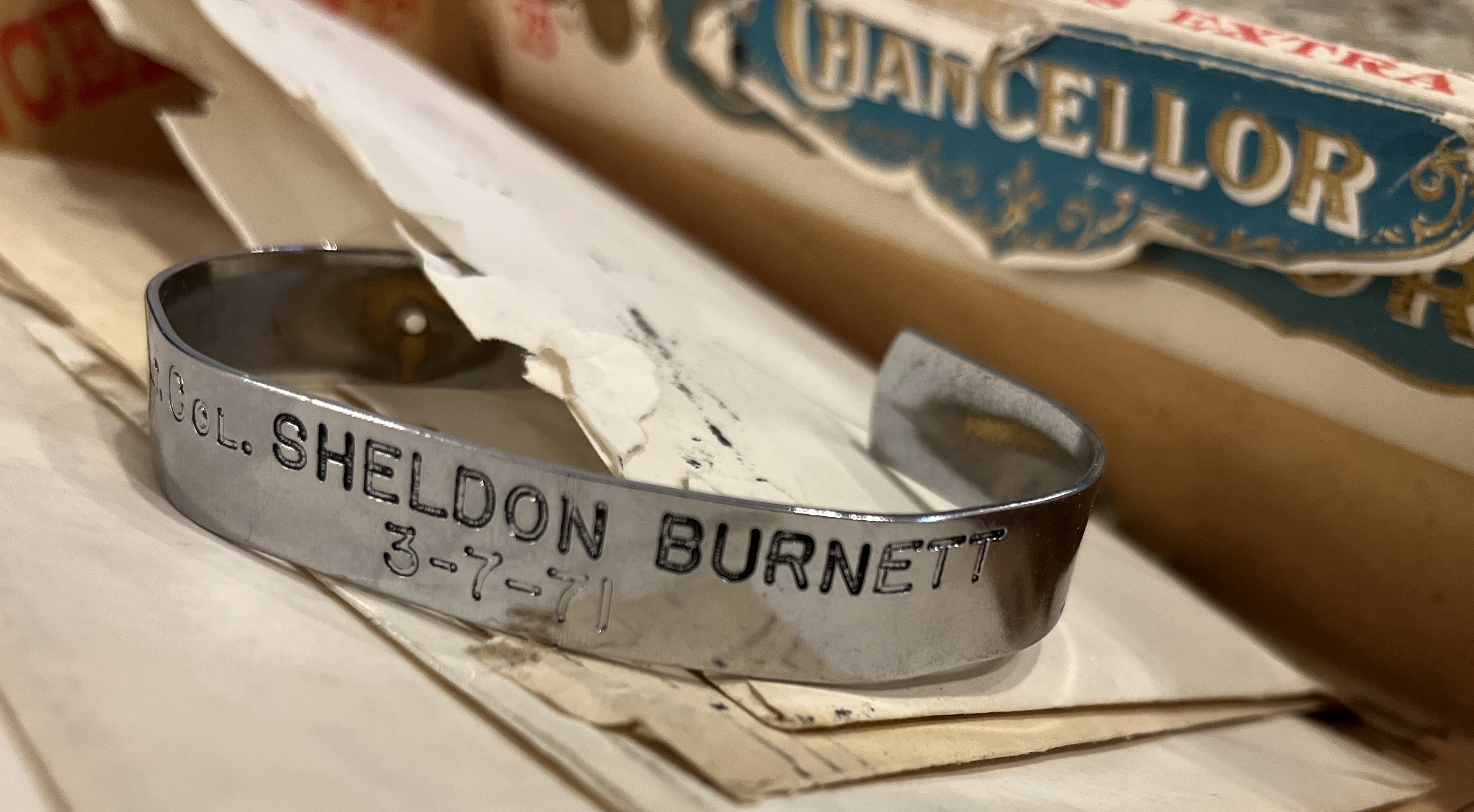
Included in her little box of memory inducing treasures were love letters from me during our brief engagement in 1975; a picture of her 1974 Korean mission team; some certificates of completion for various pursuits; and a nickel-plated bracelet on which was engraved the name of Colonel Sheldon John Burnett, and a date – March 7, 1971.

We reminisced about that bracelet, and wondered about the date. Sue Ellen remembered being one of millions who purchased for $2.50 and agreed to wear a bracelet bearing the name of an American soldier held as a prisoner of war or missing in action in Viet Nam, during what my Vietnamese friends call the American War.

Curious now, we looked up the origins of those bracelets, and what the date meant. They were conceived in 1969 by California State University, Northridge, students Carol Bates and Kay Hunter to raise awareness of missing soldiers. Bates chaired the bracelet campaign for VIVA (Voices in Vital America, originally, the Victory in Vietnam Association), a student organization that would go on to produce and distribute more than five million bracelets – as many as 40,000 a week at its peak interest.

The date, we learned, is the day the soldier whose name adorns the bracelet went missing.

Sue Ellen’s soldier went missing in March 1971, nearly three years after then Secretary of State Henry Kissinger sabotaged peace talks between North and South Vietnamese leaders to diminish the chances that Hubert Humphrey – President Lyndon Johnson’s VP – would win the presidency over Richard Nixon. Johnson had secured the peace talk agreement and the glow of that achievement would have shined on Humphrey.

Those peace talks were agreed to in 1968. A cease fire during the talks would have been likely, and the killing stopped.

The official death toll of American soldiers from that fruitless, misguided war is 58,220. Of those, 21,264 died after 1968. Including Colonel Sheldon John Burnett.

We learned Col. Burnett, from Pelham, N.H., was aboard a helicopter on a personnel transport mission to an area along the Laos/Vietnam border. The copter was shot down. Burnett did not survive the crash and his remains were not recovered at the time. On Dec. 9, 2004, the Joint POW/MIA Accounting Command identified his remains. Colonel Burnett’s name is inscribed with his fallen comrades on the Vietnam Veterans Memorial Wall in Washington, DC.

War is hell. In their quiet deliberations, even politicians know that. But when they nod, or acquiesce to the diabolical whimsy of a barely there commander in chief, they view war as some kind of video game and they watch the bombs falling on military installations, and hospitals, and schools via the onboard cameras of the planes that drop them. And somehow the fact that human beings below are vaporized, and the bombs sow seeds of hate in the next generation of sons and daughters toward those who dropped them.

The art and science of politics is to navigate the complicated landscape of differences between constituents, between nations. When negotiations “fail” or are abandoned for lack of time or commitment or personal self interest, war becomes the brutal evidence of politicians’ complete and utter failure.

“Every man has two deaths, when he is buried in the ground and the last time someone says his name,” according to a quote attributed to Ernest Hemingway Godspeed Col. Burnett and may your name, and that of untold thousands of American soldiers who politicians have sent to their deaths, be spoken of and remembered far into the future.
Committing Errors and Omissions

Oh good grief, will that lady please sit down so the rest of us can see?

I’m at the spring school concert for one of my grandchildren, who is dressed in white shirt and dark pants somewhere on the third row, right side, there, in the shadow, just beyond the edge of the light. Yeah, him. Take your finger out of your nose, buddy.

But the lady, and a dozen others, are making it hard to see my kid at all because they keep popping up, holding cameras, iPads, and phones at arm’s length to record their little darlings’ anonymous instant. Me, I’m trying to sit back, focus, and be in the moment so that the images and sounds in real time are seared into my memory.

I won’t need to pull up a grainy, dark, blurry picture to remember the grainy, dark, blurry image of the event I saw – through a viewfinder.

Studies show you will remember something better and appreciate it more if you concentrate on the moment with your own eyes, instead of looking at it through a viewfinder.

Elizabeth Loftus, a psychological science professor at the University of California, Irvine, says when our concentration at an event is to record it, it’s like we are offloading the responsibility of memory from our brain to our phones. Or, we’re so distracted by the photo taking process that we miss the moment altogether.

People upload 30,000 hours of content to YouTube – every hour.

I’m not sure if there is an exact parallel to the “losing the moment to a photo” idea, but I’ve discovered a strange phenomenon relating to journaling and memory. I’ve been transcribing my handwritten notes from journals of 50 years ago when I was in the army. Everything was new and not so wonderful for a young, pacifist country boy who grew up in a town of 788 people now thrust into a world of strangers being trained to kill people.

Still, there were friends, events, churches, girls and Kodak moments from those years that I’ve shared with people ever since. Special moments, meaningful events and forks in the pathway of my journey seared into my memory.

Yet, I’ve discovered that many of the most memorable, transformative, fulfilling moments of those days went completely unmentioned in my journals. Stories that made it through my memory dozens of times during the past half century never made it through my pen.

When I first realized the omissions, it struck me as strange. What I’ve come to believe, in a totally unscientific insight, is that I didn’t write down such significant things because I knew they were so memorable I’d never forget them. Things like:

  • My first ski trip when we encountered girls from church at the top of Monarch Mountain. It was my first day on skis and I’d done well and wanted to impress them. After we chatted a minute, we all turned to go down the hill and I immediately fell. Trying to catch up, I fell again and didn’t see them the rest of the day.
  • After wearing a full leg cast from a ski injury I had my buddy drive me to the base hospital to get it off, carrying my bike along with us so I could ride it home. Ha. My leg was useless until I’d rehabbed it.
  • A spur of the moment trip to Tacoma to see a girl I’d met through her cousin in Wisconsin.
  • After saving for a big ski trip to Vail, buddies Steve, Paul and I brought a fourth, Dennis, from Florida. He hadn’t skied, but said he was a surfer, so we thought if he could surf, he could ski. Wrong. After sleeping in the heatless van in the parking lot, waking to a quarter inch of frost inside the windows, we spent the morning at Vail, the premier ski area in Colorado, with him on the bunny slope. He never got it and we abandoned him.
  • Or, feeling compelled to back out of a trip to San Antonio to see a friend I’d met when stationed there, feeling I shouldn’t go. Hours after I was to leave, my mom called to say my cousin Dickie had died in a one-car accident. I went home to Wisconsin instead.

So, what prompts recollection of these events as I transcribe my journals? As I’ve gone through chronological entries, little butterflies flap around in my mind, whispering, “Didn’t this or that happen about this time?” We are an accumulation of our memories and each works in some kind of symbiotic relationship with others.

It’s kind of like how the things we eat work together in our bodies for nutrition and health. Who knows how an orange releases enzymes from a pork chop? Or how fish digests better with a glass of white wine?

I don’t. But thinking about why I wrote about fairly mundane things without recording events I considered very significant then and since makes me scratch my head.

Now, please scooch aside ma’am…I need to get this pic.

Fateful day half-century in the making

Sept. 13.

Fifty years ago today my dad wrapped his arms around me and said out loud for the first time I can recall, “I love you.” Then I turned toward the bus idling there to take me to Milwaukee where I was inducted into the U.S. Army.

With a draft lottery number of one, received a year earlier, this day was inevitable. But it arrived under a dark cloud of dread that wouldn’t lift for months.

I never doubted my dad loved me. I never asked myself if he did. I never wondered, pondered, considered, weighed or suspected his love. He showed me in many, non-verbal ways: working hard to provide for his family, being present, shooting baskets with me, including me with tasks we could do together, assigning me responsibilities like cleaning the barn or splitting the wood for our farmhouse furnace, then bragging about me to his friends when I worked beyond his expectations.

Primarily, my assurance of dad’s love and my subconscious security in my household growing up was how he loved my mother. Our dinner time was consistently 5:30, but no one sat down until dad arrived home from his gas route. He drove a fuel truck that serviced farmers in a four-county area, but he consistently arranged his days and route to be home for dinner on time.

Then mom would meet him at the door and the kids would have to sit at the table, waiting while they hugged and kissed and got all sloppy in the doorway.

Dad never fully grasped the implications of my lottery number. It didn’t penetrate his consciousness that radio announcing my birthday as No. 1 had changed the trajectory of my life. Nor did he comprehend my heart when I petitioned for and received status as a conscientious objector, willing to serve in the military, but not willing to bear arms.

To my surprise and delight, my basic training platoon at Fort Sam Houston consisted entirely of conscientious objectors of my same persuasion. We were all to be trained as medics. Logic was, I guess, if we weren’t going to carry a gun, we should run around with a target on our backs.

Religious belief was the overwhelming rationale for conscientious objection in my platoon. And not all represented religions were Christian. Consequently, our discussions were invigorating and affirming. Our attitudes were positive and our nascent friendships sincere.

Then, we graduated from basic. And our 40 men were divided among 10 other platoons of men who had just finished basic training that included weapons, and an indoctrination of “enemies” versus the right and righteous arm of the United States.

Suddenly, barracks were bellicose. An undercurrent of distrust and tensions ran through the room where long rows of bunks ran down both sides of the room, with lockers in the middle and footlockers at the end of each bunk. You never wanted to leave either open or unlocked.

One day I hung a pair of clean underwear on the hook while I showered. When I got out, mine had been taken and replaced by someone’s dirty underwear.

Discussions were not harmonious, but usually disintegrated into offensive and defensive positions on issues, especially religious and political. The most hard core guys could not wait to get to Viet Nam and “kill some Charlie Cong.”

Such was the atmosphere that debilitated my spirit one night when I walked to the bank of phones to call my dad for a word of encouragement. I know he loved me. But he still didn’t understand.

Depressed, I was walking back to the barracks to face another miserable night when my path took me past a base chapel. It was brightly lit and happy sounds were coming from it. I walked in. Why not?

There was a youth group on the platform getting ready to perform a musical. And I found a couple of my buddies from basic training there. After the musical, the youth offered to come pick up any soldiers who wanted to attend their church on Sunday.

Pretty girls populated the platform. I eventually dated one. My buddy Steve ended up marrying her sister.

Events of that night, and that group from Baptist Temple in San Antonio, opened the portal to the rest of my life which included a career among Baptists in communications, and marrying a girl I met at a Baptist church in my next station.

Fifty years ago. Today. As I’ve said many times since, it’s not something I wanted, nor would ever want to do again. But my life was set on course by having done it once.