Are you as good as dead?

While collecting shellfish in Australia, Eric Nerhus was bitten almost in half and swallowed by a 10-foot shark.

Swimming 25 feet below the surface, Nerhus, 41, was grabbed over his head by the shark, which took half of Nerhus’ body into his mouth. He was as good as dead.

Thinking quickly, he reached up and poked the shark’s eyes with the chisel he used to collect abalone.  The shark open its mouth and Nehus wriggled out.

Nerhus estimates he spent two minutes inside the shark’s mouth and said his chest was protected from the shark’s sharp teeth by the lead-lined vest used to weight him down as he scoured the ocean floor. He swam to the surface in a cloud of his own blood, where his son helped him into the boat and rushed him to a hospital.

The 2010 movie “127 Hours” featured the dramatic story of Aron Ralston whose arm was pinned to a rock wall by a suddenly shifting boulder while he hiked Utah’s Blue John Canyon.

No matter what he tried to dislodge his arm, he was trapped. After four days his water ran out and he drank his urine. On the sixth day, Ralston realized he was as good as dead.

Then the 27-year-old mountain climber did what he’d always known he had to do, but could not bring himself to do when he thought there was an option. Using his own body weight for leverage, he broke both the bones in his forearm. Then, with his pocketknife Ralston cut off his arm below the elbow and applied a tourniquet. He then rappelled 60 feet to the canyon floor and started walking.

He walked seven miles before encountering two tourists who called for a rescue helicopter.  

What’s the point?

Neither Eric Nerhus nor Aron Ralston are dead. At that point in their lives when there was no prospect for more life – when they were as good as dead – they found a way.

Ever thought you were “as good as dead?”  Or wished you were?

  • In the midst of company chaos, your boss approaches you with a grim face;
  • A truck in the approaching lane veers into yours;
  • You discover your father’s debilitating illness is hereditary;
  • At a conference in his office, your docor leans forward and says, “I’m sorry.”
  • Your job loss has led to anxiety, depression and a mortgage foreclosure;
  • You face an impossible financial burden to make good for a child’s accident, illness or bad mistake;
  • A dark secret you’ve carried is suddenly revealed.

Jesus’ friend Lazarus was not only as good as dead. He WAS dead. Then Jesus exercised his power of life over death and he raised Lazarus, demonstrating to us though we be as good as dead, we still possess the life option.

The same is true for a host of other biblical characters. Young David could have killed King Saul (I Sam. 24) when Saul was relieving himself in a cave and David crept in behind him and cut off a piece of his robe. Saul was as good as dead and didn’t even know it.

Joseph had a coat of many colors (Genesis 37), and was his father’s favorite, when his jealous brothers threw him into a cistern to die. He was as good as dead.  

Shadrach Meshach and Abednego were thrown into the fiery furnace; Daniel was tossed to the lions; Jonah was swallowed by the great fish; the adulterous woman dragged for stoning by an angry mob.

Why did God rescue them? Because God had a higher purpose for their lives and something in that near death experience equipped them for that purpose like nothing else could!

Your faith isn’t feeble in the face of life threatening odds. It’s most flaccid when you operate only in the realm of your own abilities, when you’re deluded enough to think you can “do it yourself.”

My favorite traditional hymn is “A Mighty Fortress is Our God.” Verse two says, “Did we in our own strength confide, our striving would be losing.”

Remember, when your dreams and promises appear to be as good as dead – yet they breathe. Aron Ralston wandered out of the dessert after cutting off his own arm. Eric Nerhus fishes again. Childless Abraham, whose body the Bible says was as good as dead, became the father of a nation.

Senior adult groups have many adorable names. One of my favorites is the ADY – Ain’t Dead Yet – Club. Circumstances may conspire to make you feel you’re as good as dead, but guess what.

You Ain’t Dead Yet.

Two Ways To Do It

I grew up working with and for my Norwegian bachelor farmer uncle Donnie, who made a living milking 19 cows on 80 sandy acres in southern Wisconsin. As a kid I tried to impress him with my strength by carrying 40 pound buckets of milk to the cooling tank when I didn’t weigh much more than twice that. I struggled to make it look easy, but he knew it took all I had.

I get to practice what i learned while young at White Horse Farm in Pennsylvania, where my son’s family lives.

In the ‘60s corn had to be cultivated to keep the weeds down before “poison ready” genetically modified seed became the norm. So I’d sit on the tractor with Don as he drove the little plows through two rows at a time to dig out the weeds. If he hit a stone or lost concentration and the cultivator dug out some corn, I’d hop off, stick it back into the ground, and run to catch up.

Building or repairing barbed wire fence, learning how to drive tractor and truck, milk a cow and slop a pig, being rewarded with a chocolate milk and donut at the Midget Kitchen on Hwy. 16 all were part of my kinetic education – along with learning how to understand the punchline of coarse jokes.

Once I reached about age 13 my services were much in demand by local farmers who needed help detasseling corn, baling hay, picking stones or cleaning out stalls and stables. I was a tall, thin kid who was young Sheldon in the classroom and who saw Arnold Schwarzenegger in the mirror.

Our local farmers were basically one-man-and-a-son operations, and I replaced the boy who had grown and gone to the city. To make hay while the sun shined, we cut the alfalfa, let it dry for three days and hoped for no rain. Then we raked it into windrows, scooped it up and compacted it into 40-50 pound bales with a tractor pulling a baler pulling a wagon with a kid on the wagon stacking the bales.

Most generally it was me and the farmer – baling, loading, unloading onto an elevator and stacking in the barn. There were two kinds of farmers when it came to engaging my services on a hot summer day. One I’ll call Uncle Donnie’s way, on account of it’s about my Uncle Donnie. The other I could call “the efficient way,” on account of it’s the opposite of my Uncle Donnie.

When Uncle Don picked me up in the morning, we’d get to the farm and have to gas up the tractor, grease the baler and put in baling twine, hook the baler to the tractor, connect the power takeoff shaft and move the elevator into position to carry the bales up into the hay mow. It wasn’t unusual for us to have round up a wagon or two that a neighbor farmer had borrowed.

All the while I’m looking at all that hay, laying expectantly in windrows in the field, itching to get out there and get started, knowing it was going to be a long day. And it was threatening to rain.

Farmers committed to “the efficient way” and to getting all the work out of me they could, completed all the preliminaries before I got there. The baler was greased and hooked to the tractor, which was gassed and ready. The elevator was in place, all the necessary wagons were lined up, and mother had lunch in the oven.

We got twice as much done in half the time. And there are few things as satisfying as looking over a freshly harvested field, seeing it cut and clean and all the hay is in the barn before the rain comes.

That, and the fact that the more efficient farmers tended to pay $1.25 an hour, rather than $1.00.

Readiness makes the difference. Many of you work with non-profit organizations. Respect the time of your volunteers. Don’t let them show up on a work day or at a fund raising event and have to stand around and twiddle their thumbs. If they are volunteer tutors, have a student already selected and matched.

Then, let it rain.

Carting away your history

Strangers carted away my friend’s history yesterday, piece by piece.

An auctioneer’s singsong cajoling held Dave’s life up for examination and bid. Chains, tractors, implements, house furniture, fuel tanks, rakes and hoes all appraised unemotionally for their “value” by area farmers hoping to find a deal, make a steal.

Dave’s farm, eight curvy, hilly miles from any main road, looked like a Ford dealership, as 120 trucks – at least 100 of them Ford F150s, 250s and 350s – parked nose first along the edge of the cornfield like piglets nursing. Amish neighbors in their round straw hats parked their buggies in the yard, and tied their horses to a shade tree. An early morning deluge left the grounds muddy but didn’t discourage potential buyers from picking at the accumulated instruments of Dave’s farming life.

Dave is in the second year of an ALS diagnosis and at age 72 he’d decided to sell the farm where he’d lived 46 years, raising his three children in a Trumanesque environment in rural Pennsylvania.

He is slowly losing muscle strength everywhere but in his smile.

When major items like his John Deere tractors didn’t sell for what he’d hoped, he shrugged and said, “Let’em go.” Trying to sell them on the open market later, hoping for a more equitable price, was just too much trouble to contemplate.

Dave and his dad built the house atop the hill, where his wife huddled now with a long-time neighbor to avoid seeing four decades of her life picked over, devalued and carted away. The house wasn’t quite finished in time for their first child to come home to it from the hospital. But it was finished two weeks later and she’s lived there ever since.

Dave decided to sell the house, barns and 45 acres on which he’d lived his entire adult life so that Debbie wouldn’t have to…later. Once decided, his second son, Mark, drove him through the rural neighborhood to pass out flyers announcing the sale. They left fliers with neighbors who Mark knew did not have the means as potential buyers, but he eventually realized he was driving his father around on a farewell tour.

“He just wanted to say goodbye to the neighbors he’d known for 45 years,” Mark said. When Mark realized that, he settled in and enjoyed the ritual.

The man who’d purchased the farm was present at the auction. He’d bought it for his daughter and son-in-law as a place to raise their children, in rural Pennsylvania, giving them the benefit of idyllic life in rolling hills, among Amish farmers, an area where church and school are the gravitational centers of community life.

Dave’s adult children and their spouses were present and helping. Grandchildren roamed through the barns for the last time, daringly climbing steep ladders to where hay once was stacked high, making sure that mom and dad saw their accomplishment. Dave’s sons recounted adventures with tractors, camping in the woods, trapping ground hogs and shooting that would make their survival a mystery.

This was their home being carted away on the backs of trucks and trailers. They weren’t sad – yet. The hard decision had already been made – to sell the farm and auction off the equipment. This was just the physical manifestation of their decision.

But, when the last cabinet was pushed into the back of a minivan; and the last tractor was loaded onto a flatbed; when the camper the grandkids slept in the night before rolled away behind a pickup, the somber reality settled over the property like an early morning fog settles into valleys.

I hugged each goodbye, Dave’s arms limp at his sides, and thanked them for including me in their family. Through thick and thin, good times or bad, through the struggles inevitably ahead, he’s my brother and the auction was another milestone toward “next.”

“I never thought about it”

Much of the remodeling and landscape work on my son’s renovation of a 200-year-old house and barn in Pennsylvania is being done by Amish. Their work is exemplary, consistent and dependable.

Amish settled in southeastern Pennsylvania in the 1720s, leaving behind in Europe the persecution of their “strange” and separatist beliefs. Amish emphasize humility, family, community and separation from the non-Amish world, which includes a reluctance to adopt modern conveniences such as cars and electricity.

The Pennsylvania Amish community in Lancaster County is the largest in the United States, numbering about 30,000, double its size of 20 years ago. They’re distinctive for their simple dress, beards, bonnets and horse drawn buggies.

We wanted to give visiting relatives an authentic Amish experience, without being “ugly Americans” who gawk or get our legs caught in tourist traps that exploit this set apart people. So, who better to ask for advice than Aaron, a white bearded, retired farmer now working for his son’s landscaping company on our project.

To my delight, Aaron suggested simply that if we wanted to experience Amish life in Lancaster County, “Come to my farm. I’ll show you around.” We made a date two weeks hence.

I texted a couple days before the appointment and was concerned that I didn’t hear back. But on a beautiful fall afternoon we pulled into his manicured yard and Aaron and Barbie, his wife of 40 years, appeared immediately. Since they hadn’t heard from me, they wondered if we were coming.

I mentioned the text I sent earlier. Then we both laughed. Their telephone is in a building separate from the house, to be used for business purposes only, and of course, is not mobile.

We took seats in their recently constructed house, modern and perfect in every way except that there are no electrical outlets, nor lamps, nor counter appliances, nor overhead lights. Designed to let in lots of sunlight, a propane tank on wheels with a filament bulb on a tall rod provided light when darkness falls.

A propane powered refrigerator graced the kitchen. While electricity is considered a convenience too worldly, workarounds with generators for power are apparent in the barns. Rules and restrictions governing humility and simplicity vary by area bishop.

We asked Aaron why farm implements roll on bare steel wheels, with no rubber tires. He said it’s a bishop’s rule to keep people from going fast.

Daily life is guided by simplicity and a pace slow enough to appreciate the smell of freshly turned earth or cut grass or a grandson’s grasp of your leg as you walk the fields together. No doubt outsiders romanticize these things about Amish life, but the truth is starker. Anyone dependent on modern conveniences woven so completely and unconsciously into daily life that we don’t even realize our dependence, would find it very difficult to shed them in favor of a slower, harder, more deliberate life.

For that reason, Aaron said, they do not encourage people not born into the Amish community to “convert” to their faith and culture.

As a young sharecropper, my grandfather walked behind a mule pulling a plow. But when he gained access to a tractor, he embraced the innovation and convenience wholeheartedly. Amish farmers are content with their mules. Whether tractors, telephones, automobiles or microwave ovens, they recognize that innovations do not necessarily contribute to a better, fuller, deeper life.

Sitting together in a comfortable living room, a Bible and reading glasses atop a small table by their chairs, we asked this 62-year-old couple if they were granted permission to embrace any single modern convenience – the kind of utility they see every day as they live among “outsiders” – what might it be?

Silence.

After a while I suggested to Barbie that I thought she might say “electricity.” She smiled meekly and said, “I considered that.” When pressed for his answer, Aaron said, “I’ve never thought about it.”

Whoa.

Aaron farmed 50 acres with mules, raised eight children, six of whom have 33 children, raises dogs and tobacco for extra income, gave the farm to a son and now works another son’s landscaping business, is a stalwart in church and community, and he’s never thought about what mechanical, transportation, electrical, communication tool available to others he might like for himself?

All the while he lives among outsiders who think camping out overnight to be first in line for a new phone model is logical and that instant gratification is too slow. We’re bombarded by constant messages that we will be happier if we grasp, strive and reach for the next purchase, entertainment, or experience that will somehow endow us with the satisfaction Aaron has just by living a simple life in a caring community of like-minded folks.

“Content” is the only word to describe a man whose lifestyle barricades him against the onslaught of television and social media, who has never thought about embracing modern conveniences. He is content and committed to a way of life that is set apart, not conforming to the world. Romans 12:2 He evidently thinks about such things no more than a fish considers water.

Few modern Christians are consciously set apart from the world. Our most significant symbol – the cross – has been so co-opted and adulterated that it no longer retains significance as a Christian symbol.

Maybe that’s why we admire the simple, quiet, slow – contented – pace of Amish life.

Before I met Aaron, I’d never thought about it.

We all find security in the coop we choose

We raise some chickens on the hobby farm in Pennsylvania where we spend time with our oldest son’s family. We got them when they were too old to be called chicks and too young to be called hens. They were teenagers at poultry puberty, eating and sleeping but not producing a darn thing.

After foxes, hawks and weasels decimated our first two flocks that ran free in a half-acre pasture, we started over with this new batch from a farm that raises chicks to this level of maturity before they start laying eggs. So, they’ve navigated their brief lives in the narrow confines of a large, dark shed.

From that shed they were pulled, dropped into a big box to transport home, and then set in a coop to protect them while acclimating to new digs. And we built a small run to provide some level of protection from predators that was more than the ungirdled range of grassland occupied by their unfortunate predecessors.

When it came time after a few days to let the young birds out of the coop the strangest thing happened – or didn’t happen. They were reluctant to leave the confines of that shelter.

I thought once I opened the door they would burst out into the brave new world of open space, green grass, bug buffet and blue sky because they’d been confined to dark, confined environs their whole lives.

Instead, I realized that it is precisely because they’ve been confined in dark spaces their whole lives that wide open spaces terrified them. It took long minutes for the first curious, brave beak to break beyond the coop threshold, and hours for a chicken body to follow that beak out the door, into the pasture.

Joined slowly, tentatively, cautiously by others, they hovered in the shadow of the coop for more long minutes, barely moving a body length into what to them must have been a vast, horizonless universe of undulating grassy waves.

When I consulted on a fund raising campaign for a Boy Scout campground I was surprised to learn that boys from the inner city were terrified by the animal and insect noises reverberating through the dark night outside their tents. These boys – familiar with gun fire, street racing, domestic violence and the cacophony of inner city life – shivered and huddled in their tents, sleepless at the sound of crickets and owls in the night.

A beautiful actress I interviewed in Houston, living with a physically abusive partner, told me it’s less frightening to hear him coming up the steps, knowing he’s going to hit her, than it is to considering fleeing with her child to the uncertain world beyond their apartment door.

We are anchored to our security, the blankets under which we find comfort and assurance, even if those blankets hinder us from moving past comfort into adventure and discovery.

Michael Easter wrote about it in his book “The Comfort Crisis.” For a month he eschewed the electronic conveniences and digital distractions of his life while camping and hunting in Alaska, enduring – then appreciating – hunger, boredom and uncertainty, the very things we work so hard to avoid.

He said challenging yourself to embrace a hardship and work through it, rather than avoiding it, will help you grow.

Being alone in nature actually will help you connect with yourself and help you feel less lonely.

And, he suggests consciously ditching unnecessary conveniences that make you lazy and, ultimately, unhappy. Rather than heading for the fridge at the first tingle of hunger, skip the snack, embrace the hunger and the next time you eat an actual meal you’ll appreciate it all the more. And be healthier for it.

The first sermon I ever preached was entitled “Comfort Kills” and I implored the congregation in Shawnee, OK to step outside their comfort zone to engage those persons who were not just like us.

Be brave, I said. Don’t be…chicken.

And the angels sang

(To read the prologue of this story, click here)

The snow outside church portended a brutal night and I watched the parking lot as much as I watched the costumed kids preparing for their role in the Christmas pageant. I expected the arrival of a new helper who was racing south from Colorado ahead of a blizzard.

She was a helper whose arrival I anticipated with mixed emotions.

I had been a volunteer at Templo Bautista in Espanola, NM for two months. Recently discharged from the Army as one of America’s last draftees, I’d gone there to exercise my faith with the goal of making a difference in an environment foreign to me, a Midwestern Scandinavian who grew up in Truman’s World.

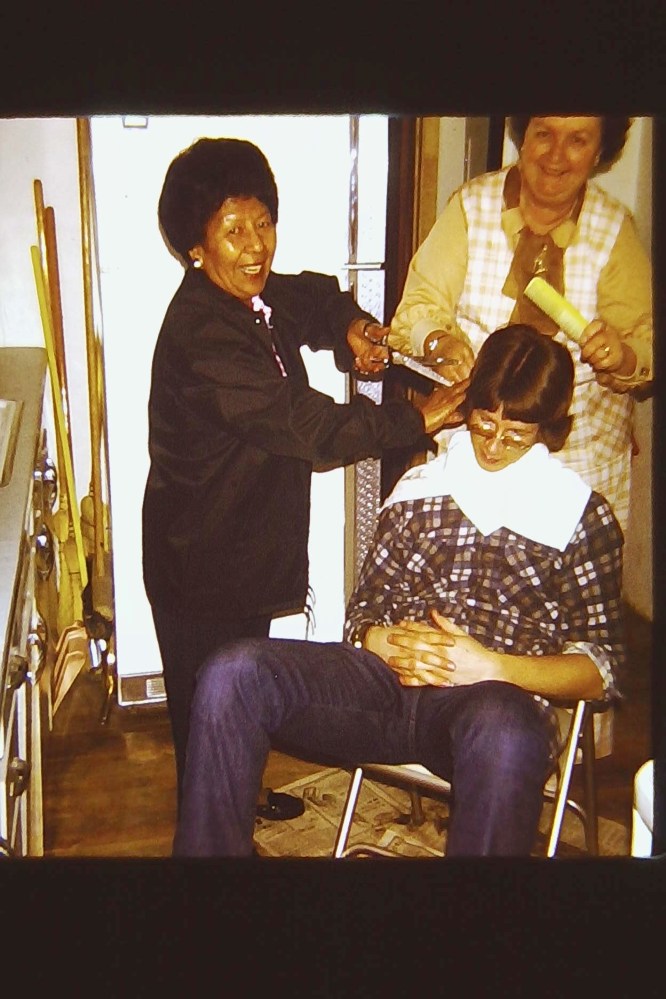
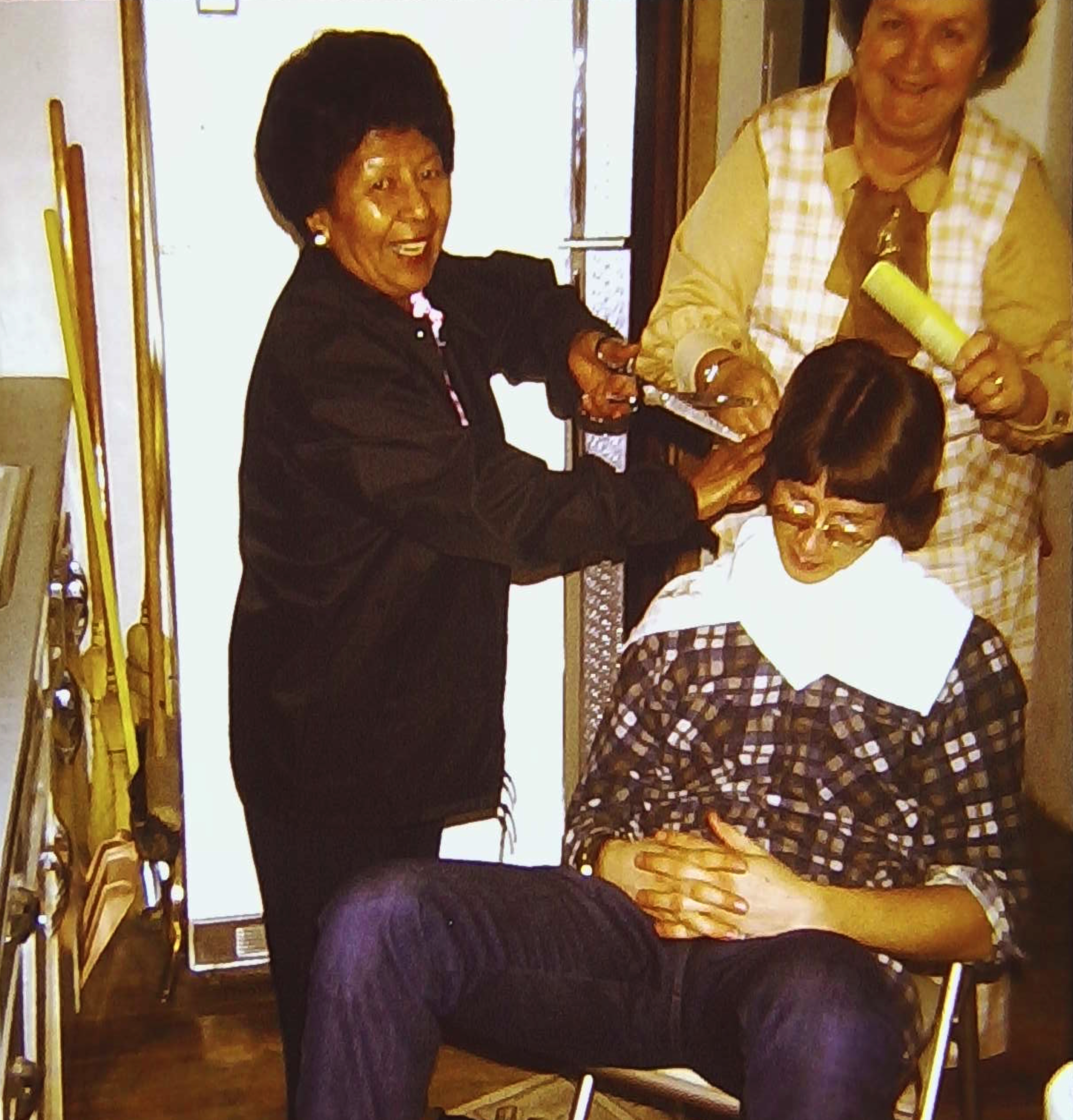
Is it any wonder I wanted no intruders? Teresita Naranjo, left, recognized as the No. 2 potter in all of New Mexico, cut my hair with Mrs. Abbott.

Mrs. John Abbott – never Ethel – carried on the work at Templo that she and her husband started decades earlier. But John had been killed in a farming accident and Mrs. Abbott told God she could only carry on as God would send help.

Enter me.

I was the first long term helper and became bus driver, Sunday School teacher, wood splitter, phone tree operator, youth director, visitation director and encourager. Life was good. Mrs. Abbott treated me like a son, fed me like a king and taught me like Socrates.

Two months later I returned to the church I attended in Colorado Springs to tell my crowd what was happening in Espanola, and to raise a few bucks to buy Christmas gifts for the kids there. In that crowd was the daughter of a man I knew well. She had just left college and was at loose ends, struggling to discern a broader, greater plan for her life.

My heartfelt appeal and enthusiasm for life at Templo Bautista struck a chord in her heart and she wanted to pray with me about the possibility of coming to help. The last thing I wanted was an intruder to dilute my lone role as Golden Child in Mrs. Abbott’s realm.

But, we prayed and this girl and I had the unmitigated gall, the brazen audacity, the cocksure brass to demand the creator of the universe provide a clearly discernible answer within seven days.

I returned to Espanola with some cash for gifts and a secret. I didn’t want my apple cart upset. I wasn’t going to stand in God’s way, but I wasn’t going to feed him an easy assist, either.

So I waited several days before telling Mrs. Abbott about Sue Ellen Carver’s interest in coming to help. I figured Mrs. Abbott would take a couple days to  pray, to cogitate and consider. By then, the seven-day deadline would be passed and I’d be home free. So, at breakfast on the sixth day, I mentioned casually that Bob Carver’s daughter, Sue Ellen, was interested in coming to Templo to help.

“Bob Carver’s daughter?” she asked. Bob had been to Templo many times on weekend work trips and was a member of a very supportive church.

And yet, who could blame me for my resistance fading?

I nodded, smug in my manipulation of the calendar. To my dismay, Mrs. Abbott reached for the phone, asked me for Sue Ellen’s number, called it and said, “Come on.”

“OK,” I thought. “It’s a couple weeks before Christmas, and she’ll have to give notice at her job and make arrangements and well, maybe I’ve got three to four weeks before the invasion.

Instead, within three days she was on the road, racing a winter storm south from Colorado to New Mexico, sliding into the median, using every ounce of knowledge her dad gave her about rocking the car to get out of a drift, crossing Raton Pass just before it was closed and arriving at Templo Bautista just as the shepherds and angels were marching through the hallway to line up for their part in announcing good news to a waiting world.

She arrived covered in frost with a smile that would melt many a heart just as the kids were shuffling down the hallway to the stage. It was a Christmas pageant scene so perfect that it would have embarrassed even Hallmark.

Over the following months, we worked daily together. Eventually, of course, I began to see Sue Ellen far less as a nuisance and far more as someone I wanted to know on a far more personal level. Sure, she was the only green-eyed blonde in Sante Fe County, but just as attractive was her indomitable, loving spirit that pitched in enthusiastically to every task and made every person who crossed her path feel like they’ve been heard, seen and loved.

Whatever it was, we left Espanola heading in different directions and had only occasional, long distance conversation until in October the following year, she came to Oklahoma Baptist University to visit her sister and we reconnected. We talked for hours – much to the dismay of her sister, who felt neglected. We talked of our own perspectives of the future, who we were and who we wanted to be, never really talking about that future together.

Yet, when I returned to my apartment after seeing her off to the airport, I knew. The next morning I called her dad and said “I want to marry your daughter.” To which he replied, “Which one?” He had four and he had no clue Sue Ellen and I had been talking.

One month later we returned to Espanola for the first time – to plan our wedding, which took place one month after that.

I’ve made a lot of decisions in my life, but none were better than that one 47 years ago.

Creeper Challenge Builds Resilience

More than 150,000 people shuttle up crooked roads each year to White Top, VA, the apex of the Virginia Creeper Trail. From there, they ride rented bikes on a thrilling 17-mile descent beneath a forest canopy, cross a winding mountain stream over 47 trestles and bridges and arrive back to Damascus, VA.

Colton, age 10, discovered a reservoir of resilience when he challenged the uphill climb on the Virginia Creeper with his grandpa.

I took my grandson, Colton, a few months shy of 11 years old, to ride the Creeper in September. But we weren’t going to shuttle to the top. We were going to ride up, then turn around and ride back down.

The Virginia Creeper follows the bed of a former railroad spur that carried a freight train uphill to White Top. Although the average grade is a manageable three percent, the heavy train creeped to the top, earning the nickname, Virginia Creeper. The trail is crushed gravel and cinders, rocky and often rutted from rainfall. The Appalachian Trail crosses it at one point, and riders are seldom out of sight or sound of a rushing stream.

Some adults suggested that surely I wasn’t going to make Colton ride UP the trail. “It’s 17 miles uphill,” they said. “He’s too young,” they said.

But his nickname is Wolf Cub, he climbs trees barefooted, he loves his bike and he loves a challenge. I knew that when he succeeded, the memory of his achievement would stick with him forever and verify in the future that yes, he can do more than people expect of him.

The generation of kids of which Colton is a part is not particularly resilient.  Part of the reason is that when they say, “I can’t,” or even “I don’t want to,” hovering parents who want to spare their kids any stress too willingly say, “OK.” In so doing, they strip their kids of opportunities to prove to themselves just what they can achieve, to see a challenge and overcome it.

Of course, that means we have to be willing to risk failure – a risk from which parents wrongly strive to protect their kids. Consequently, when the kids run into their first real life problem where crying won’t summon a helicopter parent and they don’t get a participation ribbon, they can’t bounce back.

Yes, they might fall out of that tree, but successfully climbing it builds confidence, strength, resilience.

Like any 10-year-old, Colton ignored my admonition to ride slow and steady as we started up the hill. He punched it hard, pulled wheelies, jumped every rock and root, raced ahead, drifted back then raced ahead again. We stopped for pictures and he finished his water bottle and asked how far we’d come. “Three miles,” I said.

“Oh.”

Downhill riders rolled toward us in waves, disembarking from shuttle vans at the top. Some were stopped to enjoy the scenery and they applauded Colton when they saw him riding up. That pumped him up, but even a 10-year-old can’t live on compliments alone.

At 14 miles there’s a little store called Green Cove Station that once was the last depot on the original Creeper line. Now volunteers sell refreshments and souvenirs there to support rangers on Mount Rogers. A candy bar and Gatorade reinvigorated Colton, along with the news that we were just three miles from the end, and he took off again. By now, even I was starting to yearn for the top.

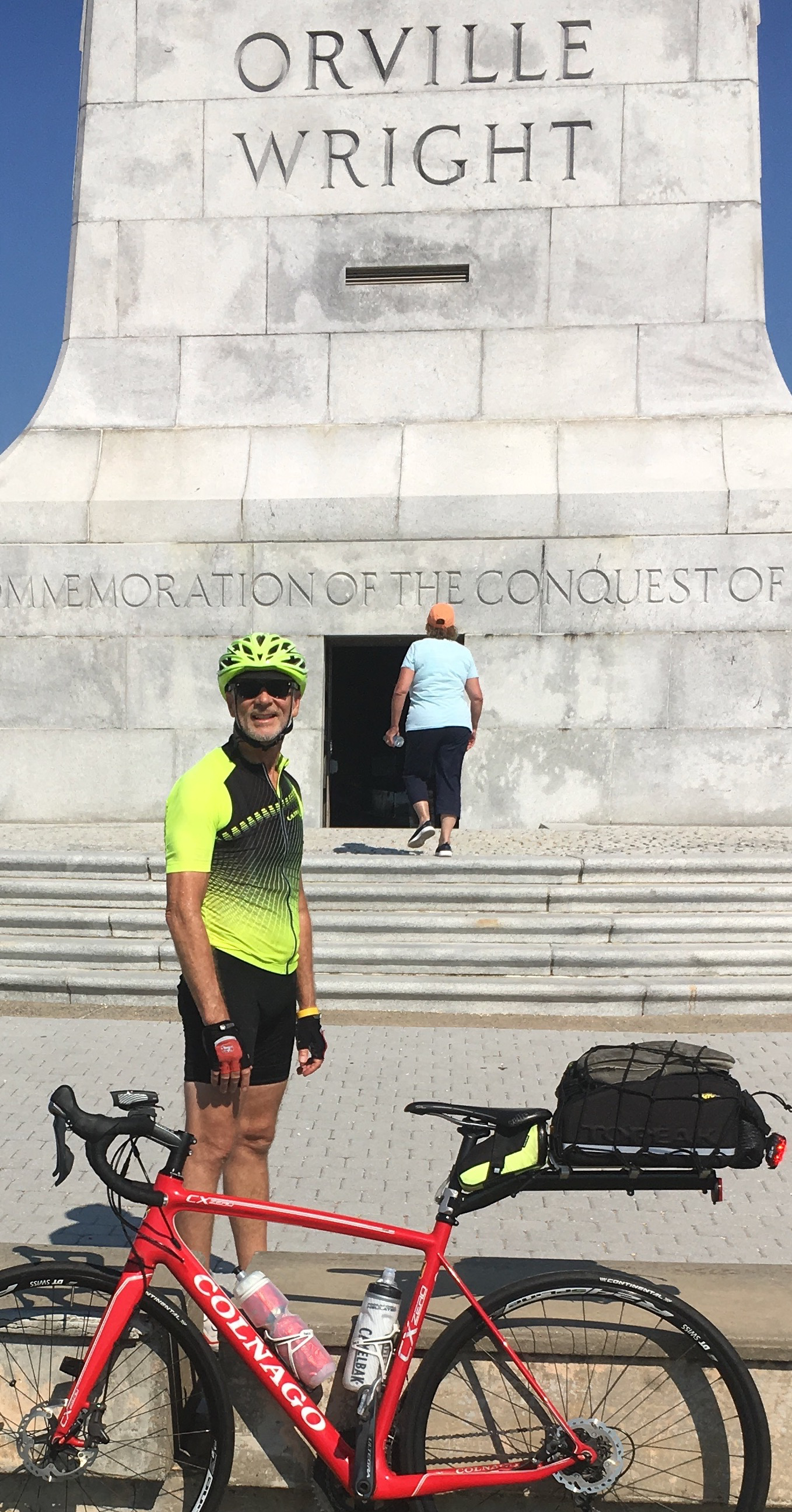
We secured photographic proof that we made it to the top!

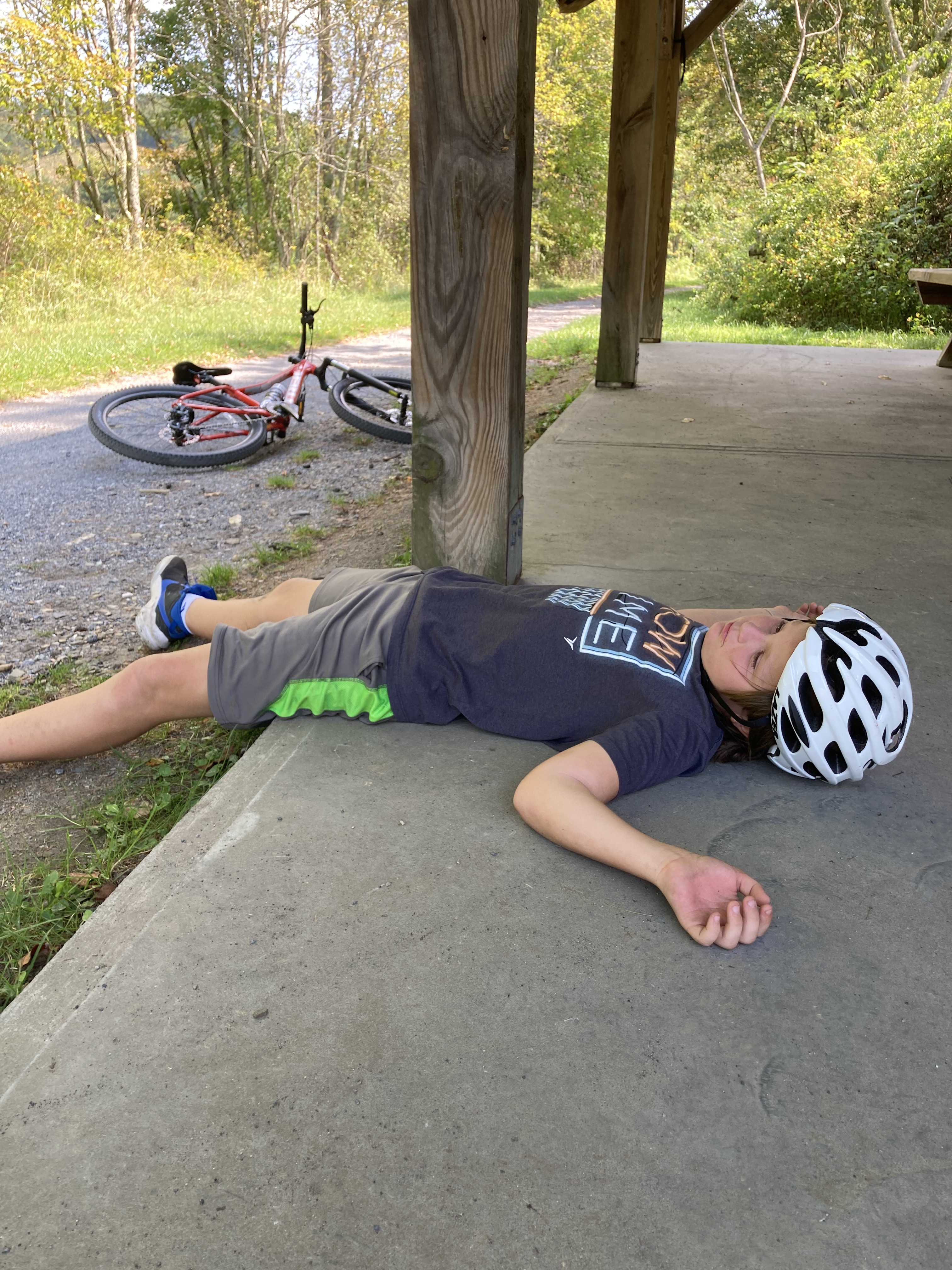
When we rounded the last turn and arrived at an anti-climactic flat spot with a shed and shelter, Colton flopped onto his back like he’d never straddle his saddle again. But, we needed to get back down and after securing photographic evidence of our achievement, we took off.

At the top, Colton took a moment to relish his victory, not sure if he’d every straddle his saddle again.

Two miles down, my back tire went BANG. Fifteen miles from the bottom, and of course, no spare in my seat bag – a huge oversight. I’m racking my brain trying to think of how to get off the mountain when Colton suggests Green Cove Station might have an inner tube.

Brillliant!

I gave him some money and he took off down the hill, empowered with a mission. In the meantime, I’m racking my brain to think of what to do if there is no tube. But in due time, Colton, once too weary to go another minute, is riding back up the hill in triumph, wearing a smile and waving a tire pump like it was a Sioux warrior lance.

The store had a tube, I had tire tools, Colton thought to bring the pump and we were back on our way toward ice cream.

I asked Colton later if there was any point on the ride up when he considered quitting, just turning around and coasting back down the hill. “At 11 miles,” he said. His butt was sore because he didn’t wear his biking shorts, his water was gone and six more miles seemed an impossibly hard distance.

But he didn’t quit.  

And when we faced a distinctly precarious position with a flat tire, 15 miles from our destination, it was Colton who suggested the Green Cove Station might have a tube and he could ride down there and find out. Not every person, let alone a 10-year-old, has the intuitive sense to conjure a solution, rather than be paralyzed by the problem.

Lots of people can be directed on how to fix a problem. Far fewer have the intuitive ability to imagine the solution even as they survey the circumstance.

If we hadn’t attempted the ride, and taken the risk, if it hadn’t been tough, if we hadn’t had a problem, Colton might not have learned about his reservoir of resilience for a long time.

Don’t be reckless, but for goodness sake, give your kids a chance to fail to prove to you and to themselves that they can be lions.

Fateful day half-century in the making

Sept. 13.

Fifty years ago today my dad wrapped his arms around me and said out loud for the first time I can recall, “I love you.” Then I turned toward the bus idling there to take me to Milwaukee where I was inducted into the U.S. Army.

With a draft lottery number of one, received a year earlier, this day was inevitable. But it arrived under a dark cloud of dread that wouldn’t lift for months.

I never doubted my dad loved me. I never asked myself if he did. I never wondered, pondered, considered, weighed or suspected his love. He showed me in many, non-verbal ways: working hard to provide for his family, being present, shooting baskets with me, including me with tasks we could do together, assigning me responsibilities like cleaning the barn or splitting the wood for our farmhouse furnace, then bragging about me to his friends when I worked beyond his expectations.

Primarily, my assurance of dad’s love and my subconscious security in my household growing up was how he loved my mother. Our dinner time was consistently 5:30, but no one sat down until dad arrived home from his gas route. He drove a fuel truck that serviced farmers in a four-county area, but he consistently arranged his days and route to be home for dinner on time.

Then mom would meet him at the door and the kids would have to sit at the table, waiting while they hugged and kissed and got all sloppy in the doorway.

Dad never fully grasped the implications of my lottery number. It didn’t penetrate his consciousness that radio announcing my birthday as No. 1 had changed the trajectory of my life. Nor did he comprehend my heart when I petitioned for and received status as a conscientious objector, willing to serve in the military, but not willing to bear arms.

To my surprise and delight, my basic training platoon at Fort Sam Houston consisted entirely of conscientious objectors of my same persuasion. We were all to be trained as medics. Logic was, I guess, if we weren’t going to carry a gun, we should run around with a target on our backs.

Religious belief was the overwhelming rationale for conscientious objection in my platoon. And not all represented religions were Christian. Consequently, our discussions were invigorating and affirming. Our attitudes were positive and our nascent friendships sincere.

Then, we graduated from basic. And our 40 men were divided among 10 other platoons of men who had just finished basic training that included weapons, and an indoctrination of “enemies” versus the right and righteous arm of the United States.

Suddenly, barracks were bellicose. An undercurrent of distrust and tensions ran through the room where long rows of bunks ran down both sides of the room, with lockers in the middle and footlockers at the end of each bunk. You never wanted to leave either open or unlocked.

One day I hung a pair of clean underwear on the hook while I showered. When I got out, mine had been taken and replaced by someone’s dirty underwear.

Discussions were not harmonious, but usually disintegrated into offensive and defensive positions on issues, especially religious and political. The most hard core guys could not wait to get to Viet Nam and “kill some Charlie Cong.”

Such was the atmosphere that debilitated my spirit one night when I walked to the bank of phones to call my dad for a word of encouragement. I know he loved me. But he still didn’t understand.

Depressed, I was walking back to the barracks to face another miserable night when my path took me past a base chapel. It was brightly lit and happy sounds were coming from it. I walked in. Why not?

There was a youth group on the platform getting ready to perform a musical. And I found a couple of my buddies from basic training there. After the musical, the youth offered to come pick up any soldiers who wanted to attend their church on Sunday.

Pretty girls populated the platform. I eventually dated one. My buddy Steve ended up marrying her sister.

Events of that night, and that group from Baptist Temple in San Antonio, opened the portal to the rest of my life which included a career among Baptists in communications, and marrying a girl I met at a Baptist church in my next station.

Fifty years ago. Today. As I’ve said many times since, it’s not something I wanted, nor would ever want to do again. But my life was set on course by having done it once.

The Abbotts defined dedication, and I got to play

John earned the shrapnel lodged in his legs, making them ache when the weather changed, when he labored in the fields. When he remembered.

As a battlefield chaplain during World War II, John Abbot worked among wounded and dying American soldiers in Europe fighting the scourge of Nazism. His was an active faith. He believed he incarnated Jesus as he walked, crawled and bled among soldiers who needed assurance that God loved them and that their destiny was assured.

Author as jack of all trades in Espanola, after the Army, before finishing college.

When he returned from the blood-soaked fields of Europe and as America shifted gears to embrace a new, wide open world of possibility, John applied to Southern Baptists’ missionary support agency responsible for “home” missions – or missions within the continental United States. He wanted to be a missionary in his native southwest, serving people, showing them the way of Jesus and leading them to faith.

He was a committed churchman in that denomination and after his service as a chaplain in the military, he assumed that he would be approved for support so he could turn his attention to the purposes of that agency: winning people to faith in Jesus.

Instead, he was denied support because he was deemed medically unsound, due to the shrapnel in his body, lodged there in battle. Disappointed, but undaunted and illuminated by his own vision, John secured support from some Texas Baptist churches where he was known. He bought farm equipment and set up shop in a converted dance hall in Espanola, New Mexico, a small town 25 miles north of Santé Fe.

The dance hall occupied a strategic corner on the main road between Espanola and Chimayo, a tiny town that houses one of only two places on earth that claim to contain healing elements. It’s the dirt in Chimayo, and the waters in Lourdes, France, to which pilgrims crawl. Discarded crutches, canes and bandages testify to the healing properties of the dirt in the Santuario de Chimayo. People have crawled from Santé Fe to Chimayo to do penance before applying the dirt to their injury or illness.

On the north side of the windy, two-lane road between the two towns perched a wooden church, little larger than a garden shed. It was the focal point of religious Penitentes, who marched in a single line, flagellating themselves, seeking forgiveness.

In that environment, John remodeled the dance hall into a church, office, classrooms and an apartment for him and his wife, Ethel, and he utilized the equipment to open doors among the small farmers in the dusty arroyos between Espanola and Chimayo. They could not afford individually field prep and harvest equipment that would increase their yields, and they welcomed the method and message of John Abbott to work among them, to share the work and to share his faith.

With hard work, ingenuity, faith and commitment, John and Ethel started and built a church which membership was primarily Spanish, descendants of Spanish invaders of the 16th century and Native American tribes.  They called it Templo Bautista – Baptist Temple.

Then one day in one of those freak accidents that make Christians wonder if God is paying attention, a piece of equipment that John was working under fell off its jack and crushed him. I guess he was medically unsound after all.

Ethel was suddenly a widow. Much of her livelihood disappeared because she could not run the equipment. John was the pastor, breadwinner, husband, visionary, guide, energy behind the entire effort. I don’t know how old Ethel was. She always seemed old to me, but I was just 20 when I met her. I’m sure I’m older now than she was then.

She promised God she would stay at Templo, would continue the work, if God would send her help. Because of her winsome spirit and compelling stories, Ethel received a fairly regular trickle of weekend or week-long helpers to lead special events and do repair work around the ancient facility. But she needed an everyday helper.

Her prayer and mine – what to do now that I’m getting out of the Army – clanged together in God’s ear and I became that first long-term helper. I was a pale, nerdy Scandihoovian from Wisconsin, knew zero Spanish and was new in evangelical faith. I’d been drafted into the Army after one year at Luther College and now I was out and at loose ends.

I started in November 1973 as a bus driver, youth minister, preacher, log splitter, painter, floor sander, week-night Bible study leader, and encourager. We called many of our members on Sunday morning to wake them in time to catch the bus I drove.

I brought them to church, preached at them and hauled them home. All this was done with sincere, naive spirit and within a profoundly knit community. The names “Ethel” or “John Abbot” opened any door in the county quicker than an electronic key.

I realize now the way we did church was paternalistic. We expected and required too little of members. There was an easy believe-ism in which membership at Templo eased seamlessly into whatever other influences they were weighing. Part of our motivation with activities was to “keep the kids out of trouble.”

But we slogged on. I went back to my home church in Colorado Springs to tell them of the work in New Mexico, and to raise money for Christmas goody baskets for the kids. One young lady was struck by the need, by the opportunity and by my wistful pleas. A few weeks later she arrived as a second helper, in the midst of a snow storm, as the children were trekking down the hallway in their angel and wise men costumes to present the Christmas story.

Her arrival on that snowy night declared that what I’d thought to be the first chapter of this story was merely prologue.

(First chapter to come)

Beautiful killer

This morning I saw the most beautiful fox ever. Larger than typical, with bright red fur, tail long and bushy, not matted by thorns. It looked fresh from a spa: fluffed, puffed, tufted, shampooed and blow dried. Eyes intense, intelligent, confident and controlled. Lithe, nimbly athletic, light of foot like a dancer. 

And I wanted to kill it.

Coming back from her sunrise walk, my wife heard the terrorized shrieking of chickens in the open range pasture just behind the cottage where we stay on my son’s property. She stepped quickly to the pasture where she saw a fox with a chicken in its jaws. When she shouted and clapped, the fox sprinted away. The chicken didn’t.

Granddaughter helped to bury the first two victims of the carnage.

As Sue Ellen told me what happened, she asked what to do with the carcass. “Make nuggets” seemed an inappropriate suggestion. 

Before we could fully get our minds around what had just happened, we heard the terrified squawking again. I rushed to the door and this time I saw the fox…with another chicken in its mouth. I threw open the door and for an instant was shocked silent by the fox’s beauty.   

But my anger at its audacity quickly overcame my admiration and I stepped out the door and shouted. It understood my threat and I was pleased to see it run away, leaping the fence as if the rails were a padded obstacle in tumbling class.

I grabbed my shotgun and followed the fox’s trail, knowing it would never show its head to me while I stumbled and tripped through its habitat. I felt better somehow, though, knowing I was “doing” something, at least dropping some “man scent” around so the fox would know who it was messin’ with.

The second chicken was still breathing, its legs twitching, eyes registering a resigned acceptance of fate. I dispatched it, then tossed it into the garden while I went to get a shovel. 

My seven-year-old granddaughter watched wide eyed the entire proceedings, dressed in the “farmer girl” overalls we’d given her for an early Christmas present the day before. 

Uncowed, she helped me dig a hole, her sudden awareness of the life cycle presenting her a sad, but not devastating new insight. 

The life cycle as presented on a National Geographic special sees the fastest lion chasing down the slowest antelope, and it all seems natural and normal, almost pristine, except for the dust. Eating a hamburger never makes me think of the feed lot on which the donor was raised. 

Yet, somehow, because we fed and cared for these chickens, tucked them in at night and gave them special treats from our vegetable shavings, it became a personal insult. 

Yes, they’re free range and hawks circle constantly overhead. Yes, the fox has to eat and yes, the prey/predator cycle is natural. But, the fox invaded my space with impunity, looking at me as if I was an inconvenient interruption at his meal, like a waiter who informed him he had an urgent phone call and he had to leave the cordon bleu to cool.

It was a sad morning, but only a prelude. 

Worse, we came home after dark that night and I went out to check on the chickens, to make sure they had put themselves up in the coop, where safety lay behind a closed door. I looked inside and there was not a single chicken in the coop. 

With a sickening dread, I cast my light over the field and the beam fell on multiple carcasses, each with the head and neck gone. The goats huddled in their own shed, witness to the horror. I followed my flashlight beam around the pasture, accounting for all the chickens but one. 

I found her in the far corner, shaken and shivering. She didn’t protest a bit when I picked her up and put her in the coop, behind closed doors. I don’t know what killed the chickens and I don’t know how this one survived.

We named her Lucky.